Predators shape coral reefs even when they are not hunting
The top predators of coral reef ecosystems are more than dramatic hunters. They influence where small fish feed, how schools move, when prey leave shelter, and which animals become bold enough to dominate a patch of reef. A healthy reef is not peaceful because predators are absent. It is balanced because predators, prey, grazers, cleaners, and shelter all shape one another.
A: No. Groupers, morays, jacks, barracuda, snappers, and large wrasses can all be important predators.
A: Yes, indirectly. They shape prey behavior and help maintain ecological balance.
A: Many are patient ambush predators that strike quickly when prey comes close.
A: Schooling helps confuse predators, share risk, and respond quickly to danger.
A: Some appear by day, but many are more active at night or in crevices.
A: Some can in specialized systems, but many are unsuitable for community reef tanks.
A: Prey behavior and population balance can shift, sometimes affecting the wider reef.
A: No. Their presence influences behavior even when they are resting.
A: They can bring predators and smaller fish into temporary, structured contact.
A: Look for how prey use shelter, schools, timing, and distance.
Why reef predators matter
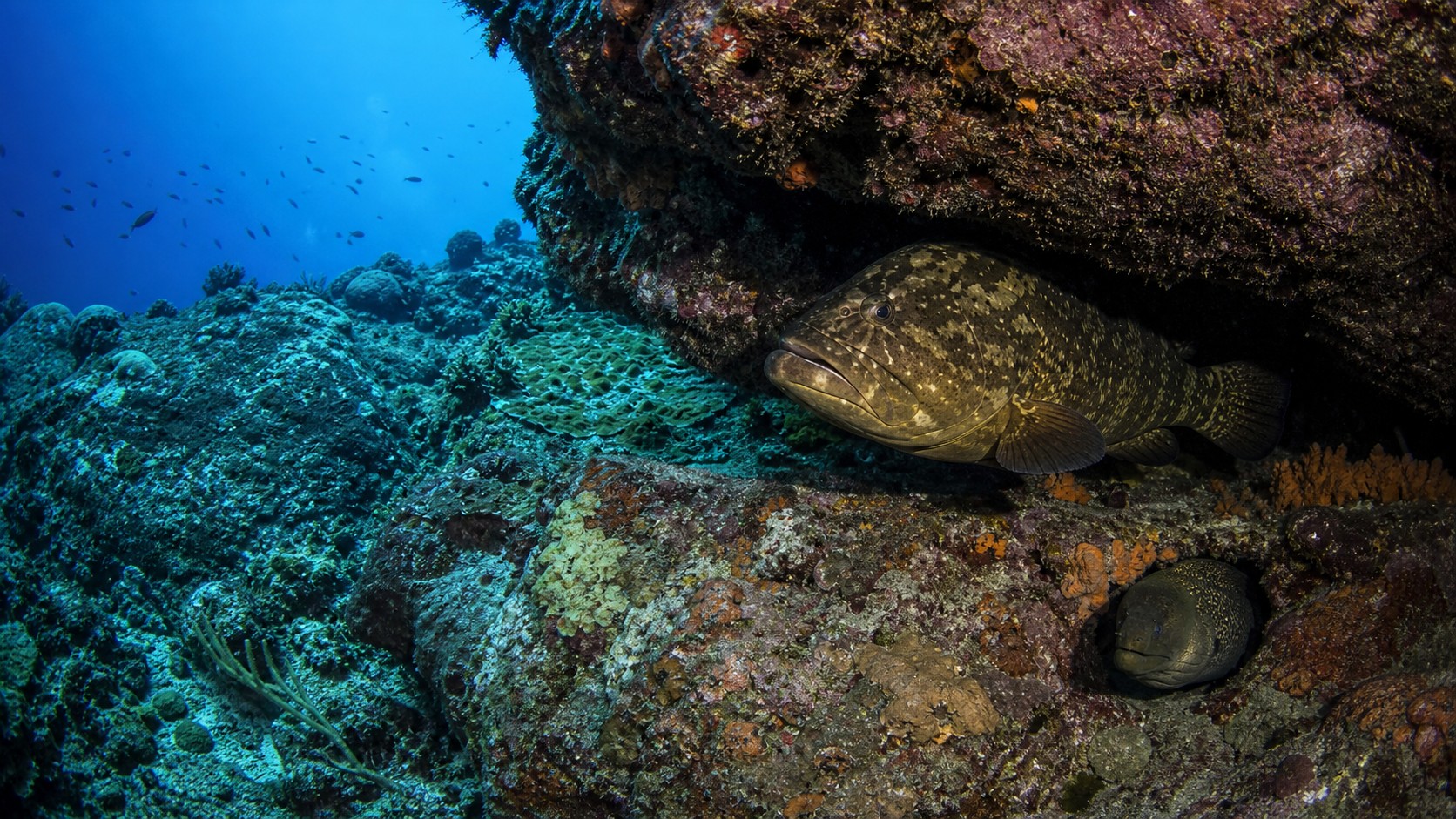
Predators are often described as the top of the food web, but their influence moves through the whole reef. A grouper resting near a ledge can change how small fish use open water. A moray eel in a crevice can make nearby animals avoid a promising hiding place. A reef shark passing along the edge can tighten a school before any chase begins.
This pressure is not only about eating. It is about possibility. Prey animals make daily decisions around risk, and those decisions affect grazing, breeding, shelter use, and competition. Predators help prevent one group from behaving as if the reef has no limits.
For beginners, this is the key idea: a predator's role continues between meals. The reef is shaped by watchfulness, retreat, timing, and the constant adjustment of animals that want to feed without becoming food.
Groupers are patient reef authorities
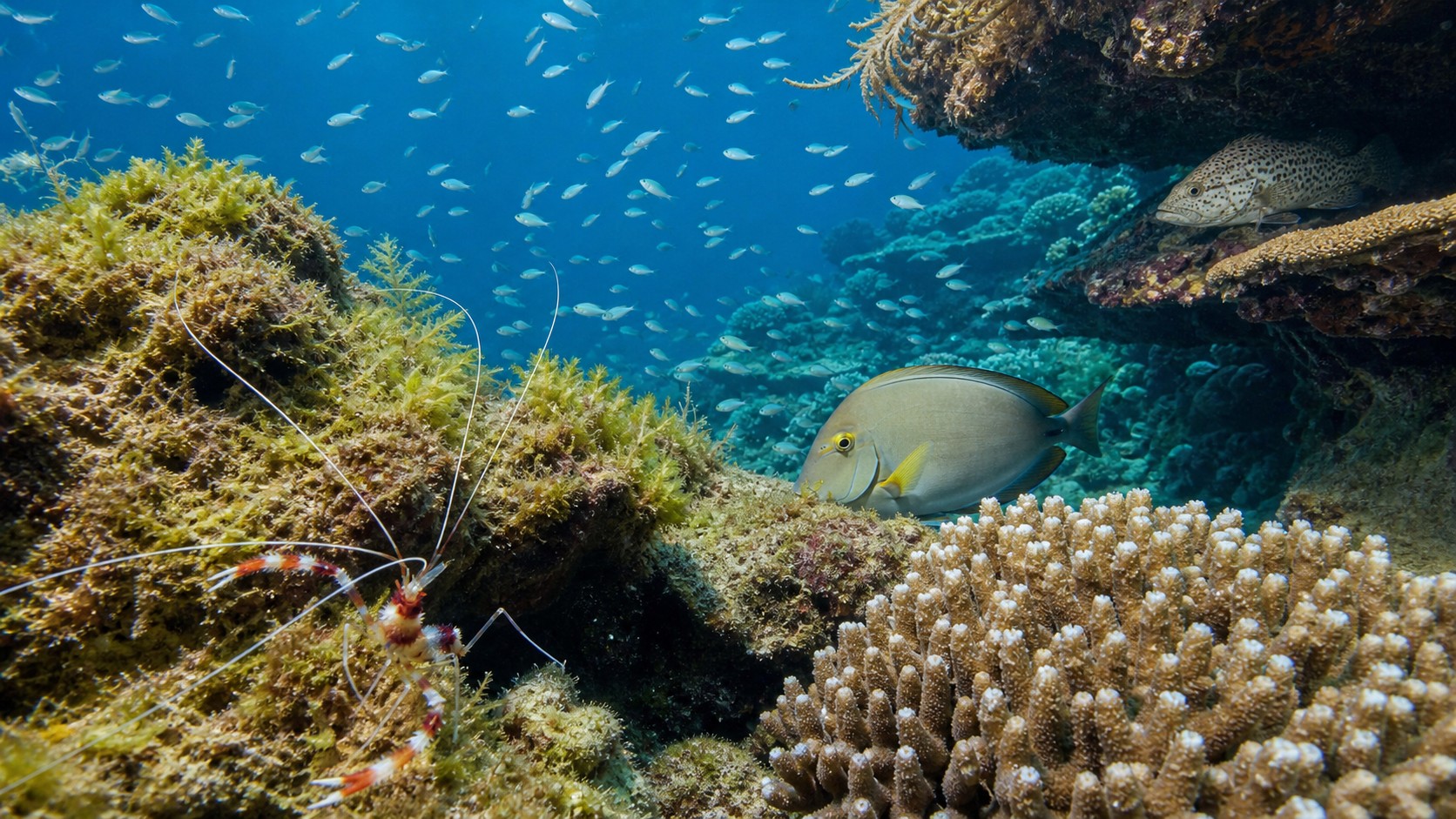
Groupers are among the most recognizable reef predators because they combine size, patience, and sudden speed. Many spend long periods near ledges, caves, or coral heads, watching the same routes used by smaller fish. They do not need to chase constantly. Their presence alone can make prey animals stay closer to shelter.
Large groupers also connect reef habitats. Some move between cleaning stations, hunting zones, and resting caves. Their broad mouths and ambush style make mouth size more important than attitude labels. If a fish fits, it may be food.
Ecologically, groupers remind us that a reef has hidden power. The animal that looks still may be controlling the behavior of everything around it.
Reef sharks patrol the edges
Reef sharks often move along slopes, channels, and outer reef edges where open-water prey and reef-associated fish overlap. They are not mindless threats. They are efficient patrol predators that test weakness, opportunity, and movement. Their routes can influence how fish gather and when they disperse.
Sharks also carry symbolic weight because they are easy to imagine as the top predator. In reality, their role is part of a broader web. They may influence mid-sized predators, feed on injured animals, and move energy across reef zones. Their absence can change the confidence and numbers of animals below them.
A reef with sharks is often a reef where large-scale predator pressure still exists. That pressure helps maintain a more complete ecosystem.
Moray eels rule the crevices
Moray eels bring predation into places where open-water hunters cannot easily go. Their long bodies and strong jaws let them investigate cracks, holes, and caves. Many reef animals use those spaces for safety, so a moray changes the meaning of shelter.
Some morays hunt mostly at night, while others appear during the day with only the head visible. Their reputation can make them seem aggressive, but much of their behavior is cautious and habitat-bound. They conserve energy, wait for opportunity, and use the reef's structure as part of the hunt.
Morays show that top predators are not always open-water cruisers. Some of the most important pressure comes from within the reef itself.
Barracuda and jacks bring speed
Barracuda and jacks represent a different predator style: speed, open-water positioning, and fast reaction. They often work the margins where schools move over reef slopes or through channels. Their long bodies and quick bursts make prey fish organize tightly or change direction together.
These predators make schooling behavior easier to understand. A school is not just a pretty cloud of fish. It is a defensive structure that confuses attackers, shares risk, and reacts faster than a single fish could. Speed predators help maintain that pressure.
Watching these hunters teaches a useful reef lesson. Some predators control space by occupying a ledge; others control it by crossing distance quickly.
Snappers and hunting wrasses work the middle levels
Not every important predator is enormous. Snappers, larger wrasses, hawkfish, and lizardfish may occupy middle levels of the reef food web, hunting smaller fish and invertebrates. They connect the tiny prey world to larger predators and keep pressure on animals that might otherwise overuse a niche.
Large wrasses can flip rubble, inspect sand, and pick prey from places other fish miss. Hawkfish perch and strike. Snappers patrol edges and respond quickly when prey breaks formation. These predators are often easier to overlook than sharks, but they shape daily behavior in very direct ways.
Predators protect balance indirectly
A reef without predator pressure can become unbalanced in subtle ways. Certain prey fish may feed too boldly, mid-sized predators may increase, or grazing patterns may shift. These changes can ripple toward algae growth, coral recruitment, and competition for shelter.
This does not mean more predators always equals a healthier reef. Balance depends on habitat, prey availability, human fishing pressure, water quality, and many other factors. But removing large predators often changes ecosystems in ways that are difficult to reverse.
Predators are therefore part of reef resilience. They help maintain relationships that took a long time to develop.
How predators affect reef watching
When observing a reef, look for predator influence rather than only predator action. Do small fish hover close to coral branches? Do schools tighten near open channels? Do gobies keep one fin near the burrow entrance? Does a cleaning station attract large fish that smaller animals avoid?
These details reveal the invisible map of risk. The reef is full of boundaries that are not marked by walls. Predators help draw those boundaries through movement, memory, and repeated encounters.
This makes reef watching richer. Instead of waiting for a chase, you can read the anticipation that shapes the entire scene.
Predators in aquariums require caution
Many reef predators are unsuitable for typical home aquariums, especially coral displays with small fish and ornamental invertebrates. Groupers, lionfish, morays, and large wrasses may be fascinating, but their adult size, feeding needs, and mouth size can make them poor matches for community reefs.
The aquarium lesson is not to copy the wild predator list. It is to understand why compatibility matters. A fish does not need to be cruel to eat a tankmate. It only needs the instincts, size, and opportunity that nature gave it.
Responsible aquarists admire predators without forcing them into systems that cannot support them.
The big takeaway
The top predators of coral reef ecosystems are important because they create structure. They influence where animals feed, when they hide, how schools move, and which species gain confidence. They make the reef less random.
A coral reef is not healthy because every animal is safe. It is healthy because risk, refuge, feeding, cleaning, grazing, and reproduction are all held in tension. Predators are a major part of that tension, and understanding them makes the entire reef easier to read.
Predators and hiding places evolve together
The structure of a reef makes predator-prey relationships more complex than a simple chase. Branching coral, rubble, caves, ledges, sea fans, and sand channels all create different levels of safety. A small fish may be vulnerable in open water but nearly unreachable inside dense coral. A moray may be powerful in a crevice but less effective in open water. The habitat decides which hunting style works.
This is one reason coral loss can affect predator relationships even when predator numbers do not change immediately. If shelter becomes flatter or less complex, prey animals may lose the fine-scale refuge they depend on. If algae smothers coral structure, the whole map of safety can shift. Predators still hunt, but the rules of escape have changed.
Healthy reef structure therefore supports both hunters and hunted. Predators need access to prey, while prey need enough refuge that populations can persist. The balance is physical as well as biological.
Human pressure changes predator roles
Fishing pressure often removes large predators before people notice changes in smaller reef animals. Big groupers, snappers, sharks, and jacks can be especially vulnerable because they are valuable, slow to mature, or easy to target at predictable places. When those animals decline, the reef may still look colorful, but the behavior of the community can begin to shift.
The effects are not always simple. Removing a large predator can release some mid-sized predators, alter grazing behavior, or change which fish dominate shelter. Different reefs respond differently depending on habitat, protection, and the remaining food web. Still, predator loss is rarely just the loss of one impressive animal. It is the loss of pressure that helped organize many others.
Marine protected areas often show why predators matter. Where large fish have time and safety to recover, the reef can regain a more complete range of sizes and behaviors. That fullness is part of what makes a reef feel wild rather than merely decorative.
Predator behavior is often misunderstood
Predators are easy to describe with dramatic language, but most reef predators spend much of their time conserving energy. A grouper resting under a ledge is not failing to be a predator. It is using a strategy. A shark cruising calmly is not always searching frantically for food. A moray opening and closing its mouth may simply be moving water across its gills.
This matters because fear can flatten understanding. Predators are not villains in the reef story. They are animals with energy budgets, territories, cleaning needs, breeding seasons, and risks of their own. Young predators can be eaten by larger predators. Injured hunters may struggle. Even top predators respond to habitat quality and prey availability.
Seeing predators accurately makes the reef more interesting. Instead of waiting for violence, observers can notice patience, positioning, timing, and the way other animals negotiate the predator's presence.
A beginner-friendly way to map predator pressure
One simple exercise is to choose a reef scene and mark three imaginary zones: open water, shelter edge, and deep refuge. Open water is where speed predators have the advantage. Shelter edges are where ambush predators and prey meet most often. Deep refuge is where small fish, shrimp, and nocturnal animals may be safer from some hunters but exposed to others like morays.
Now watch how animals move between those zones. Small fish may feed at the shelter edge and retreat into deep refuge when a shadow passes. A predator may hold just outside the refuge, waiting for mistakes. Schools may use open water when the risk feels low and compress when it rises. This map reveals predator influence without needing to see a capture.
The same exercise helps aquarists understand compatibility. A tank with no refuge forces animals into constant contact. A tank with only caves and no open lanes limits active swimmers. Even in captivity, space is behavior.
Why predator diversity matters
Different predators apply different kinds of pressure. Sharks patrol. Groupers wait. Morays search crevices. Barracuda accelerate. Snappers work edges. Wrasses pick and flip. Because their methods differ, prey animals cannot solve every threat with one response. They need schooling, hiding, timing, vigilance, camouflage, and speed.
That diversity keeps the reef dynamic. If only one predator type remains, some prey strategies may become more successful than others. A complete predator community makes the reef more layered, because risk comes from multiple directions and at different times of day.
This does not mean every reef should look the same. Predator communities vary by region, depth, habitat, and human impact. The important point is that predator variety adds ecological texture. It creates a richer and more resilient set of relationships.
What reef keepers can learn from wild predators
Most home reef aquariums should not attempt to recreate wild predator communities. The lesson is more practical: respect adult size, mouth size, territory, and natural feeding behavior. Many compatibility problems come from ignoring the same predator-prey rules that are obvious on wild reefs.
A fish that can swallow a tankmate may eventually try. A shrimp that fits a predator's diet may not remain ornamental. A small peaceful fish placed with a larger opportunist may live under constant stress even if it is never eaten. These are not moral failures by the predator; they are predictable outcomes.
Understanding predators therefore makes aquarists more careful with community design. It encourages stocking lists where animals are not forced into relationships that nature would resolve very differently.