

Iwagumi & Rock Architecture is dedicated to the art of simplicity, where stone becomes structure and restraint creates impact. Rooted in balance, proportion, and natural harmony, Iwagumi aquascaping uses carefully selected rocks to form the foundation of the entire underwater landscape. Every stone placement carries meaning, from the dominant focal rock to supporting stones that guide flow, depth, and movement across the tank. Unlike heavily planted or decorative styles, Iwagumi layouts rely on negative space, subtle elevation, and clean lines to evoke calm, timeless environments inspired by nature’s geology. Low-growing plants and minimal livestock are chosen to enhance the rockwork rather than distract from it, allowing form and composition to take center stage. Articles in this section explore stone selection, layout rules, scaling techniques, planting balance, and long-term maintenance needed to preserve clarity and intent. Whether you’re crafting your first minimalist scape or refining a competition-level layout, this hub helps you build powerful aquariums through precision, patience, and architectural vision.
A: Iwagumi centers on stone architecture and minimal planting; Nature Style uses varied hardscape and heavier planting for “wild” landscapes.
A: It’s highly recommended—carpets and strong light perform best with stable CO2.
A: Fewer plants early means less nutrient uptake; tight light/CO2 control is crucial.
A: Typically 3, 5, or 7—odd numbers look more natural in classic compositions.
A: Deep enough that they look rooted—often 20–40% of the stone is below the substrate line.
A: Enough to show depth—many scapes rise noticeably toward the back while keeping the front clean.
A: It’s possible, but classic Iwagumi looks best with one consistent geology.
A: Small schooling fish and shrimp that enhance scale and keep the scene calm.
A: Regular short trims once it fills in—this keeps it dense and prevents lifting.
A: Too much light too soon without stable CO2 and frequent early water changes.
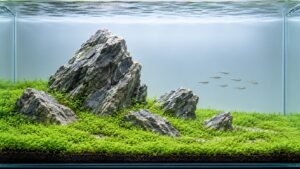
Iwagumi Aquascape Guide for Beginners
Learn beginner Iwagumi principles through stone hierarchy, negative space, safe foundations, realistic carpeting, cycling, livestock, and restrained upkeep.
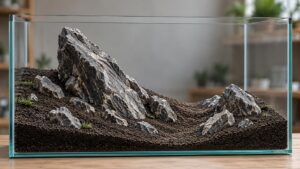
How to Create an Iwagumi Aquascape
Create an Iwagumi aquascape by rehearsing the terrain, choosing a primary stone, engineering the slope, planting deliberately, and protecting its visual hierarchy.