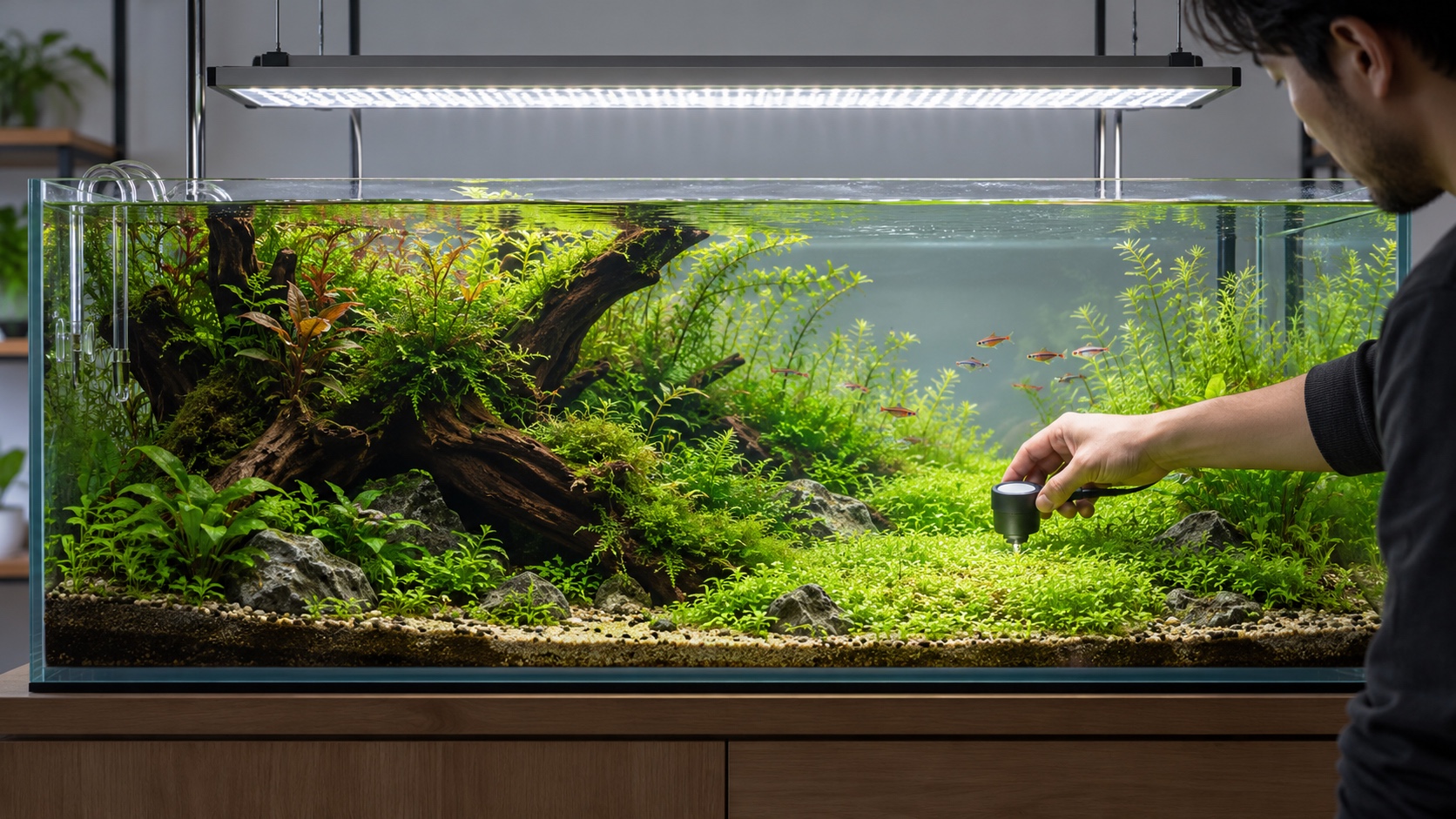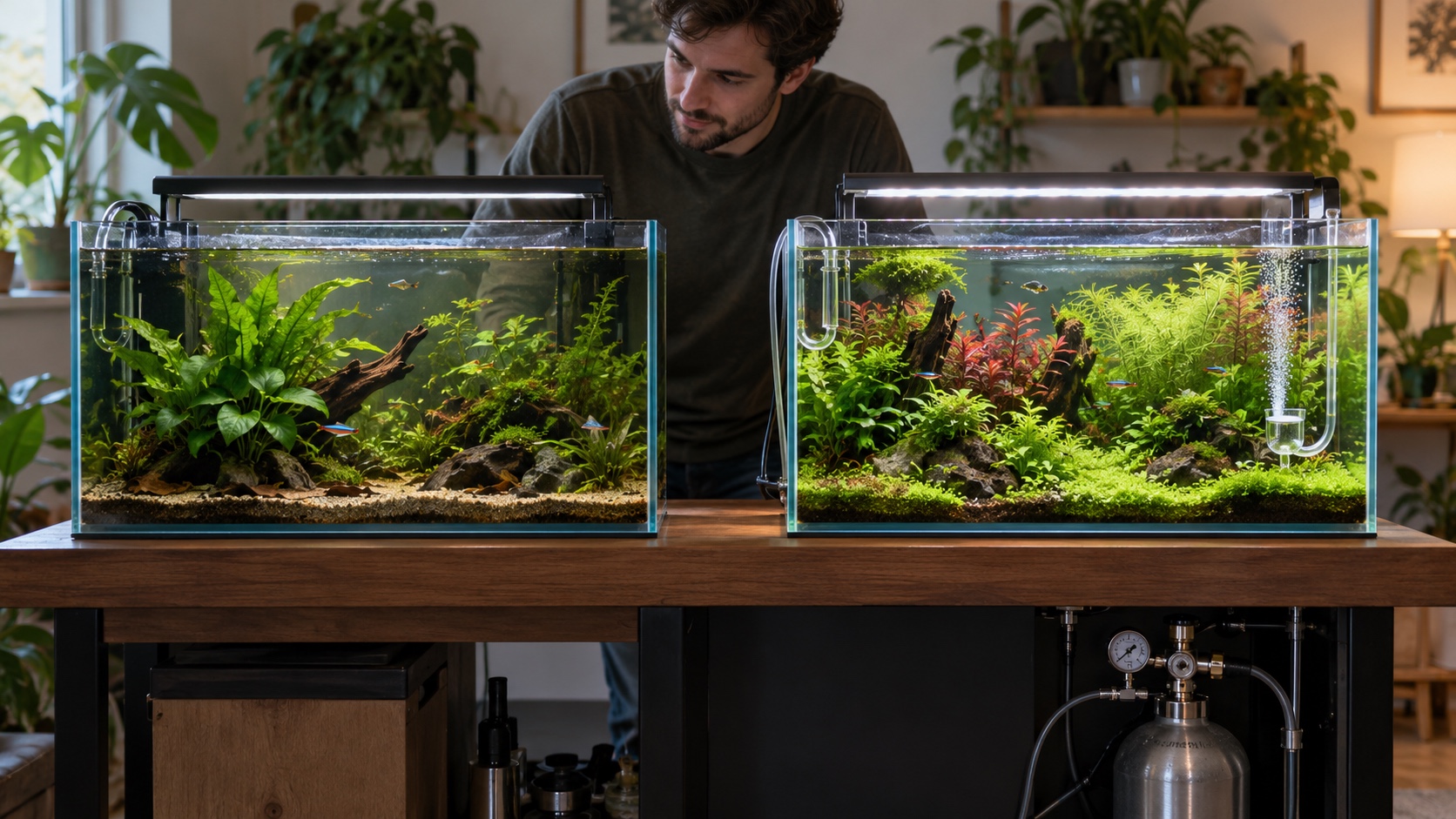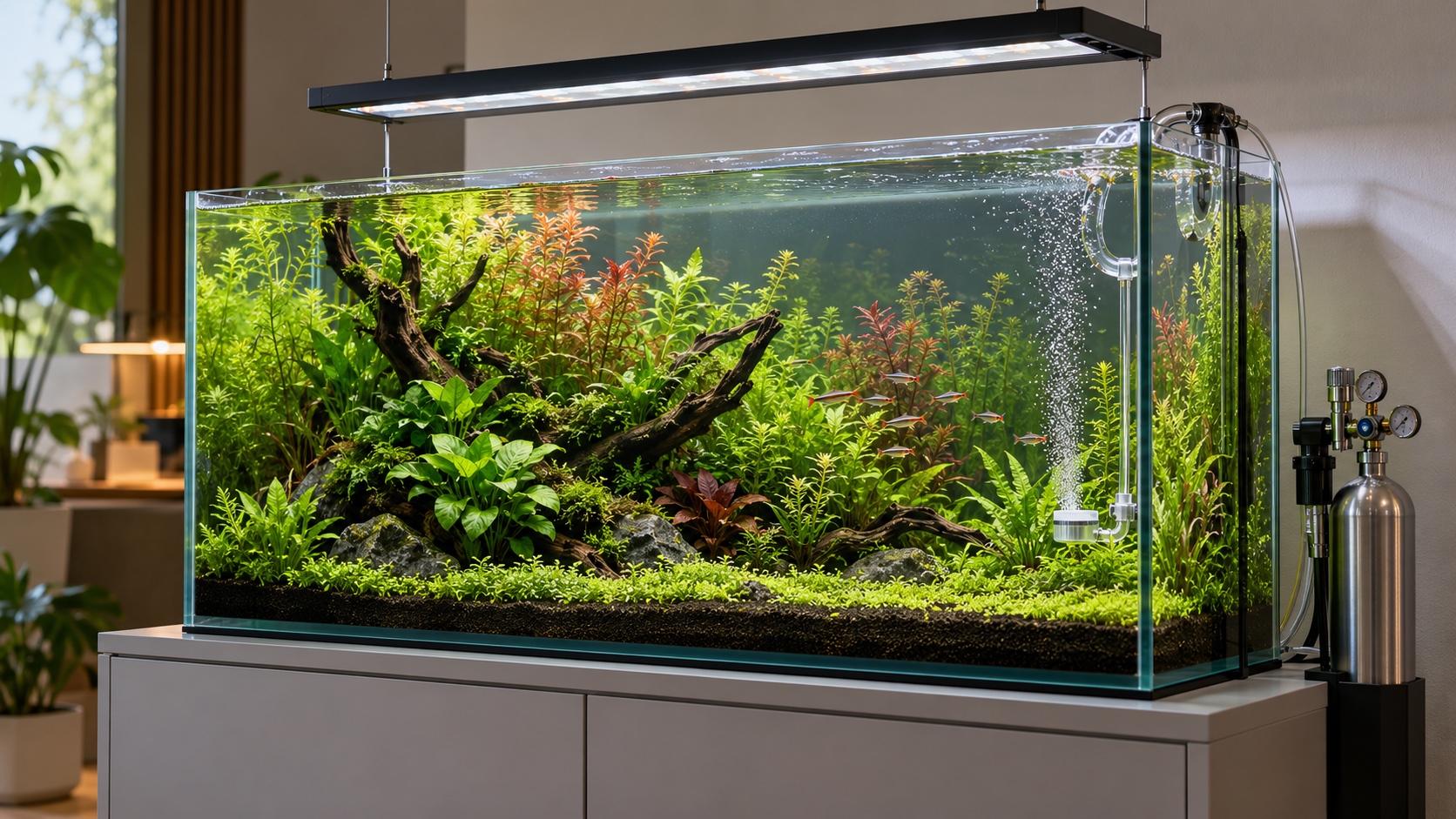
Light and Carbon Dioxide Set the Aquarium’s Pace Together
Lighting and carbon dioxide are often discussed as separate upgrades, but plants experience them as parts of one growth system. Stronger light increases photosynthetic demand. If carbon, nutrients, circulation, or plant mass cannot keep pace, extra intensity does not create a healthier aquarium; it creates a larger imbalance. Beginners should choose an energy level they can monitor safely, then coordinate fixture output, photoperiod, gas exchange, fertilizer, and trimming around that level. Pressurized CO₂ can support faster, denser growth, but it is optional for many suitable plants and never justifies risking livestock. Stability is more useful than maximum output.
A: No. Many suitable plants grow without it when light, expectations, nutrition, and maintenance match a lower-energy system.
A: Many systems start earlier, but exact timing depends on measured behavior, distribution, equipment, and animal safety.
A: No. It is only a repeatability reference within one unchanged setup because bubble size and system efficiency vary.
A: Strong exchange can release gas, but adequate oxygenation remains essential; balance circulation and injection rather than eliminating movement.
A: Stop injection, increase aeration and surface movement immediately, and investigate before restarting at a safer verified condition.
A: Color also depends on species, nutrition, carbon, maturity, and stress; excessive light is not a safe universal color control.
A: No. They are different products with different behavior and compatibility, and must be used only according to their guidance.
A: It reduces biomass and changes shade, flow, and demand, so observe the tank before making large companion adjustments.
A: Reduce demand when support cannot remain stable, livestock safety limits more CO2, or maintenance cannot match the growth pace.
A: Healthy new growth, normal livestock behavior, even distribution, manageable pruning, and repeatable safe settings define balance.
Choose a Low-, Moderate-, or High-Energy Direction
A low-energy aquarium uses suitable undemanding plants, modest light, ambient carbon, and slower expectations. It can be lush, but coverage and recovery take time. Maintenance focuses on preventing shade and preserving consistent nutrition rather than forcing rapid growth.
A moderate system increases plant choice and growth without making every resource extreme. Pressurized CO₂ may or may not be used, depending on the plants and goals. The keeper needs reliable timers, measured fertilizer, broad circulation, and regular pruning because plant demand and biomass change more quickly.
A high-energy layout combines strong light, stable injected CO₂, complete nutrition, and frequent horticulture. It magnifies equipment failures and missed maintenance. Beginners should select it only when they understand safe gas equipment, can observe livestock daily, and genuinely want the trimming pace.
Understand What Fixture Specifications Cannot Tell You Alone
Wattage and advertised brightness do not describe the light reaching every leaf. Fixture optics, length, mounting height, aquarium depth, water clarity, surface movement, covers, hardscape, and plant canopy alter distribution. A fixture can be powerful in the center and weak at the ends. Use manufacturer coverage information, trustworthy measurements when available, and plant response across the full footprint.
Spectrum affects appearance and plant use, but broad claims about one perfect color ratio should be treated cautiously. Choose a fixture with appropriate output, coverage, control, and visual rendering. Avoid using saturated decorative colors to compensate for poor intensity or distribution.
Start With a Conservative Photoperiod
Set one uninterrupted schedule on a timer and begin moderately. Longer hours raise total daily light even when intensity stays constant. A split schedule may suit viewing preferences, but it complicates diagnosis and does not automatically prevent algae. Keep the starting schedule simple enough to repeat and record.
Decide Whether Pressurized CO₂ Serves the Plant Plan
Injected CO₂ can improve growth, carpeting, compact form, and recovery for demanding plants when the rest of the system is coordinated. It also adds equipment, cost, adjustment, and animal-safety responsibilities. Do not install it because a tank appears on a checklist. Identify which selected plants or design goals benefit and whether a lower-energy alternative would satisfy the same role.
Non-injected tanks should use light and plant species matched to naturally limited carbon. Liquid carbon products are not equivalent to gaseous CO₂ and can affect sensitive plants or livestock; follow current product directions and do not treat them as a universal substitute.
Pressurized systems require an appropriate cylinder, regulator, needle valve, check valve, tubing, diffuser or reactor, timer or controller strategy, and secure installation. Use rated equipment and follow manufacturer and local safety guidance. Never modify cylinders or regulators casually.
Place the cylinder upright and protected from tipping, heat, and corrosion. Check connections for leaks with a safe approved method. Route tubing so water cannot siphon backward. A beautiful aquarium is not worth an unsafe compressed-gas setup.
Coordinate Timing Before Adjusting the Gas Rate
Many systems begin CO₂ before the light so dissolved carbon is available when photosynthesis starts, then stop it before the light ends. Exact timing depends on equipment, circulation, gas exchange, and water. Establish a consistent schedule, observe the daily profile, and adjust conservatively. Do not copy another aquarium’s clock settings without considering how this system reaches and releases dissolved gas.
Keep the schedule independent from casual manual operation. A timer should fail predictably after a power interruption. Check it regularly. If CO₂ continues while circulation stops, local concentration and animal risk can change quickly, so contingency planning matters.
Distribute CO₂ Across the Plant Mass
Place the diffuser or reactor where flow carries dissolved gas through the aquarium rather than directly to the surface. Fine bubbles should pass plant zones without creating a blinding cloud. Dense stems, hardscape, and prefilter clogging can change distribution after an initially successful setup.
Observe different regions. One carpet corner may stall while stems near the diffuser grow rapidly. Before increasing the overall rate, restore filter flow, trim circulation barriers, and adjust broad movement. More gas cannot compensate safely for a dead zone that remains isolated.
Surface movement should support oxygenation without wasting all injected gas immediately. Find a balance appropriate to livestock and the system. At night, plants and animals consume oxygen. Many aquariums benefit from continued filtration and adequate surface agitation after CO₂ stops.
Measure Consistently Without Trusting One Indicator
A bubble count is useful for returning one system to a known setting, not for comparing tanks. Bubble size, counters, diffusers, water, and circulation differ. Drop checkers respond slowly and show conditions near their location. pH change can be informative when baseline chemistry is understood, but acids and buffering sources complicate interpretation.
Let Livestock Set the Safety Limit
Observe fish and invertebrates during startup, peak injection, feeding, and the end of the photoperiod. Gasping, crowding the surface or outflow, loss of balance, or unusual inactivity requires immediate attention. Stop gas addition, increase aeration and surface movement, and follow an appropriate emergency response. Do not wait for a plant indicator.
Maintain biological filtration, temperature control, and stocking discipline. CO₂ does not replace oxygen management. A heavily planted tank can still have low oxygen, especially overnight or after a large die-off. Keep equipment and emergency aeration accessible.
Match Fertilization to the Chosen Energy Level
Faster growth consumes nutrients faster and creates more biomass to trim. Use a complete measured fertilizer method and account for nutrients in source water, food, substrate, and livestock waste. Avoid removing nutrients broadly in response to algae while maintaining intense light and CO₂.
Rooted plants may need substrate nutrition in addition to water-column supply. Record root-tab placement and replacement. Prevent concentrated products from entering open water or animal reach. Active soil also changes early nutrient and water-change requirements.
After a major trim, plant demand falls temporarily while light penetration and flow increase. Continue the stable core routine and observe rather than making large immediate dosing changes. Repeatedly chasing weekly biomass creates oscillation.
Test and water-change according to the chosen method, livestock, and product guidance. Keep measurements comparable by sampling at consistent times. A result taken immediately after dosing should not be compared casually with one taken before a water change.
Adjust Light Before Forcing More CO₂
If plants struggle and CO₂ is already near a safe stable limit, reduce demand by lowering intensity or duration. This can restore balance without increasing animal risk. Clean the fixture, cover, and surface first so an apparent reduction is not caused by dirt or floating plants.
Use Plant Form and Algae Location as Context
Long internodes may suggest insufficient light, excessive shading, species habit, or unstable resources. Compact growth directly under the fixture and weak growth at the sides may indicate uneven coverage. Algae concentrated on slow leaves near the light may reflect excessive local demand. None of these signs proves one cause alone.
Compare several plants and locations, verify equipment schedules, and inspect circulation. Use new growth after a controlled adjustment as evidence. Old algae and damaged leaves remain until removed, so appearance can lag behind correction.
Stabilize the System Through a Monthly Energy Review
Photograph plant groups and note trim frequency, carpet density, lower-leaf condition, algae locations, and livestock behavior. Compare them with the recorded light and CO₂ settings. A system that needs emergency adjustments every week is operating above its manageable pace.
Clean the diffuser, filter, intake, and light shield according to their requirements. Check regulator connections, tubing, check valves, timers, and cylinder stability. Replace worn parts with rated components. Equipment maintenance is part of plant care.
Reassess plant mass after major removals or additions. A dense mature tank and a newly trimmed tank do not distribute flow or consume resources identically. Preserve consistent settings first, then make small corrections if repeated observations support them.
Keep a simple emergency plan: how to stop gas, increase aeration, restore flow, and move livestock if necessary. Everyone responsible for the aquarium should understand it. Safety cannot depend on one person’s memory. Place a concise shutdown sequence near the cabinet so immediate action does not require searching for instructions.
The balanced target is not the brightest tank or the largest pH change. It is healthy new plant growth, normal animal behavior, manageable pruning, and settings that remain stable through ordinary life. Choose that target deliberately and protect it. Write the operating plan in clock time so it can be checked without guesswork: room light exposure, fixture ramp, full-light period, gas start and stop, feeding, maintenance, and overnight aeration if used. Confirm the aquarium’s timers after power interruptions and seasonal clock changes. Observe at the beginning, middle, and end of the programmed day because a system that looks calm in the morning may accumulate gas or heat later. Keep the filter return, diffuser, spray bar, and plant mass shown on a simple top-view sketch. When circulation is altered, update the sketch and watch whether bubbles, surface movement, and plant leaves indicate that water still crosses the intended zones. Do not use visible bubbles alone as a carbon measurement; they are a distribution clue that must be interpreted with plant response, consistent water testing, and animal behavior. Establish a baseline before changing anything. Record the fixture percentage or channel settings, mounting height, photoperiod, gas timing, regulator working pressure where applicable, bubble-count location, measured pH using a consistent method, and recent maintenance. Bubble counts are not transferable between diffusers or counters, but they can help the same aquarium detect an unintended change. Make one conservative adjustment and state the reason in the log. Afterward, evaluate new growth, algae location, oxygenation, and livestock through multiple full cycles. Never leave a newly increased gas setting unobserved. Plan for cylinder depletion and replacement as well; regulator behavior can change near the end of a cylinder, and every connection should be leak-checked using an appropriate safe method after service. Secure the cylinder upright, protect tubing from kinks and curious animals, and use components rated for the job. If routine attention or budget cannot support that equipment safely, choose a lower-energy plant plan rather than improvising. The same honesty applies to lighting. A powerful fixture is useful when it can be dimmed and distributed well, but unused capacity is not wasted. It provides flexibility without forcing the aquarium to operate at maximum demand. The durable beginner system is the one whose settings can be explained, repeated, and maintained by the actual household. When light, carbon supply, circulation, nutrition, and plant mass move at a compatible pace, small errors remain correctable instead of becoming emergencies.