Decide Whether Added Carbon Solves a Real Planting Problem
Aquarium plants always need carbon, but that does not mean every planted aquarium needs pressurized carbon dioxide. Fish respiration, microbial activity, surface exchange, and bicarbonate use can support many modest plantings when light and species demand remain moderate. Injected CO₂ becomes useful when a design asks plants to grow faster, remain compact under stronger light, or sustain species that perform poorly at ambient carbon levels. The right question is therefore not whether plants use CO₂. It is whether the intended aquarium can meet its plant goals safely and consistently without adding a gas system.
A: Yes. Many compatible species grow well with ambient carbon when light and expectations remain moderate.
A: It contributes carbon, but the useful amount varies and may not support demanding high-energy layouts.
A: No. Algae control still depends on balanced demand, nutrition, maintenance, plant health, and stable operation.
A: No. Begin with moderate light and raise demand only after gas timing, distribution, and safety are stable.
A: Fast species may show new growth relatively soon, while slow plants require longer observation of new tissue.
A: No. Counters, diffusers, flow, volume, and water chemistry differ, so counts are not transferable doses.
A: Plants do not use injected CO2 for photosynthesis in darkness, and nighttime oxygen deserves protection.
A: No. They are different chemical products and must be evaluated and dosed according to their labels.
A: A verified design goal that compatible light, nutrition, and care cannot meet at ambient carbon levels.
A: Yes, but plant choice and lighting demand should be reduced deliberately while the layout transitions.
Separate Biological Need From Equipment Choice
Plants use carbon to build tissue during photosynthesis. In water, available carbon can come from dissolved carbon dioxide and, for some species, bicarbonate. A sealed-looking aquarium is still exchanging gases at its surface, while animals and microbes continuously produce CO₂. Those sources are limited and variable, but they are not zero.
Pressurized injection is one way to increase and stabilize dissolved CO₂ during the light period. It is not a fertilizer and does not replace nitrogen, phosphorus, potassium, trace elements, circulation, or suitable light. Treat it as one part of an energy system rather than a cure for every weak leaf.
Recognize the Tanks That Often Succeed Without Injection
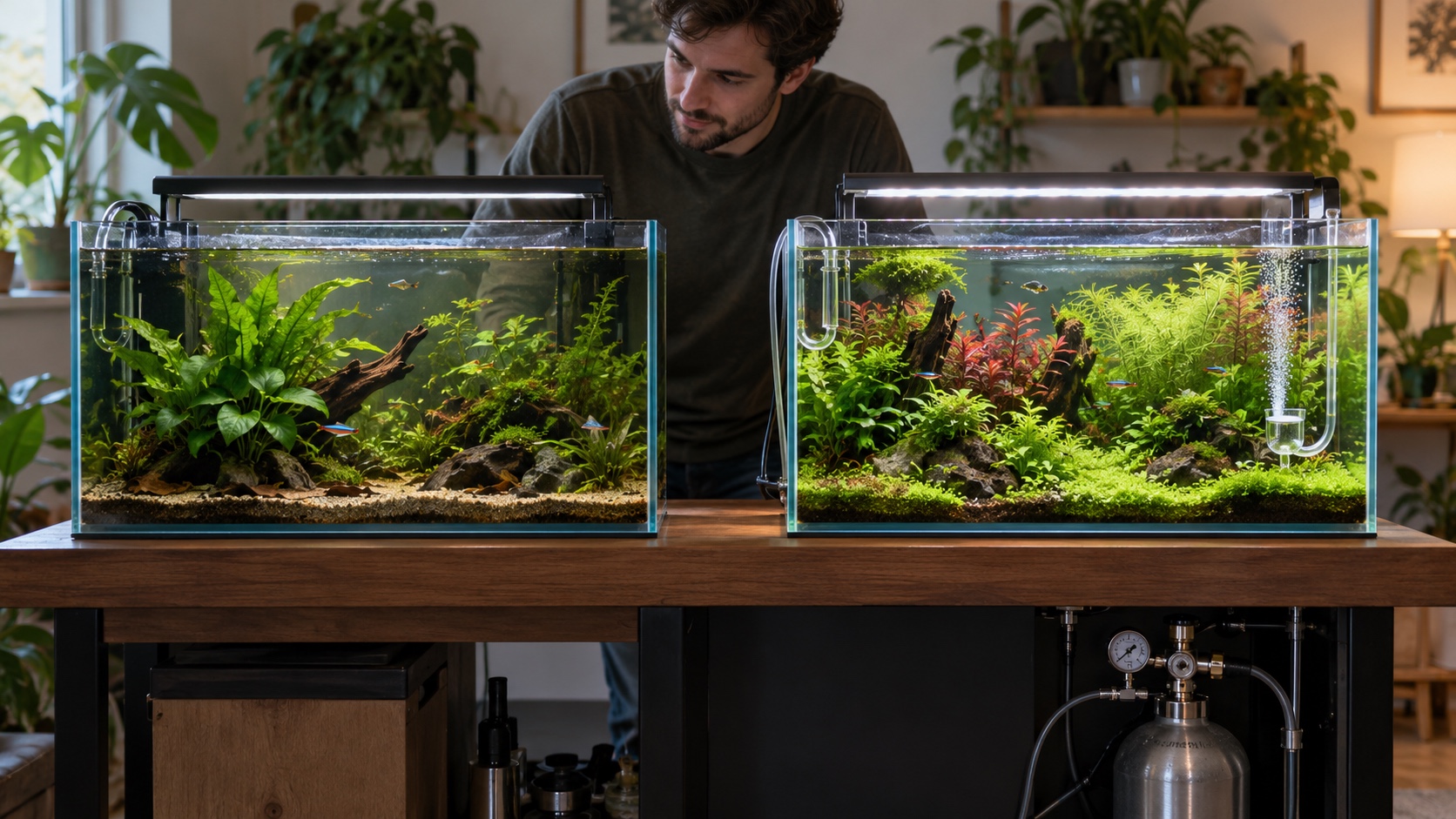
A low-energy aquarium can grow healthy Anubias, Java fern, many Cryptocoryne, mosses, and other tolerant plants without compressed gas. Success depends on honest expectations. Leaves may develop slowly, carpets may remain open, and stems may be less compact than they would be in a more energetic system.
Moderate light is central to that approach. Strong light increases photosynthetic demand before the aquarium has necessarily gained more carbon or nutrients. A conservative photoperiod and broad, even coverage usually serve a non-injected tank better than a bright center and dim edges.
Plant mass also matters. A few slow-growing groups attached to wood and rooted in stable substrate place different demands on the water than a densely planted field of fast stems. Choose the layout around the available resources instead of expecting ambient carbon to support any design.
Maintenance must still be deliberate. Thin floating cover, remove failing tissue, preserve circulation, and feed plants through a coherent nutrient method. “Low tech” describes the equipment level, not permission to ignore the garden.
Identify Goals That Make Pressurized CO₂ More Useful
Injection becomes more compelling when the plan includes dense carpeting, frequent sculptural trimming, demanding stem species, or a competition-style finish on a deadline. It can improve growth rate and plant form when the rest of the system supports that higher demand. It cannot make an unsuitable temperature, unstable substrate, or weak husbandry disappear.
Match Light to the Carbon Strategy
Choose the carbon approach before setting the fixture aggressively. In a non-injected aquarium, use the lowest light that produces acceptable new growth across the intended zones. Extra fixture capacity can remain unused. Plants do not benefit from demand that the tank cannot reliably supply.
With pressurized CO₂, light still should not begin at maximum. Establish gas timing and distribution under moderate intensity, then assess several weeks of new growth. Raising intensity before carbon reaches every bed often produces uneven response: compact tops near the diffuser, weak bases in stagnant corners, and algae on slow leaves.
Duration is not a substitute for intensity or carbon. Extending the photoperiod can prolong a daily imbalance. Change only one lighting control at a time and record the setting, date, trim state, and plant response.
Understand What a Complete Gas System Requires
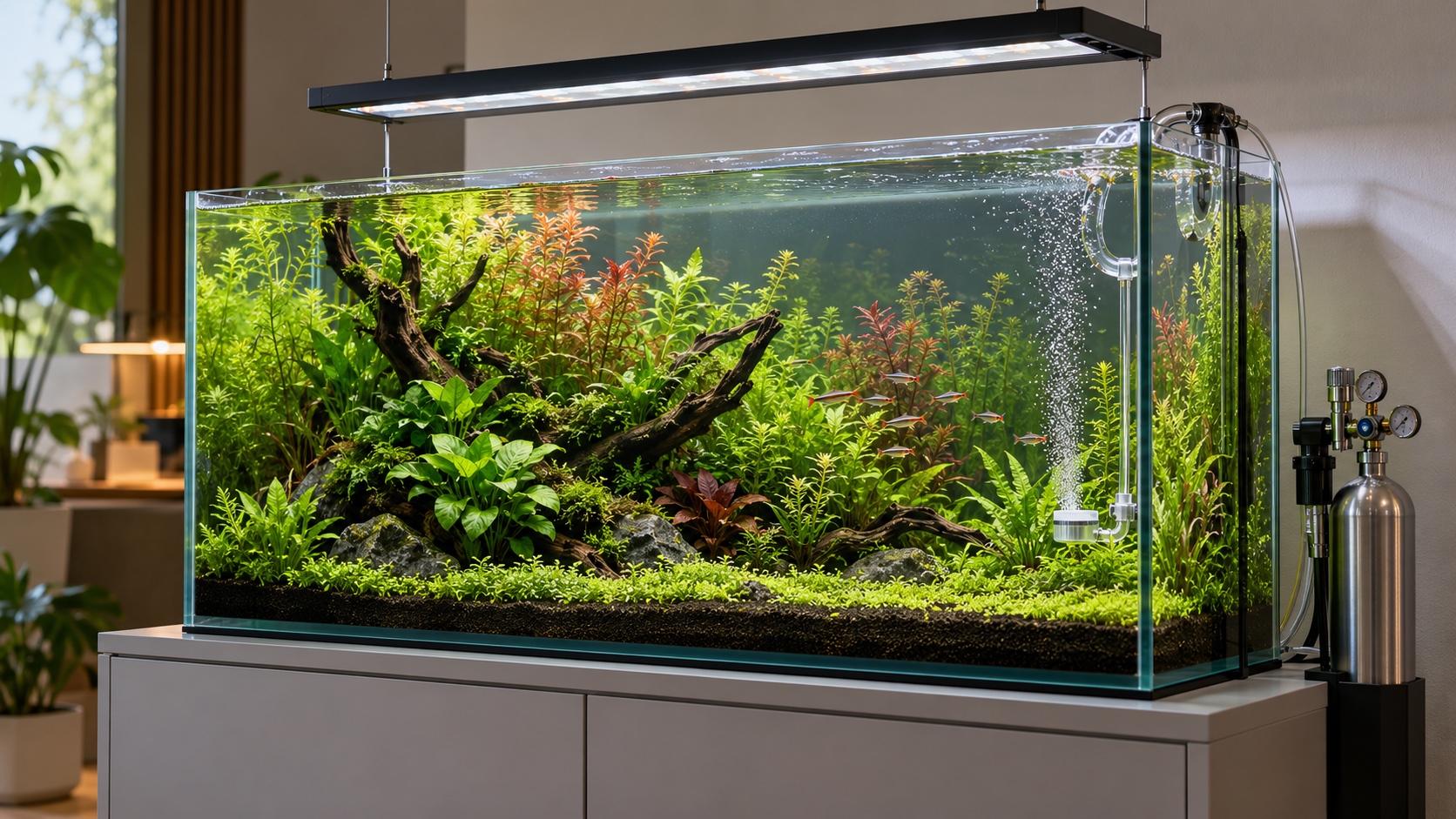
A reliable pressurized setup normally includes a secured cylinder, regulator, needle valve, solenoid, pressure-rated tubing, check valve, bubble counter or another repeatable reference, and an appropriate diffuser or reactor. Every component must be compatible with the operating pressure. The cylinder should remain upright and protected from falls, heat, and accidental valve damage.
The system also needs a timer strategy, routine leak checks, diffuser cleaning, and a plan for cylinder replacement. The cost is not only the initial hardware. It includes refills, maintenance, observation time, and the responsibility to respond if livestock shows distress.
Time Injection Around Plant Access, Not Just the Light Switch
Many aquarists start gas before the main light so dissolved CO₂ approaches a useful level when photosynthesis begins, then stop it before the light ends. The exact lead and stop times depend on circulation, diffuser efficiency, water chemistry, surface movement, and plant mass. Copying another aquarium’s clock times without testing can create either a slow morning ramp or an excessive late-day accumulation.
Distribute Carbon Through the Whole Planted Footprint
A diffuser producing fine bubbles does not guarantee that carbon reaches every leaf. Watch the direction of water movement around wood, rock, and dense stems. Dead zones often appear behind hardscape, beneath overgrown canopies, or in corners shielded from the return.
Position the diffuser where flow carries dissolved gas across the planting without blasting fish or uprooting substrate. A visible mist can help reveal a route, but bubble visibility is not the same as dissolved concentration. Compare plant response in several locations.
Trimmed and mature layouts distribute water differently. After a major cut, the same return may push much farther through the tank. As stems regrow, resistance increases. Recheck circulation instead of assuming a placement that worked in week two remains ideal in month six.
Surface movement should support oxygenation and normal animal behavior. Do not eliminate all agitation in an attempt to retain gas. Efficient injection and adequate exchange can coexist when flow is designed deliberately.
Measure Trends Without Trusting One Number
A pH change measured with a consistent method can help the same aquarium compare days, but it is not a universal dosing target. Carbonate chemistry, other acids, test accuracy, and sampling time affect interpretation. Bubble counts are likewise useful only as a repeatable equipment reference for that specific counter and diffuser.
Combine measurements with new plant growth and livestock behavior. Healthy compact growth across multiple zones supports the setting. Fish gathering at the surface, rapid breathing, unusual hiding, or invertebrate distress requires immediate action regardless of the planned target.
Let Animal Safety Define the Upper Limit
If animals show possible gas stress, stop injection, increase aeration and surface movement, restore normal flow, and observe closely. Do not wait for a test result before protecting livestock. Everyone responsible for the aquarium should know how to close the cylinder valve and activate the emergency response.
Introduce changes only when someone can watch the complete light cycle. A setting that appears safe shortly after startup may become unsafe later as gas accumulates. Avoid increasing the rate immediately before leaving home or after a large maintenance change.
Account for night conditions. Plants and microbes consume oxygen in darkness, and CO₂ injection generally provides no plant benefit when the light is off. Maintain appropriate gas exchange overnight and confirm that timers return to the expected schedule after outages.
Do Not Confuse Liquid Products With Injected Gas
Products marketed as liquid carbon are not bottled dissolved CO₂ and may contain compounds that affect sensitive plants, algae, microbes, or animals. Follow the exact label, understand local restrictions, and never increase a dose to imitate pressurized injection. A product’s algae effect does not prove that it supplies carbon in the same way as gas. Research the active ingredient and warnings rather than relying on the front label’s category name. Some mosses, liverworts, Vallisneria, invertebrates, or microbial communities may respond differently, depending on product and exposure. Do not spot-dose around livestock unless the approved instructions explicitly support that use. Store chemicals securely, measure with dedicated tools, and treat any adverse response as a reason to stop and reassess.
Test the Low-Energy Option Before Buying More Equipment
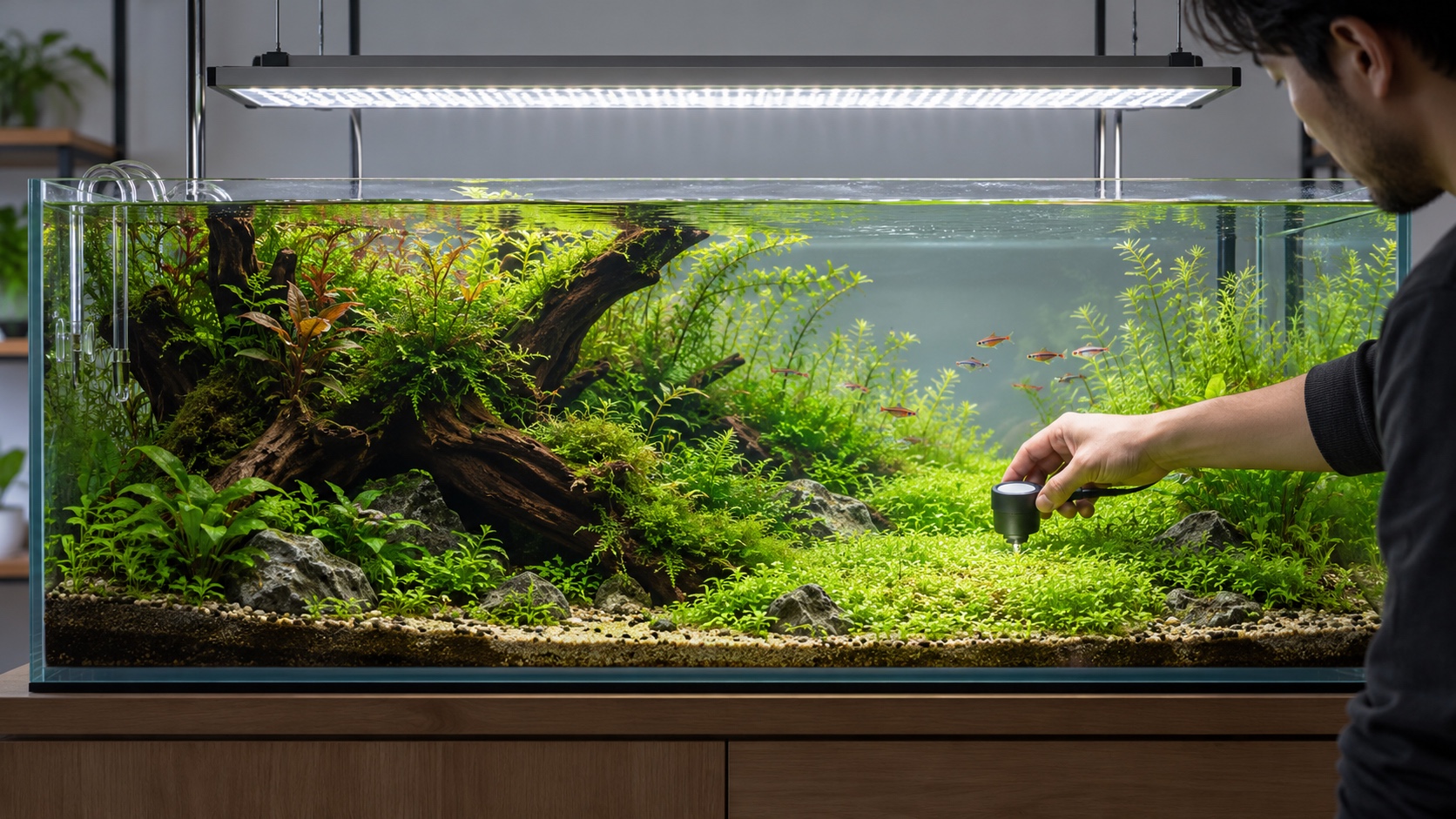
Start with compatible plants, moderate light, complete measured nutrition, stable temperature, and useful circulation. Photograph the tank weekly for six to eight weeks. Look at new submerged leaves, stem spacing, rooting, and algae location rather than expecting immediate fullness. Keep the camera angle, fixture setting, and observation time consistent. Note major water changes and trims. This baseline makes a later injection trial meaningful because the aquarist can compare the same plants under documented conditions.
If the chosen plants remain healthy and the growth rate fits the design, injection may add complexity without solving a problem. If the layout repeatedly falls short because verified plant demand exceeds ambient carbon, the evidence supports reconsidering the system.
Choose the System You Can Operate Consistently
List the actual design goals before choosing equipment. A calm epiphyte-and-crypt aquarium may need patience more than gas. A dense carpet and tightly trimmed stem wall may justify injection because their desired form depends on a higher, steadier resource supply. Write those goals as observable outcomes: new leaves without distortion, stems remaining compact at a chosen height, or a foreground filling at an acceptable rate. Vague dissatisfaction encourages equipment purchases that cannot be evaluated. A specific outcome gives the aquarist a baseline and a fair date for reassessment.
Calculate ongoing responsibility as well as purchase price. Include cylinder access, refill transport, replacement seals, diffuser cleaning, timer checks, and the ability to observe adjustments. A sophisticated system operated inconsistently can be less stable than a modest one managed well. Consider who will manage the aquarium during travel and whether that person can recognize distress, stop gas, and restore aeration. Keep spare rated seals and the correct tools nearby, but do not improvise regulator repairs. Service components according to their manufacturer rather than treating every leak as a tightening problem.
Keep the option to change direction. A non-injected tank can later receive carefully installed CO₂, and an injected tank can be redesigned around lower-demand plants if upkeep no longer fits. Make the transition by adjusting light and plant selection, not by abruptly removing one resource while leaving demand high. During a move toward lower energy, reduce light conservatively, favor plants already proving tolerant, and thin species that continually demand rescue. When moving toward injection, install and test hardware without animals at risk where practical, then establish the gentlest useful rate under observation. Either transition should be documented through new growth.
Review the tank after every major trim or plant addition. Biomass, flow resistance, nutrient use, and daily gas uptake all change. Preserve stable settings first, then make conservative corrections supported by repeated observations. Compare the same time points in the daily cycle because pH, visible bubbling, and animal distribution can vary from morning to evening. Note water-change volume and surface agitation as well. A setting that appears different after maintenance may reflect temporary mixing or altered flow rather than a need to turn the needle valve.
Aquarium plants need carbon, but aquarists do not all need cylinders. The successful choice matches plant species, light, composition, livestock, budget, and maintenance capacity. When those pieces agree, both low-energy and injected aquariums can produce healthy, intentional gardens. Judge success by the whole system: characteristic new growth, predictable pruning, normal animal behavior, manageable algae, and a routine the household can sustain. Do not treat slower growth as failure when it is healthy and intentional, or rapid growth as success when it forces neglected maintenance. Carbon strategy is a design decision whose value appears in stability over months.