The Right Amount of Light Is a Range the Whole Tank Can Support
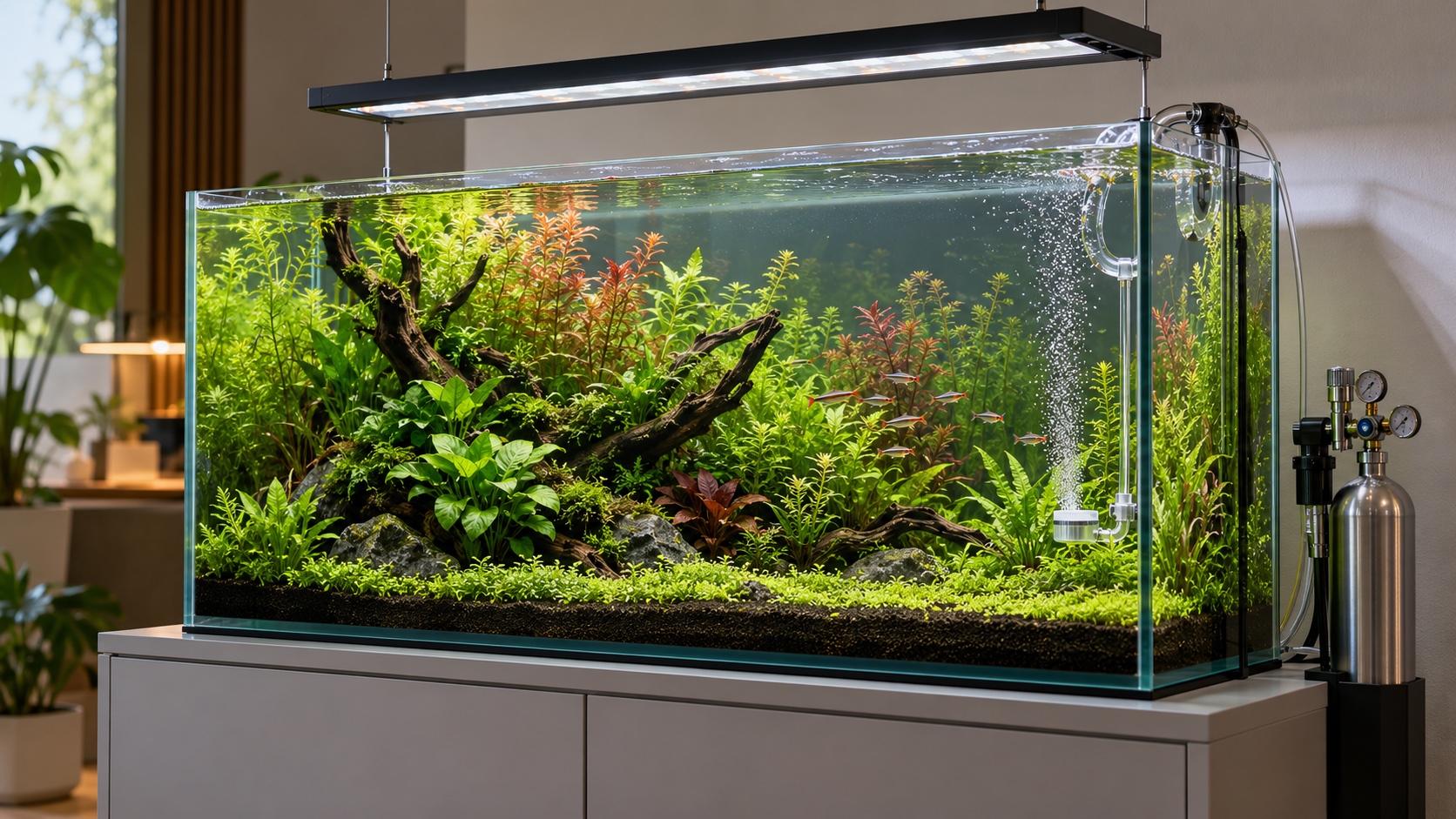
A planted aquarium does not need a universal number of watts or a fixed number of bright hours. The useful amount is the light that reaches each plant strongly enough for healthy growth without driving demand beyond available carbon, nutrients, circulation, and maintenance. Fixture optics, mounting height, water depth, surface cover, hardscape shade, and plant canopy can make two tanks with the same lamp behave differently. Start with a conservative repeatable setting, evaluate distribution and new growth, and adjust gradually. The answer comes from the relationship between the fixture and the aquarium, not from the fixture label alone.
A: There is no universal duration; begin with a moderate consistent schedule and adjust from plant response and system balance.
A: No. Wattage measures power use, while optics, height, depth, and coverage determine delivery to plants.
A: They describe visible output to human eyes and can aid product comparison, but do not replace plant-level distribution information.
A: Not always, but careful measurements can map actual delivery when interpreted with the fixture, water, location, and plant needs.
A: It raises total daily exposure but does not correct poor spatial distribution or guarantee the required plant response.
A: The fixture may have a center hot spot or weak edge coverage; also compare carbon, flow, and shade across locations.
A: Observe carefully because biomass, shade, demand, and distribution changed; a temporary reduction may help in some systems.
A: No. It provides context but also responds to carbon stability, nutrients, waste, surfaces, maintenance, and plant health.
A: No. Species, nutrition, carbon, health, and stress all influence color, and excessive demand can destabilize the tank.
A: Healthy intended growth across the footprint, normal livestock, manageable algae, and supportable demand indicate an adequate range.
Separate Intensity, Duration, and Distribution
Intensity describes how much usable light reaches a location at a moment. Duration describes how long the aquarium receives it. Distribution describes where that light falls. A tank can have adequate center intensity yet weak corners, or modest intensity delivered for too many hours. Treat these as separate controls. Changing duration does not repair a dark spot, and lowering fixture height may increase center intensity while reducing evenness.
Begin With Plant Demand and Tank Geometry
List plants by verified light requirement and position. Low-growing foreground plants at the bottom of a deep tank may need more delivered light than epiphytes near the surface. Tall stems can shade their own bases. A low-light plant beneath wood may receive less than the same species in an open midground.
Measure water depth, fixture length, mounting height, and the front-to-back footprint. Check whether the light covers the full tank or concentrates into one strip. Braces, lids, tannins, surface ripples, and floating plants reduce or redirect light. Geometry often explains uneven results better than the advertised fixture category.
Use Fixture Data Carefully
Lumens describe visible output to human eyes and do not directly measure photosynthetically active radiation at the plant. Wattage describes power consumption, not delivery. Color temperature describes appearance, not total usable intensity. These specifications help compare related products but cannot answer the tank alone.
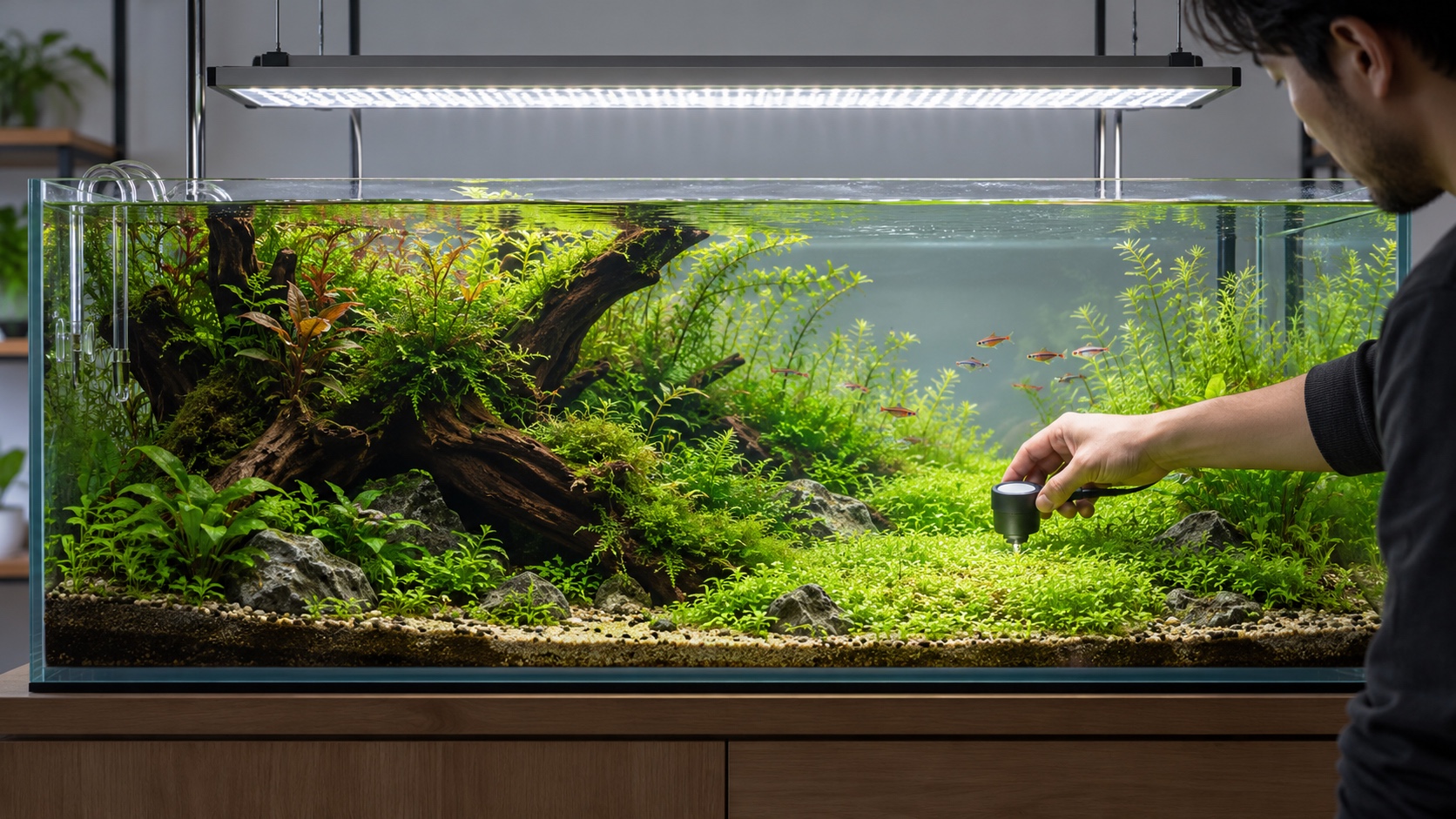
PAR measurements can estimate photosynthetically active radiation at specific locations, provided the meter and method are appropriate. A single center reading is not a map. Measure foreground, corners, shaded zones, and different depths when possible. Record fixture settings, height, and water condition so later readings remain comparable.
Manufacturer coverage maps and independent measurements can be useful when they match the fixture, mounting, and tank dimensions. Avoid transferring a value from a shallow open test to a deep covered aquarium without adjustment. Treat the data as a starting estimate, then verify with the actual system.
Plant categories such as low, medium, and high light are broad. Species, cultivars, carbon availability, and desired growth form affect the useful range. A plant may survive at one level and grow compactly at another. Define the outcome you need instead of treating survival as full success.
Set a Conservative Starting Schedule
Use a timer and begin with a stable moderate photoperiod appropriate to the system. Avoid leaving the light on from breakfast until bedtime simply for viewing. Choose a consistent block that allows observation and maintenance. If the room receives strong daylight, include that contribution when judging total exposure.
Adjust Mounting Height for Coverage Before Maximum Brightness
Raising a fixture can broaden its footprint and soften hot spots, though intensity at the plants falls. Lowering it can increase intensity but may create strong center-to-edge contrast. Use the manufacturer’s mounting limits and water-resistance requirements. Never improvise a suspension that can fall into the aquarium.
Observe shadows cast by hardscape and tall groups. Moving the fixture slightly may improve a dark bed without raising overall output. Some tanks benefit from multiple lower-output fixtures for coverage, but added equipment should be evaluated for heat, control, electrical safety, and total light.
Keep the chosen height measurable. A fixture moved during maintenance and returned by eye can produce recurring variation. Record the distance from the water surface and maintain the normal fill level.
Match Light to Carbon and Nutrient Availability
Light increases photosynthetic demand. In a non-injected aquarium, strong light can exceed naturally available carbon even when fertilizer is present. Select suitable plants and keep output moderate. Slower growth is not automatically poor growth.
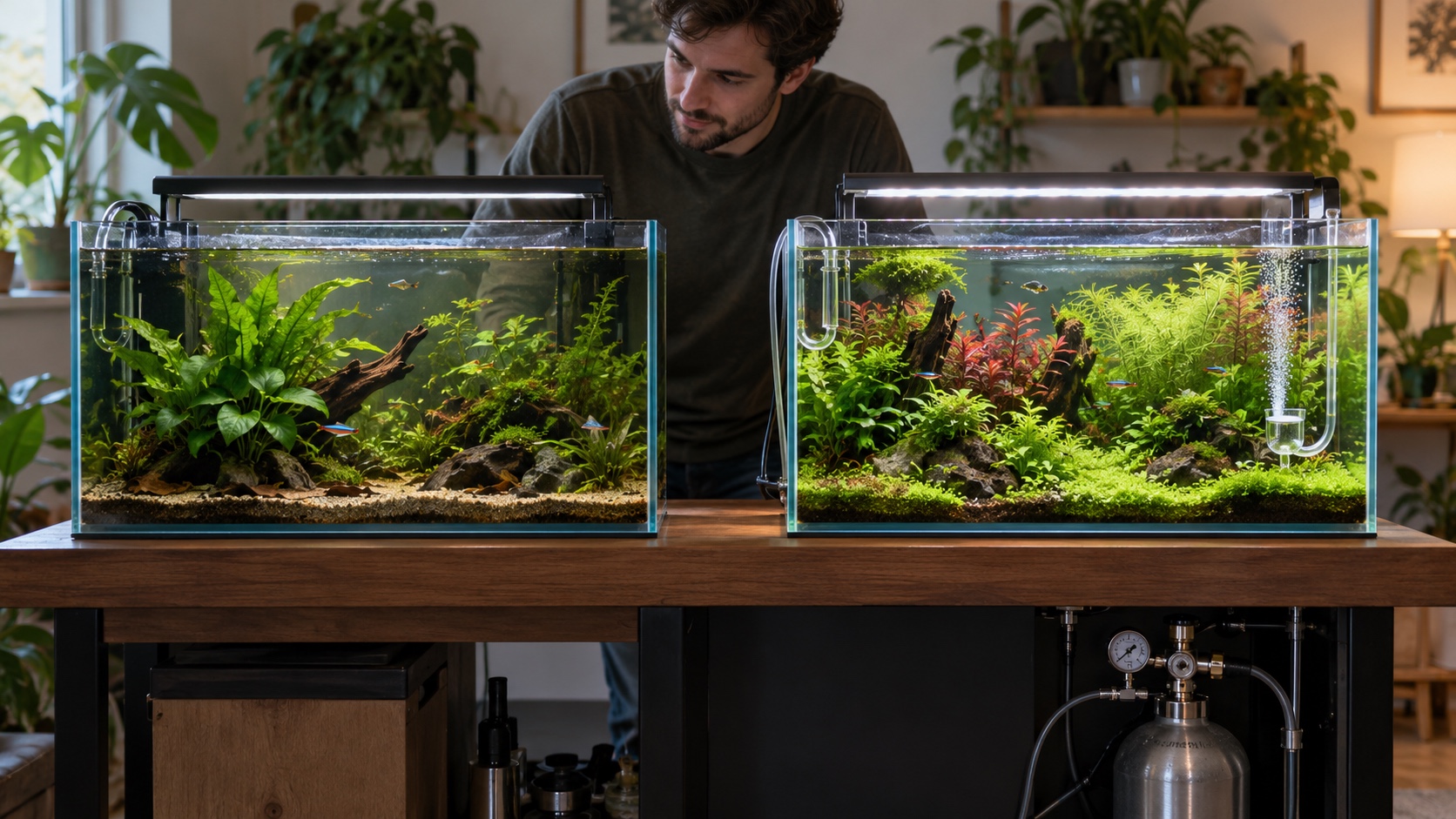
Injected CO₂ can support higher light, but it must be stable, distributed, and safe for livestock. Do not raise intensity until injection, gas exchange, circulation, and nutrition are reliable. Plant growth can consume nutrients faster under higher energy, making a complete measured fertilizer method more important.
Read Plants Across the Entire Footprint
Compact healthy growth near the center with stretched stems at both ends suggests uneven coverage. Pale lower leaves beneath a dense canopy may reflect self-shading rather than insufficient fixture power. A carpet growing only in an open lane may reveal hardscape shade or blocked flow.
Use Algae as Context, Not a Light Meter
Algae can increase under high light, but light is only part of its environment. Organic waste, unstable carbon, plant damage, nutrient imbalance, surfaces, and grazing also matter. Reducing light may lower demand, yet it does not identify every cause.
Map where algae appears. Slow leaves directly under the fixture, glass near a bright window, and shaded debris pockets indicate different relationships. Clean affected surfaces, remove decaying tissue, restore circulation, and review recent changes before altering the whole schedule.
After reducing intensity or duration, judge new plant growth and new algae formation. Old growth remains until removed. Daily adjustments prevent a fair comparison and can stress plants that were adapting.
Do not black out a planted aquarium repeatedly as routine management without considering plant and livestock needs. Correct the system that allowed the imbalance. Temporary interventions should serve a diagnosed plan.
Increase Light in Small, Documented Steps
If healthy plants stretch, lose lower growth despite adequate spacing, or fail to meet a verified species need, confirm fixture cleanliness, coverage, carbon, nutrients, and flow first. Then increase one light control conservatively. Record the exact change and date.
Wait through enough new growth to assess the response. Fast stems may show change sooner than slow rhizomes. Avoid interpreting one afternoon of pearling as proof. Review several species and livestock behavior.
Reduce Light When Demand Outruns the Aquarium
Lower output or duration when carbon cannot remain stable, fertilizer and maintenance cannot keep pace, algae repeatedly colonizes the brightest zones, or sensitive livestock needs more shade. Reducing demand is a valid design choice. It often improves stability without sacrificing a healthy planted appearance.
Thin or corral floating plants instead of letting uncontrolled shade set the light level. Use intentional hardscape and plant canopy to create refuges. A tank can contain bright and shaded zones when every chosen species is placed accordingly.
After a major trim, more light reaches lower areas while total plant demand falls. Keep the routine stable and watch the new distribution. A setting balanced for dense growth may be temporarily excessive after half the biomass is removed.
Recheck Light as the Aquarium Matures
Clean the fixture shield, lid, and waterline according to safe instructions. Mineral deposits and dust reduce output gradually. Compare before and after without changing intensity immediately. Maintenance can restore the original level.
Map plant height and shade monthly. Move or trim groups that permanently block incompatible neighbors. Replace species that require a different energy system from the rest of the aquarium rather than continually altering the whole tank for one plant.
Check timer accuracy and settings after outages. Confirm the fixture has not shifted and the water level remains normal. Small physical changes can explain apparent biological inconsistency. Repeat observations after routine cleaning and after a representative trim. Note whether lower leaves remain healthy, whether stems lean toward one part of the fixture, and whether shade-tolerant plants retain their expected form without being buried by faster neighbors. Save the final intensity, channel, ramp, and schedule settings in a maintenance note so they can be restored after a reset. Include the fixture height and water depth because both affect future comparisons.
Review livestock behavior at full light. Provide cover for species that need it and preserve normal feeding and swimming. Plant goals do not override animal welfare. Evaluate the tank from each animal’s likely position: open-water fish, bottom dwellers, and shy species may experience the same fixture differently. Deliberate shaded refuges can coexist with bright planting zones when their boundaries are planned. If the fixture uses separate color channels, do not treat a visually pleasing color as proof of greater plant effectiveness. Adjust channel balance conservatively and keep the system’s total energy demand in mind.
The aquarium has enough light when new growth is healthy across intended zones, plant form suits the design, algae remains manageable, and carbon, nutrients, and maintenance can support the demand. Keep the lowest effective setting that produces that result. Reserve extra fixture capacity for future adjustment rather than operating at maximum by default. To make that judgment repeatable, create a simple light map with front, center, rear, left, and right observation points. Mark the plant groups in each zone, their approximate height, and any shadow cast by wood, stone, floaters, or taller neighbors. Photographs taken from the same position with identical camera settings can reveal coverage changes even when they cannot measure plant-usable light. If a suitable PAR meter is available, measure at plant height under normal operating conditions and record the fixture setting, mounting height, water depth, and time since cleaning. Treat the readings as a map for that aquarium, not as a universal promise about a species. Borrowed measurements from a different tank may have another fixture, lid, water tint, mounting distance, or layout. Without a meter, use several weeks of new growth as the primary evidence and make even smaller adjustments. Review the dimmest intended planting zone rather than judging only the bright center. A fixture may deliver ample intensity directly beneath it while leaving the ends unsuitable for the same plants. Raising the light can sometimes improve spread, though it may reduce intensity and spill more light into the room. Moving a demanding group inward or choosing a shade-tolerant species for the edge can be more efficient than increasing the entire system. Consider vertical change too. As stems approach the surface, their tops receive much more light and their bases receive less. Trimming and replanting changes both the canopy and the demand profile. Floating plants can create moving shade that varies daily, while condensation, lids, and mineral film gradually reduce transmission. Include these factors before changing the programmed output. When comparing schedules, calculate the change conservatively: an extra hour and a higher intensity introduced together prevent a clear interpretation. Adjust one control, record it, and wait for several cycles of relevant new growth. Keep feeding, fertilization, carbon, water changes, and trimming as consistent as practical during the trial. Fish hiding, rapid breathing, unusual heat, or reduced surface access calls for immediate welfare-focused correction regardless of the plant experiment. The right amount of light is therefore a managed range, not a single number. It is the range that reaches the selected plants evenly enough, maintains their intended form, and leaves the keeper able to supply every linked resource safely and predictably.