Treat a Contest Entry as a Managed Project
Contest aquascaping asks for more than an attractive home aquarium. The entry must communicate a deliberate idea in one image, satisfy the chosen competition’s rules, remain healthy through a planned peak, and survive close technical inspection. Beginners do not need the most expensive materials or the rarest plants, but they do need a schedule, a clear composition, disciplined maintenance, and honest photography. The strongest first entry is usually a restrained project built around one readable concept rather than a crowded attempt to display every technique at once.
A: No. Health, composition, integration, and presentation matter more than rarity by itself.
A: Begin early enough to satisfy the rules and work backward through establishment, trimming, recovery, and photography.
A: Yes, if its design, timing, documentation, and eligibility fit the current event requirements.
A: No. Deliberate negative space and visible transitions help the composition remain readable.
A: Photograph during the planned horticultural peak after disruptive work has settled and animals behave normally.
A: Only when the current rules allow it and animal safety remains protected.
A: Follow the event's explicit limits and preserve an accurate representation of the aquarium.
A: Judging criteria vary and may include plant health, technical execution, originality, realism, and presentation.
A: Use comments that diagnose whether the intended visual message is clear, then protect the chosen concept.
A: Yes. A deadline, rules, documentation, and critique can create a valuable structured learning project.
Read the Current Rules Before Designing
Every competition defines its own eligibility, image format, entry period, categories, livestock expectations, editing limits, and disclosure requirements. Obtain the current official rules before buying materials. A beautiful aquarium can be disqualified by the wrong file dimensions, prohibited manipulation, missed deadline, or ineligible tank history.
Note how many images are accepted and whether equipment may be removed for photography. Some events judge a single frontal image, while others request supporting views. The number and angle of allowed photographs should influence how completely the design must communicate from the front.
Confirm authorship and originality requirements. Keep dated build photographs and receipts when useful. If collaborators helped, follow the event’s disclosure language rather than assuming that informal assistance needs no mention.
Create a submission checklist containing only verified requirements. Do not rely on an older entrant’s summary because rules and categories change. Mark the deadline in the relevant time zone and plan to submit before the final day.
Write a One-Sentence Visual Intention
Describe the scene, movement, or spatial experience in one specific sentence. “A narrow mountain pass opening into a quiet plain” gives stronger direction than “natural aquascape.” The sentence should guide material selection, focal emphasis, negative space, planting density, and the camera view.
Design for the Final Frame
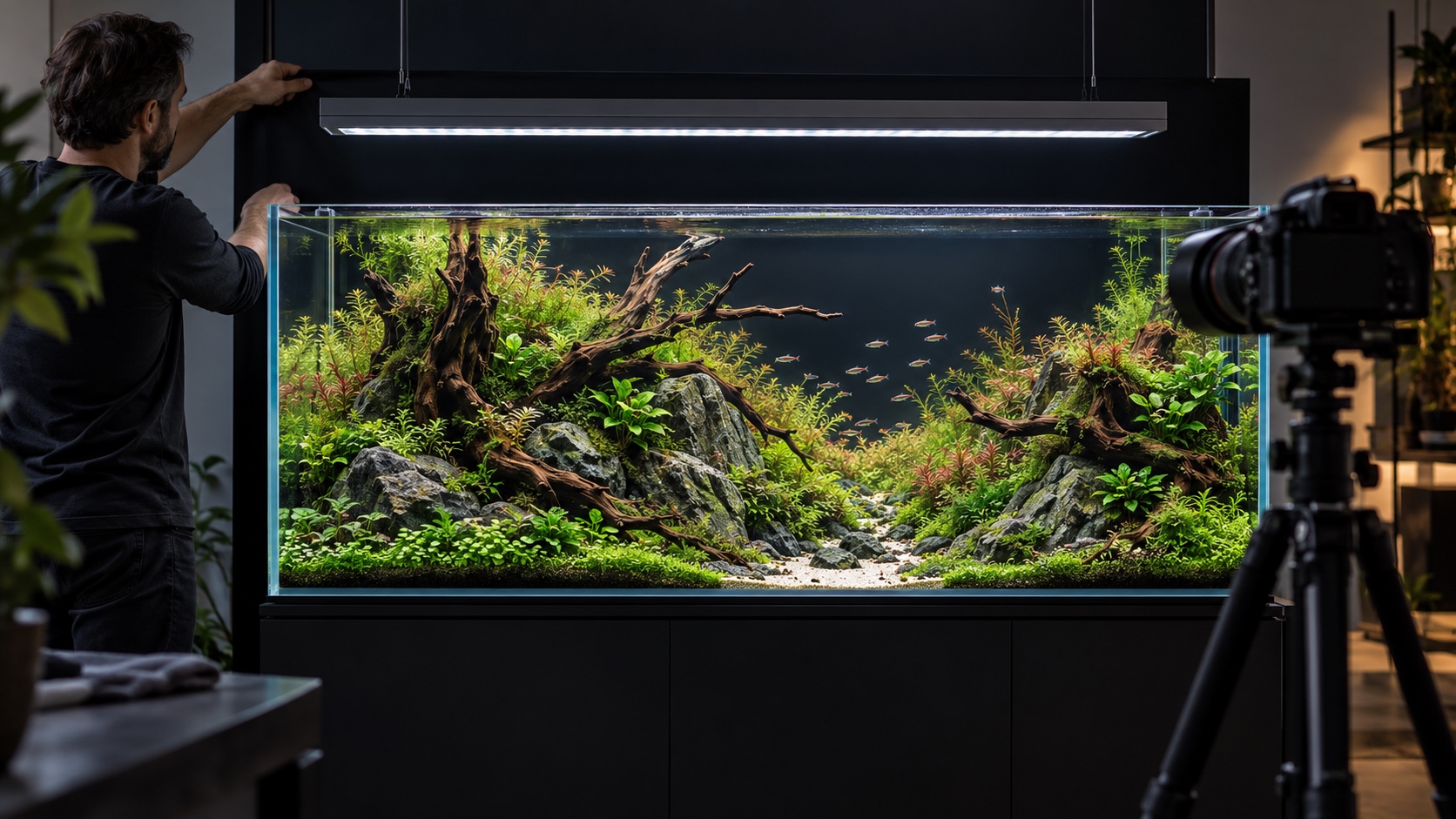
A contest entry is experienced through a photograph, so compose from the likely camera position. Establish the horizon, primary mass, counterweight, open route, and depth layers while the tank is dry. Check how the side panes, substrate line, and background appear from a square frontal viewpoint.
Use a temporary phone photograph to reveal tangencies and scale problems that the eye overlooks in three dimensions. A branch touching the rim, stone aligned with a glass seam, or path ending abruptly can flatten depth. Move materials physically rather than planning to repair composition digitally.
Preserve crop safety around the aquarium. If rules require the full tank, do not let important shapes depend on trimming away edges. Leave enough dark or quiet space for the composition to breathe without looking unfinished.
Rehearse Hardscape Outside the Aquarium
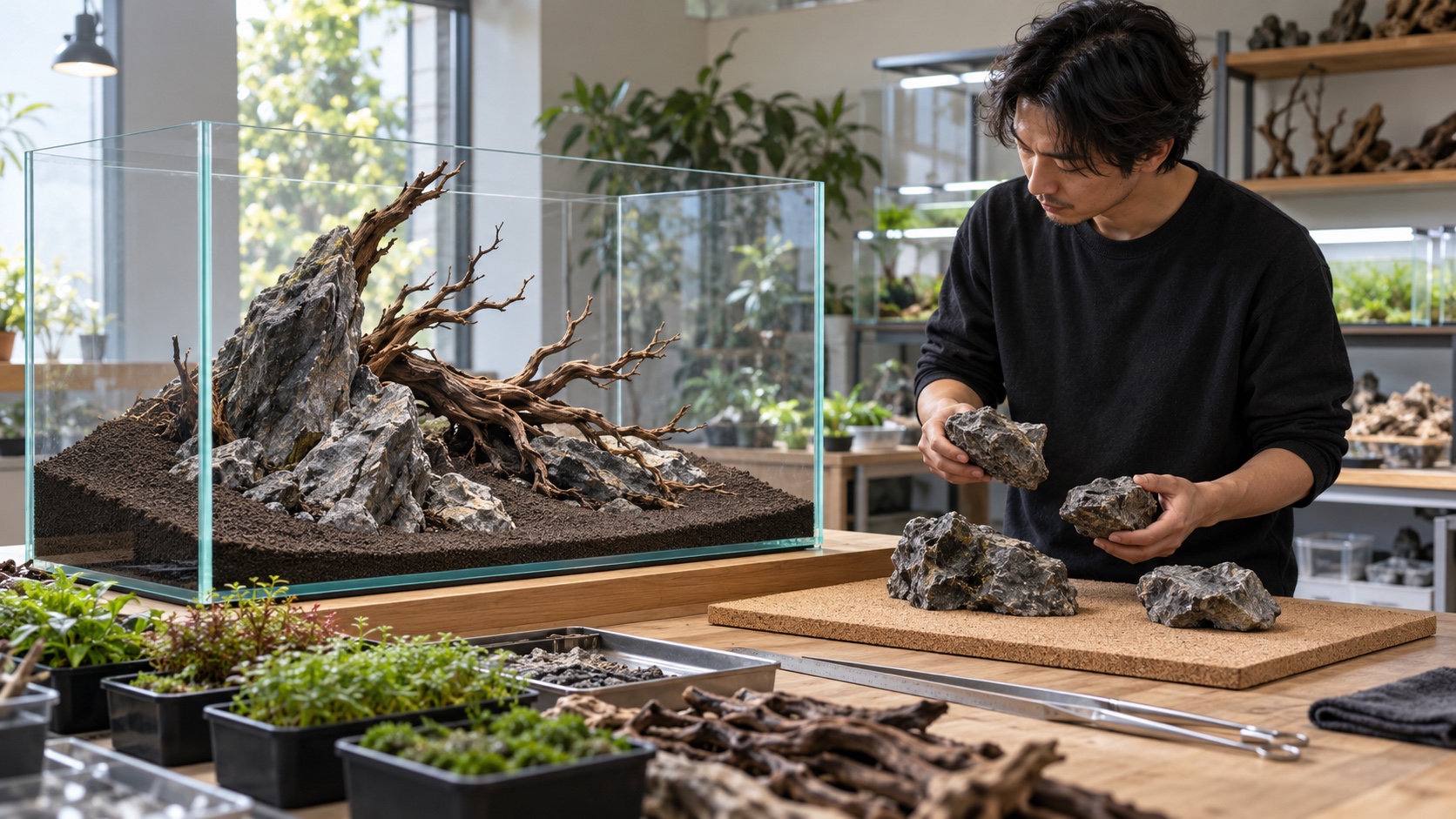
Arrange candidate materials on a board matching the tank footprint. Photograph alternatives from tank height, not only from above. Rehearsal reduces rushed decisions inside glass and helps confirm that stone grain, wood direction, color, and scale belong to one visual world.
Choose a limited family of materials. Several impressive rocks that contradict one another can weaken unity. Reserve smaller fragments from the same source for transitions and natural contact points instead of filling gaps with unrelated pieces.
Build Structural Stability Before Fine Detail
Support heavy stone on an appropriate stable foundation, not loose decorative substrate alone. Test each piece from several directions and account for maintenance contact, burrowing livestock, and water movement. The finished composition must remain safe after plants obscure the joints.
Lock the main silhouette first. Secondary stones and branches should reinforce its direction, scale, and rhythm rather than compete for equal attention. Step back frequently because close work exaggerates the importance of tiny details.
Create depth with overlap, size progression, converging lines, and controlled substrate elevation. A steep slope needs hidden retention and a maintenance plan. If it collapses whenever the foreground is cleaned, the photographic concept will deteriorate before peak day.
Use transition pieces sparingly where large hardscape meets substrate. Small fragments can imply erosion and scale, but evenly scattered chips look decorative. Group them according to gravity and the imagined history of the scene.
Select Plants by Visual Function and Timing
Assign each plant a job: soften a joint, frame the focal mass, create a distant texture, preserve an open path, or supply a controlled color accent. Verify mature size, growth speed, trimming response, and compatibility with the intended light, carbon, water, and temperature. Map each group at mature width and include the space needed to reach it with scissors and tweezers. A tiny nursery pot can become a dominant mass, while a slow epiphyte may barely change before the deadline. Note which species are likely to arrive in emersed form and allow time for submerged replacement leaves. Keep substitute species in mind, but do not mix replacements impulsively after planting. A substitution should preserve leaf scale, color role, growth direction, and energy requirement so the composition and operating plan remain coherent.
Plan the Peak Date Backward
Different plants require different time to root, transition, branch, and recover from trimming. Work backward from the submission window to schedule planting, major shaping cuts, fine trims, and photography rehearsals. Leave contingency time for algae, equipment failure, or a plant group that develops unevenly.
A peak is temporary. Fast stems may look best days after a cut, while moss and carpets can require weeks to regain natural edges. Coordinate these rhythms rather than trimming every group on the same date. Mark each major group on the calendar and keep photographs of its previous recovery speed. Seasonal room temperature, aging lights, and changing plant mass can shift the schedule, so preserve a buffer rather than trusting one earlier cycle exactly. The goal is overlapping readiness, not identical age.
Maintain Health Without Erasing Character
Stable plant health is part of presentation quality. Keep light, carbon, nutrition, temperature, filtration, and circulation consistent enough that new growth can be interpreted. Emergency changes made to chase color often produce uneven form or livestock stress.
Trim according to the intended silhouette. Use selective thinning to preserve depth, reveal hardscape, and prevent lower growth from failing. A uniformly sheared surface may look neat but can remove the varied scale that makes the scene convincing.
Clean negative space deliberately. Open sand, paths, and foreground edges attract attention because they contrast with dense planting. Remove fragments and algae without sterilizing natural transitions.
Use Livestock as Living Scale
Choose animals for adult size, group behavior, welfare needs, water conditions, and compatibility with the planting. Their movement should support the composition without depending on stress, overcrowding, or a last-minute introduction. Quarantine and acclimation timelines belong in the project plan. Observe the group before the final week so normal swimming height, reaction to the photographer, and feeding schedule are understood. Provide cover that remains functional outside the chosen camera view. If the species scatters under bright contest lighting, adjust the photography environment gradually rather than trying to force one pose. The final frame should capture behavior the animals already express comfortably.
Prepare the Tank for Photography
Rehearse the photograph before peak week. Align the camera square to the glass, control room reflections, clean both sides of the front pane, hide only equipment the rules allow to be removed, and check that the background remains even. A tripod and remote release improve consistency.
Photograph when plants and animals are in normal condition, not immediately after disruptive maintenance. Remove floating debris and allow fine particles to settle. Preserve adequate oxygenation and temperature while temporary photography changes are in place.
Use lighting that represents the aquarium accurately. Avoid clipped highlights, crushed shadows, and color changes that misrepresent plant health. If image adjustments are allowed, keep them within the competition’s stated limits and retain the original file.
Make multiple careful frames rather than one frantic session. Review focus at full size, especially foreground plants and focal hardscape. A technically soft image can hide months of good work.
Evaluate the Entry Like an Unfamiliar Viewer
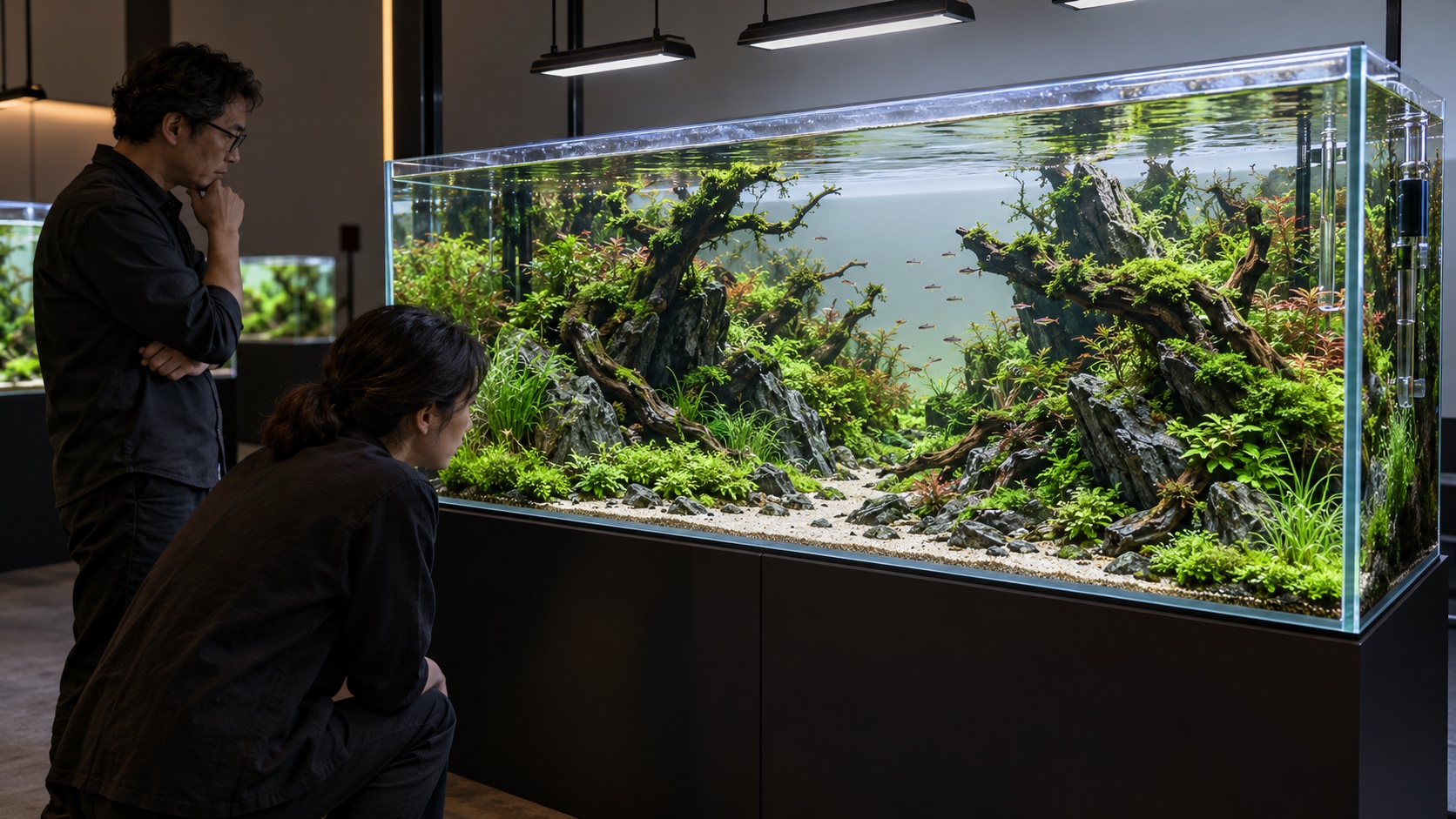
View the candidate image small and in grayscale. The main mass, open space, and directional flow should remain readable. If the composition depends entirely on color saturation, strengthen structure before the final photograph. Rotate the image briefly and inspect its silhouette without species detail. This unfamiliar orientation can reveal equal competing masses, accidental symmetry, or an empty corner that daily viewing has made invisible.
Ask a few specific reviewers what they see first, where their eye moves, and which area feels unresolved. Do not collect dozens of conflicting preferences. Use feedback to diagnose communication, then keep the design’s intention intact.
Submit Cleanly and Learn From the Result
Match the required filename, dimensions, color space, file type, and entry fields exactly. Verify the final upload rather than assuming a progress indicator means the submission is complete. Save confirmation and a local copy of everything submitted. Export from the final approved image rather than from a social-media copy that may have been compressed or resized. Open the exported file and inspect its pixel dimensions, orientation, embedded profile when relevant, and sharpness. If the portal generates a preview, compare it with the local file and correct any unintended rotation or cropping before final confirmation.
Do not rebuild the aquarium for every late opinion. Once the entry communicates clearly and meets the rules, protect its health and photograph it well. Last-minute additions often create visual noise without giving new material time to integrate. Establish a change cutoff before the intended shoot. After that point, permit only maintenance, safety corrections, and small reversible refinements. This protects roots, keeps water clear, and prevents the final image from documenting an aquarium that has not recovered from the entrant’s anxiety.
After judging, separate placement from useful critique. Scores reflect a particular event, panel, field, and year. Record comments that identify specific compositional, horticultural, or presentation issues, then test those lessons in the next project. Compare feedback with the published criteria and the actual submitted frame, not with a later improved version of the tank. When several judges identify the same unclear hierarchy or unfinished transition, that pattern deserves attention. A single taste-based preference can remain useful without becoming a universal rule.
Archive the timeline, maintenance notes, setup photographs, final settings, and peak-day sequence. This record is more valuable than trying to remember why a carpet, stem group, or camera setup worked. It turns one entry into a repeatable learning process. Include failed trials, because they show which material angles, plant placements, and timing assumptions were rejected. Note the labor required during the final month. A design that looked strong but demanded unsustainable emergency care teaches a different lesson from one that reached its peak through a calm routine.
A first contest aquascape succeeds when it is eligible, healthy, deliberate, and honestly presented. Build around a clear intention, manage the peak backward from the deadline, and submit a technically careful image. Awards cannot be guaranteed, but disciplined preparation can make the work worthy of serious evaluation. Continue caring for the aquarium after submission instead of treating it as a disposable stage. The mature system may reveal a stronger future photograph, supply propagated plants, or become the starting point for a different concept. Competition should deepen aquarium skill, not shorten the keeper’s responsibility to the life inside the glass.