Build for Coherence Rather Than a Trophy Formula
No checklist can guarantee an aquascaping award, because every competition, judging panel, and field is different. Strong entries nevertheless share a demanding kind of coherence: the concept reads immediately, hardscape and plants feel inseparable, scale remains convincing, livestock behaves naturally, and the final photograph reveals careful work without misrepresenting it. Creating that result means developing one visual idea through material selection, construction, horticulture, timing, and presentation. The award is an external outcome; the aquarist’s controllable task is to remove every avoidable contradiction from the finished scene.
A: No. A checklist can improve controllable execution, but judging and competitive fields remain variable.
A: No. Study relationships and finish standards, then develop an original concept from different observations.
A: Not necessarily. Complexity helps only when it remains coherent, healthy, readable, and technically controlled.
A: It should already carry the intended movement, scale, and hierarchy before foliage softens it.
A: Yes. Precise placement, health, trimming, and integration matter more than rarity alone.
A: A fixed camera view reveals compositional changes and helps direct trims toward the final frame.
A: No. Remove neglect and accidental debris while preserving believable natural irregularity.
A: Reduce the strongest competing idea first so the intended hierarchy becomes clearer.
A: Only the adjustments allowed by the current rules and consistent with honest representation.
A: The disciplined design process, horticultural record, presentation skills, and specific critique remain reusable.
Study Criteria Without Copying Past Winners
Read the current scoring categories and definitions. Some events emphasize natural impression, others innovation, horticultural execution, long-term viability, or photographic presentation. Translate each published criterion into a design question, but do not reverse-engineer a previous champion’s layout.
Review successful entries to understand standards of finish, scale, and image control. Look for relationships rather than objects: how open space balances mass, how plants bridge rock to substrate, and how fish movement reinforces depth. Copying signature shapes produces comparison without reproducing the reasoning behind them.
Keep a short reference library from landscapes, architecture, erosion, roots, and plant communities outside contest galleries. Originality often comes from observing a real spatial relationship and translating it into aquarium materials, not from combining fashionable techniques.
Develop a Concept With an Emotional Temperature
Name both the physical scene and its emotional temperature. A windswept ridge feels different from a sheltered ravine even if both use gray stone. The choice affects line direction, density, color, water movement, fish behavior, and the amount of empty space.
Create several thumbnail sketches that change the position and proportion of major masses. Work in black and white at first so color cannot rescue weak structure. Select the version with the clearest hierarchy, then test it against tank dimensions and service access.
Define what the composition will omit. A restrained palette gives the viewer fewer visual languages to decode. Limiting stone type, wood character, plant forms, and accent color makes subtle variation inside those families more meaningful.
State the final camera height and framing early. A convincing overhead layout can collapse from the required frontal view. Build the aquarium that the final lens will see while preserving a viable three-dimensional habitat.
Control Scale From Foreground to Distance
Large textures read as close; small textures suggest distance. Progress stone size, branch thickness, leaf size, and path width through the scene. The changes should be gradual enough to feel natural and strong enough to survive the photograph.
False perspective must not compromise physical stability or plant health. Tiny rear stones still need secure support, and fine-leaved background plants still require circulation and trimming access. Visual depth that fails during maintenance will not last to the peak.
Make the Primary Hardscape Irreplaceable
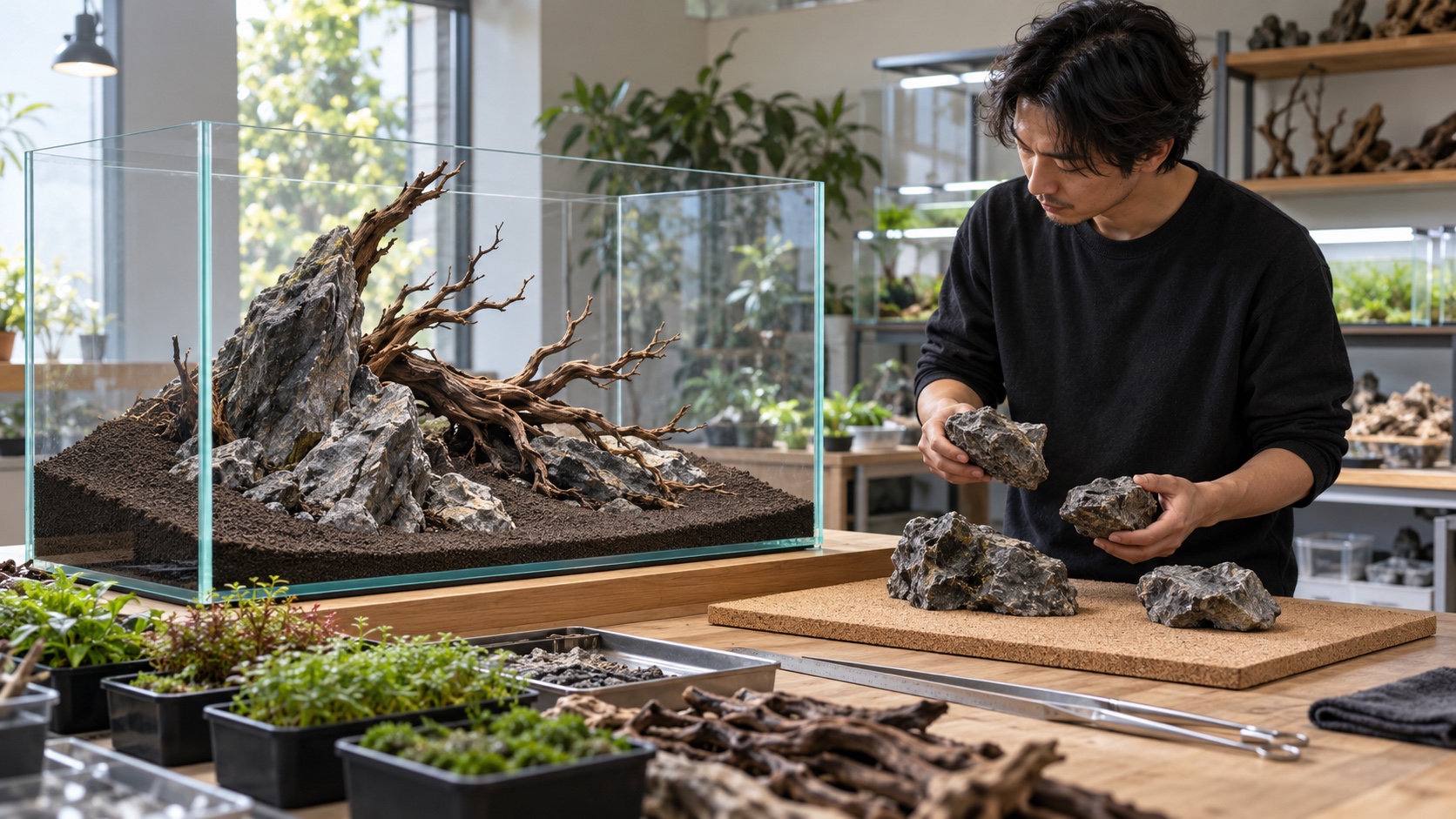
The main stone or wood structure should carry the concept even before plants are added. Rotate it until its grain, taper, weight, and direction reinforce the intended movement. If any similarly sized object could replace it without changing the design, the relationship is not yet specific enough. Study the silhouette against both light and dark temporary backgrounds. Check where the highest point falls, how branches leave the main mass, and whether the base looks anchored from the final camera height. Test slight rotations rather than only large relocations; a few degrees can turn a flat face into a directional plane or reveal a taper that strengthens depth. Once selected, record the position with photographs and simple measurements before building supports around it.
Construct Transitions That Explain the Scene
Hardscape rarely looks integrated when large pieces simply sit on smooth substrate. Use related fragments, roots, shadow pockets, controlled planting, and substrate variation to explain contact with the ground. Each transition should appear to result from the scene’s imagined geology or growth.
Do not distribute fragments evenly. Gravity and erosion create clusters, deposits, exposed edges, and quiet areas. Concentrated detail near key contacts can make untouched negative space more powerful.
Allow some hardscape to disappear behind plants and reappear. Total exposure can make every piece look displayed; total concealment wastes structure. Alternating revelation gives the viewer evidence that the composition continues through the plant mass.
Plant for Integration, Not Collection Value
Choose species by leaf scale, color temperature, growth direction, pruning response, and placement role. A rare plant that breaks the scene’s visual language can weaken the entry. A common moss or fern used precisely may do more compositional work.
Group plants in meaningful masses instead of placing one of everything. Repeat selected forms to link distant regions, then use a restrained accent where attention should pause. Preserve boundaries long enough to read while softening them enough to avoid a planted-map appearance.
Anticipate the shape after trimming. Stems should branch into the desired volume, carpets should meet stone with controlled irregularity, and epiphytes should reveal rather than bury key contours. Planting density on day one is less important than the mature response to planned cuts.
Match horticultural ambition to equipment and skill. A design that depends on unstable carbon, excessive light, or incompatible species risks arriving at the deadline with damaged tips and algae. Healthy restraint photographs better than stressed complexity.
Use Fish to Complete the Spatial Reading
Livestock is not decoration. Choose a species whose adult scale, group cohesion, color, swimming height, current preference, and temperament fit the aquarium. Provide enough individuals and habitat for normal behavior rather than adding a minimal group for the photograph. Plan quarantine, acclimation, feeding, and long-term housing before the image date. Observe how the group responds to bright photography conditions and preserve shaded refuge outside the main frame. A calm school that uses the intended open corridor gives stronger scale than a larger group pressed into one corner.
Direct Growth Toward a Planned Peak
Maintain a calendar of structural trims, recovery windows, fine shaping, and photo rehearsals. Different plant groups peak on different schedules, so the final week should not be the first time their silhouettes are coordinated.
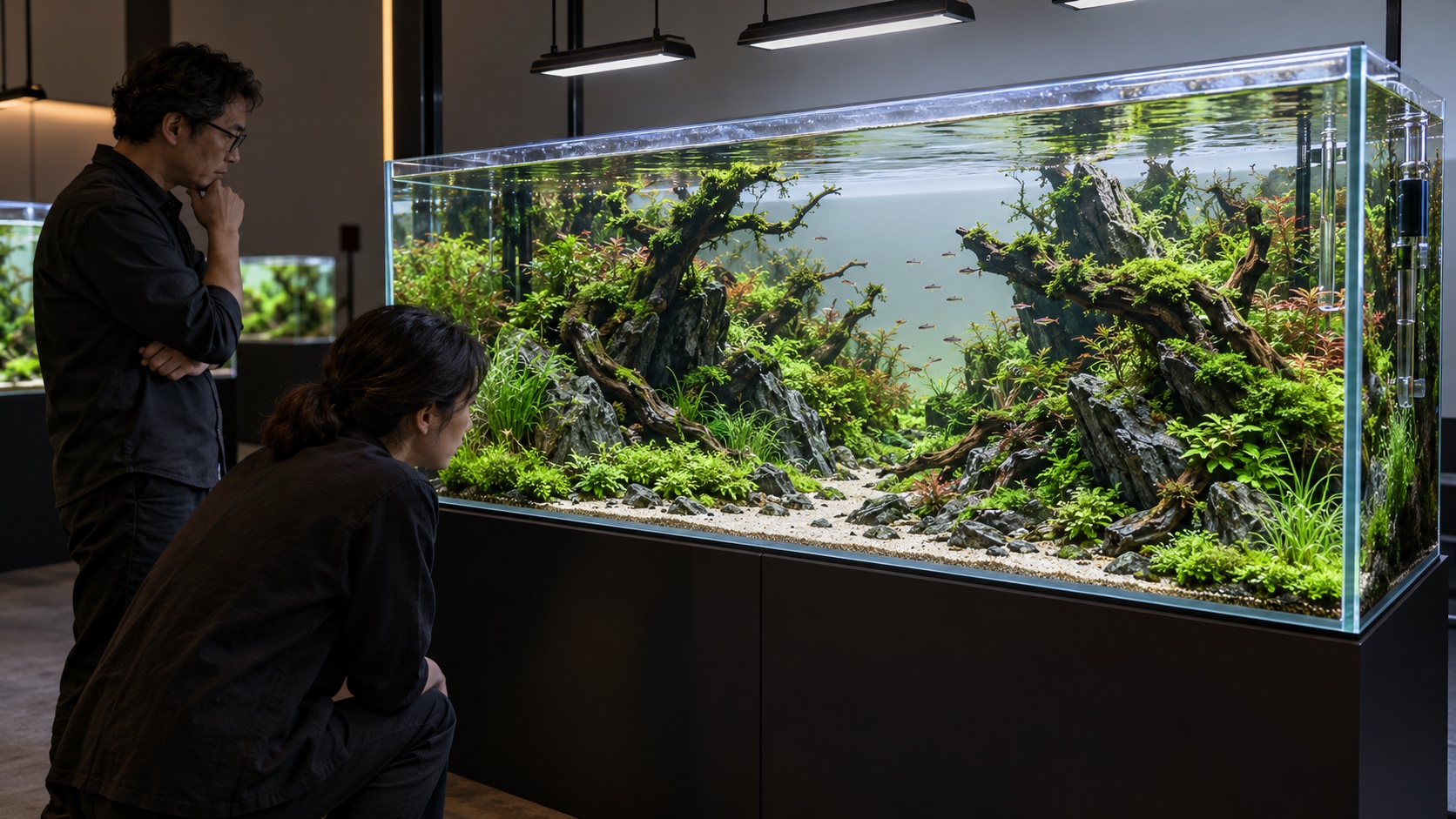
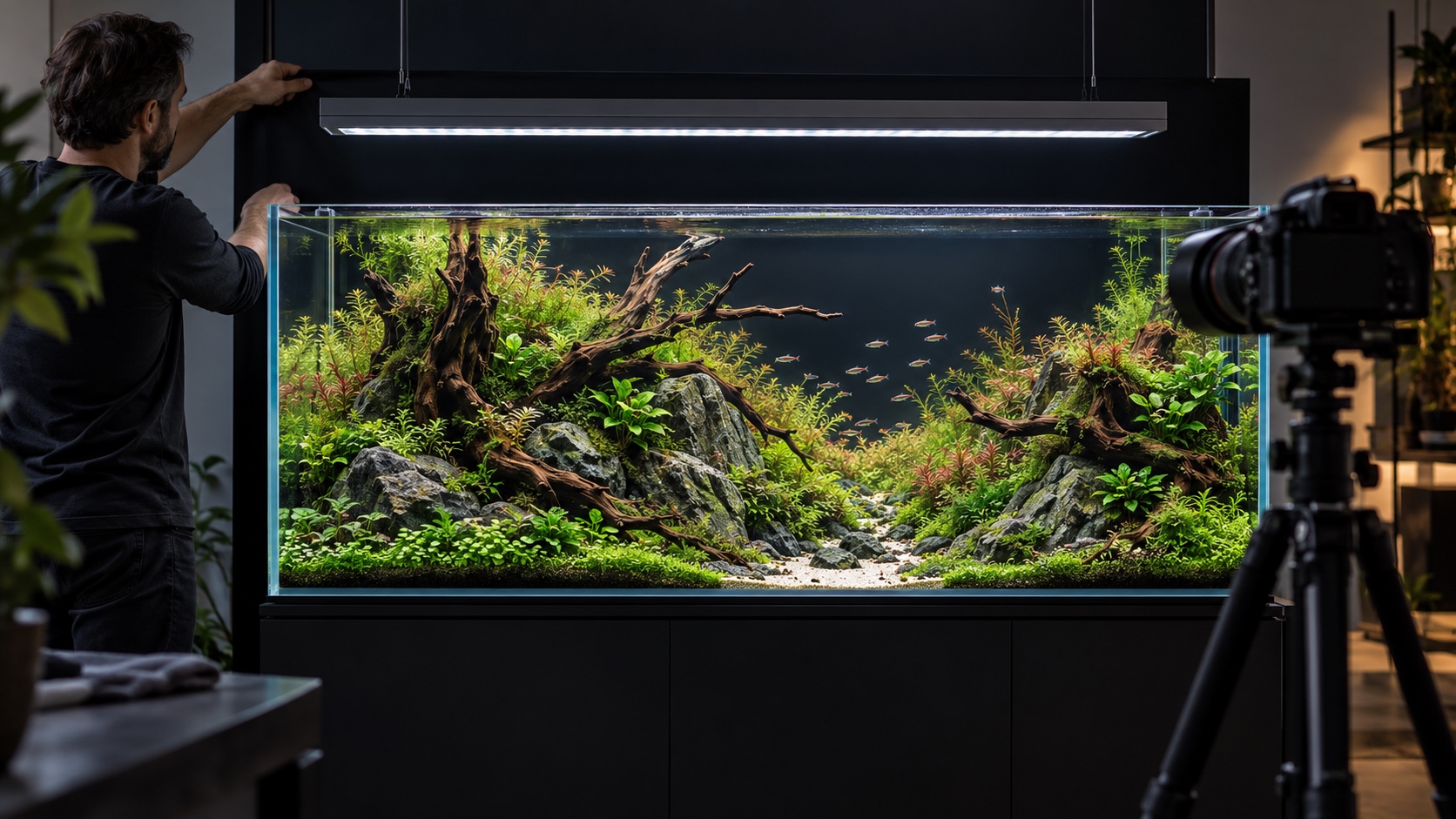
Photograph the aquarium from the contest angle after every major trim. The camera reveals holes, mergers, and flattened layers that are easy to miss in daily viewing. Use those images to guide the next cut rather than reacting to the tank from arm’s length.
Polish the Edges Judges Will Notice
Inspect the substrate line, front corners, path boundaries, exposed attachment points, cut stems, algae on slow leaves, and equipment shadows. These details are small but visible evidence of control. Correct them through maintenance and design, not digital removal.
Protect natural irregularity while cleaning. Perfectly combed sand and identical plant domes can feel artificial. The goal is intentional finish: no accidental debris or neglect, yet enough variation for the scene to remain alive.
Clean both faces of the front glass and the outside side panes that reflect into the frame. Check the waterline, surface film, and condensation. A pristine underwater scene loses credibility when the boundary containing it appears neglected.
Photograph the Aquarium Honestly and Deliberately
Use a stable camera position square to the front pane. Control ambient reflections with dark room surfaces and careful light placement, not by crushing the image into unnatural black. Choose an aperture and focus strategy that resolves the important depth layers.
Balance aquarium channels for natural plant and fish color. Avoid extreme saturation or selective edits that change the actual condition of the entry. Follow the event’s rules for exposure blending, background cleanup, cropping, and object removal.
Remove the Last Competing Idea
Before the final shoot, identify the second-most-demanding focal area. If it competes with the intended center, simplify it by reducing contrast, opening space, changing plant height, or revealing a directional line. The answer is often subtraction. Recheck the change from the fixed camera position before cutting further.
Check the image mirrored and at thumbnail size. A reversed view exposes balance habits, while a thumbnail reveals whether hierarchy survives without detail. If the eye wanders randomly, clarify mass and space rather than adding accents.
Invite reviewers to describe the scene before explaining it. Their first words show whether the visual intention communicates. Questions about personal taste matter less than repeated confusion about scale, direction, or focal hierarchy.
Finish the Project With Professional Discipline
Verify eligibility, consent, image specifications, and required disclosures. Export from a color-managed workflow when possible and inspect the exact submitted file on another screen. Keep the original capture and editing history according to the rules. Compare the export with the aquarium while it is still available in peak condition. A color shift that seems subtle during editing may exaggerate red plants, neutralize warm stone, or close important shadow detail. Correct the file through permitted global adjustments rather than selective changes that create a different aquarium.
Prepare the aquarium for the period after photography. Restore equipment, normal room conditions, and maintenance routines immediately. Fish welfare and system stability continue after the shutter closes. Confirm normal temperature, filter flow, gas timing, surface movement, and cover before leaving the room. If equipment was cleaned or repositioned for the image, observe the complete system rather than assuming it returned to its previous performance. Record the change so an unexpected plant or animal response has context.
Submit before the deadline and confirm receipt. Do not assume a browser upload has completed until the organizer’s system records the entry. Save the confirmation page or message with the final files. Reopen the entry record when the platform permits it and verify the selected category, entrant information, image, title, and optional description. Avoid replacing a correct file during last-minute second guessing. A calm administrative review protects the work from an avoidable technical omission.
When results arrive, study category-level feedback and visible comparative strengths without turning one placement into a permanent verdict on the design. A strong field can contain many excellent entries, and scoring necessarily compresses complex work into a ranking. Compare the feedback with the intention written at the start. If judges read the scene differently, decide whether the image failed to communicate or whether the alternative reading reveals useful ambiguity. Preserve decisions that served the concept even if they did not maximize one score.
An award-winning aquascape cannot be manufactured from a universal formula. It can be pursued through a coherent concept, exact construction, healthy integrated planting, believable scale, ethical livestock care, and technically honest presentation. Those are the standards the aquarist can control, and they remain valuable regardless of the final award list. Maintain a project archive containing early sketches, dry-layout alternatives, planting maps, trim dates, representative water and equipment notes, rehearsal frames, the original capture, permitted edits, and the exact submission. Review it before the next design to identify which decisions carried through successfully and which were patched late. The archive should reveal process rather than become a gallery of only polished images. Over several projects, patterns emerge: a recurring weak transition, an unrealistic growth schedule, or a camera habit that flattens depth. Correcting those patterns is more likely to improve future entries than buying a rarer plant or reproducing a fashionable silhouette. The pursuit of an award is most productive when it raises the keeper’s standard of observation, planning, and care.