Choose an Idea That Fits the Tank You Actually Have
The best nature-aquarium idea is not necessarily the most dramatic photograph on your inspiration board. It is the concept that works with your aquarium’s dimensions, viewing angle, water, equipment, livestock, and appetite for maintenance. A shaded root bank can thrive under moderate light, while a bright stem meadow may demand regular pruning and carefully balanced nutrients. A deep valley needs front-to-back space that a narrow tank cannot provide. The ideas below are therefore presented as adaptable design directions, not recipes. Each one explains the visual principle, suitable materials, planting character, and practical tradeoffs so you can recognize which landscape belongs in your freshwater tank. By choosing the underlying structure first, you can create an original aquascape without copying another person’s exact hardscape or plant list.
A: A root bank or mossy boulder field using adaptable epiphytes and crypts can work well under moderate, stable lighting.
A: A narrowing path, finer rear textures, raised background, and one small schooling species can strengthen perceived depth.
A: Yes. Concentrated color can reinforce a focal route, while scattered red plants often weaken unity.
A: No. Visual current and actual hydraulic needs are separate; set flow for livestock, plants, and filtration.
A: Keep enough to make the intended opening readable and maintainable; the exact amount depends on the composition.
A: No. Wood, stone, shade plants, and substrate can imply a forest without leaf litter.
A: Yes, when one controls the silhouette and both share materials, direction, and habitat logic.
A: A compact island, root mound, or asymmetric stone group uses the concentrated footprint effectively.
A: Borrow the structural principle, then use your own tank proportions, materials, plant behavior, and reference landscape.
A: It is ready when you can explain its focal route, planting energy, livestock space, and routine maintenance access.
A Shaded Root Bank for Calm, Low-Key Displays
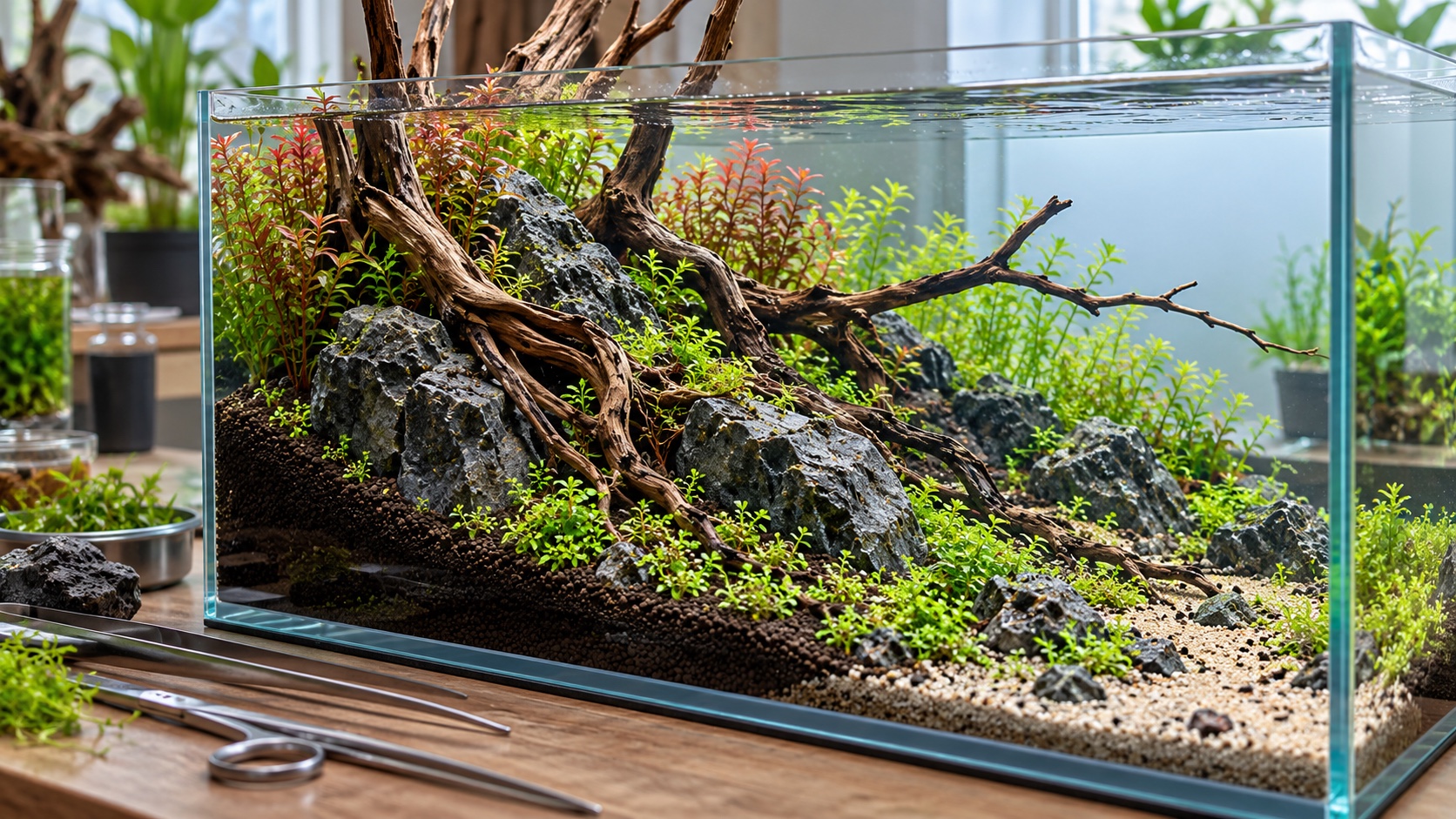
Build one side around a dark, branching root mass that appears to enter the aquarium from beyond the glass. Angle the main roots downward into stone and substrate, leaving the opposite side open for swimming. This layout works especially well in tanks viewed from the front and one side because the wood can conceal equipment near the rear corner. Choose pieces with several thicknesses so the structure resembles an old root system rather than a bundle of identical twigs.
Plant the bank with Java fern, Anubias, moss, and shade-tolerant crypts. Keep the open side lower and brighter with sand, small gravel, or a modest patch of Marsilea. The contrast between dense shade and clear water gives the scene its atmosphere. Slow-growing plants reduce trimming, but their leaves can collect algae under excessive light, so begin conservatively. This concept suits peaceful schooling fish that use the open water and species that appreciate covered margins, provided their individual needs match the setup.
A River Bend Defined by Current and Stone
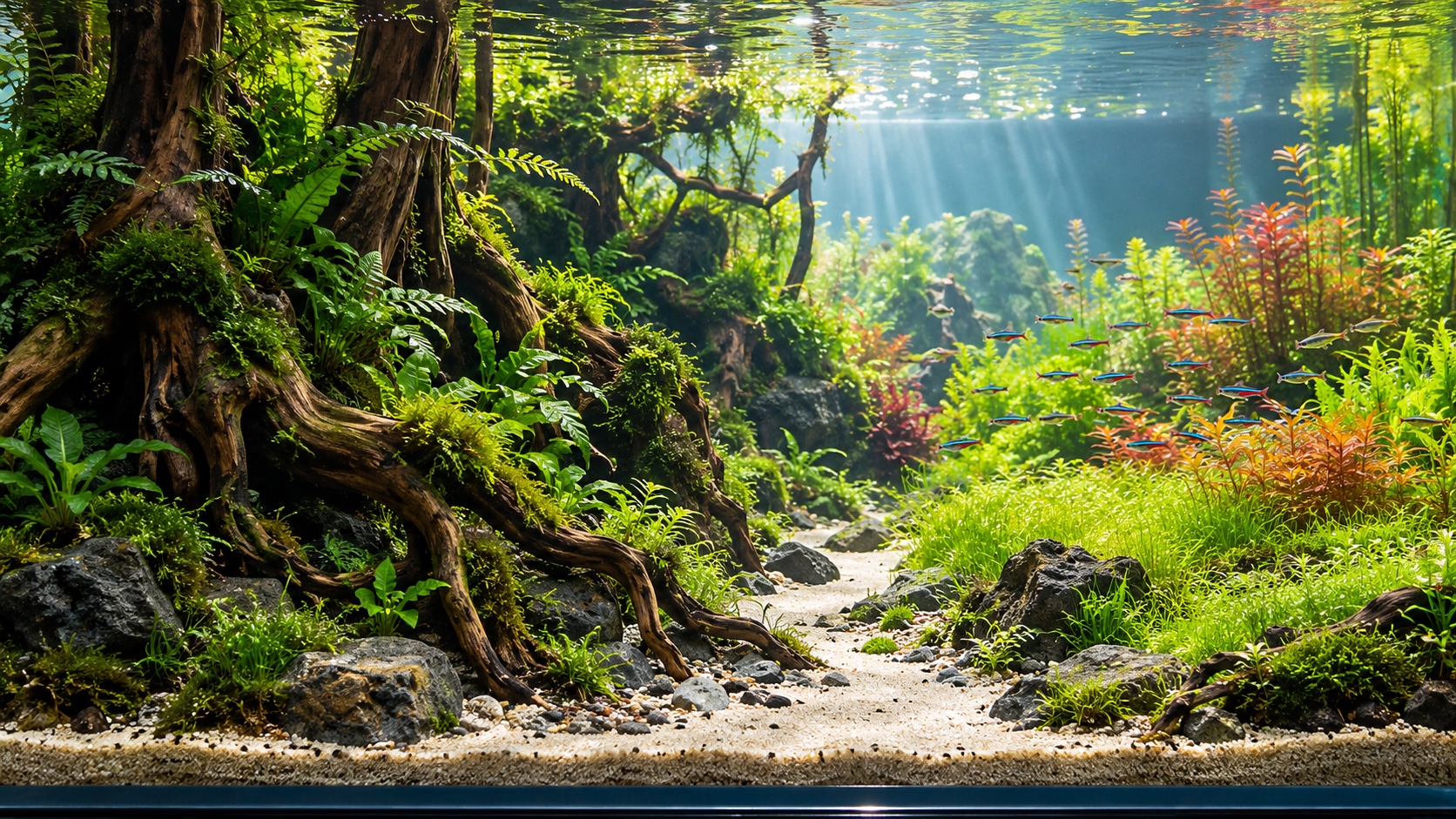
Imagine water sweeping around a bank. Place the largest stones on the outside of the implied bend, orient their strata consistently, and trail smaller pebbles toward the quieter inside edge. A curved band of sand or fine gravel can describe the channel, but it should change width and disappear behind a formation rather than run like a centered road to the back glass. Low grasses and compact stems along the banks make the channel legible without turning it into a hard border.
A Forest Edge With Vertical Rhythm
Use slender wood pieces as trunks, varying their diameter, height, and distance from the front. The arrangement should form clusters and openings rather than a uniform picket fence. Dark substrate, scattered leaf litter appropriate to the livestock, and small stones at trunk bases can suggest a flooded forest floor. Position the thickest trunk away from center and let several narrower pieces recede behind it to create depth.
Ferns, moss, and low crypts provide a convincing understory. A restrained background of fine stems can imply foliage beyond the trunks without burying them. The concept is particularly effective in taller aquariums, where vertical material uses the available height, but leave enough horizontal swimming room for the chosen fish. If tannins are part of the desired mood, confirm that the water chemistry and species selection are compatible rather than assuming every “forest” tank should be dark.
Maintenance depends on keeping trunk windows open. Moss expands outward, ferns produce plantlets, and background stems can close the brightest gaps. Thin from the base instead of simply shearing everything to the same height. The forest effect comes from alternating density and distance; once every opening is filled, the design becomes a wall.
An Open Meadow With a Distant Horizon
For a bright, spacious look, keep hardscape low and concentrate texture near the substrate. A few weathered stones can anchor the scene while dwarf sagittaria, hairgrass, Marsilea, or another suitable low plant creates the meadow. Raise the rear substrate and use slightly finer textures toward the back. A low horizon leaves generous open water and makes a small schooling fish appear to travel across a broad landscape.
Meadow layouts look simple but expose every inconsistency. Uneven carpet health, scattered algae, and a flattening slope are immediately visible. Select a foreground plant that fits the lighting and carbon dioxide plan rather than choosing solely by leaf size. Break the carpet with small bare patches or stones so it does not resemble artificial turf. A restrained secondary plant group can mark the horizon without competing with the openness.
A Rocky Ravine for Tanks With Real Depth
Place two unequal stone masses on opposite sides and allow a narrowing void to run between them. The closer mass should contain larger, more detailed stone; the distant end can use smaller fragments and finer plants. Overlap edges so the ravine bends or vanishes, preventing the viewer from seeing a flat endpoint. This is a strong choice for aquariums with generous front-to-back dimensions because the perspective can unfold in layers.
A Fallen Tree Scene Built Around One Piece of Wood
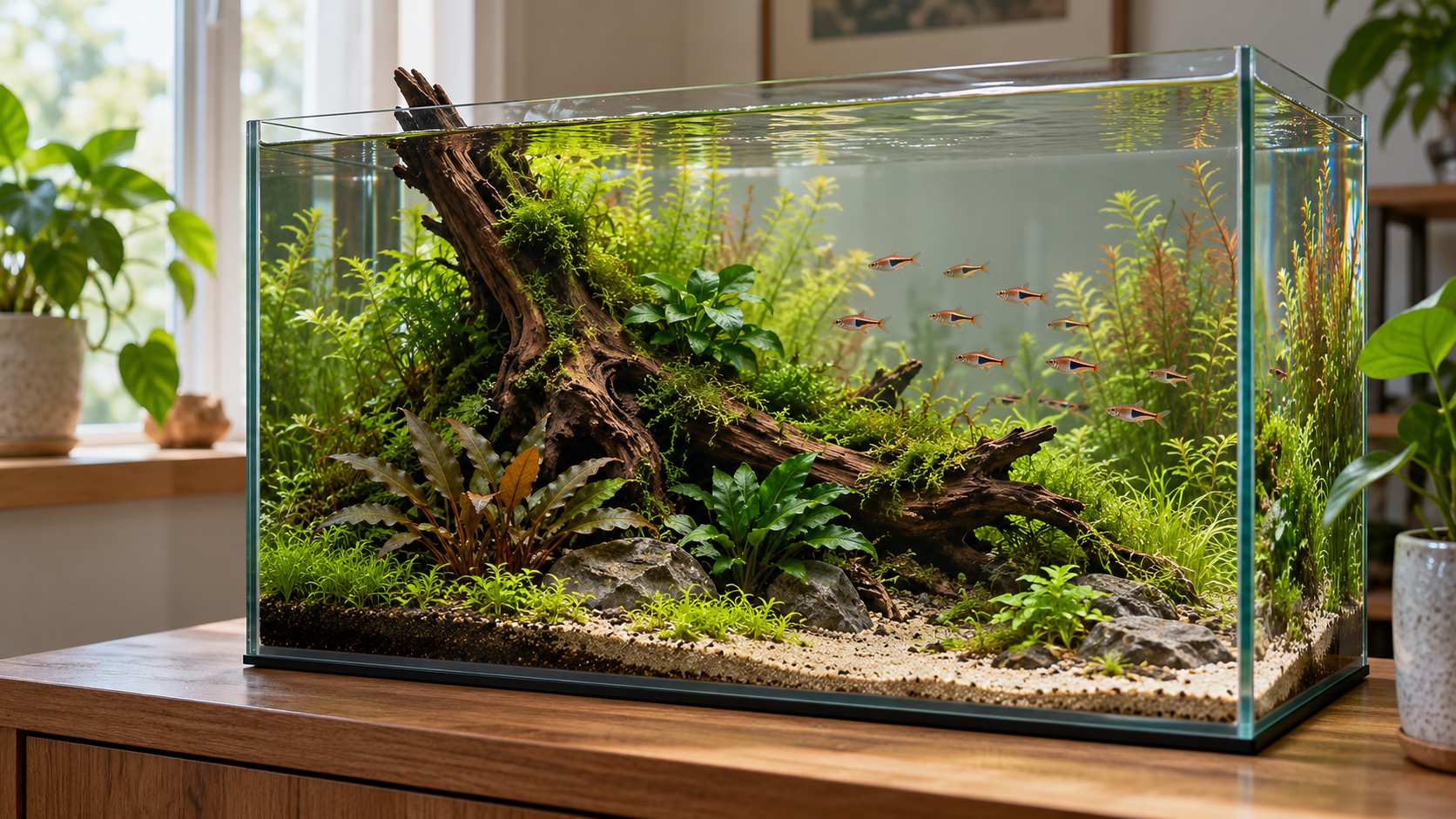
Let a long trunk or branch cross the composition diagonally as if it fell into shallow water. One end may disappear into a planted bank while the other reaches over open substrate. The wood must be securely anchored and placed so it does not divide the aquarium into two equal halves. Add a few stones where the trunk meets the ground to suggest weight and accumulated debris.
Plant selectively along the wood. Moss and small epiphytes can imply age, but leave enough bare grain to preserve the identity of the fallen tree. Taller plants behind the raised end help connect it to the background, while low crypts or grasses at the base soften contact with the substrate. This design accommodates a wide range of plant energy levels because its visual strength comes from the wood silhouette.
Check animal movement through and under the branches. Openings that look spacious when empty may become traps or dead ends after plants mature. Smooth sharp tips in active swimming routes and preserve broad passages during trimming. The most successful version feels sheltering without consuming all usable water.
A Stone Island Surrounded by Negative Space
Concentrate rock, soil, and plants into an off-center mound, then surround it with open sand or a very low foreground. The island can be compact and steep or long and gently sloped, but its base should vary rather than form a perfect oval. Use one dominant stone and several subordinate pieces that share its direction. Plant tallest near the structural peak and taper height toward the edges. Keep the mound asymmetric when viewed from above as well as from the front. A rear projection can hide the filter intake, while a lower front shelf carries the island visually into the substrate. This uneven footprint feels more like an eroded remnant and gives plants several distinct elevations to occupy.
Negative space is the main material in this idea. It creates calm, makes maintenance routes obvious, and gives bottom-level livestock visible room when appropriate. The open area will collect debris, so circulation and siphon access matter. Use a contained boundary under the substrate to slow soil migration, and remove runners that cross the edge before they become rooted throughout the sand.
A Green Canyon for Long Aquariums
Instead of a bare ravine, build two planted banks that frame a corridor of open water. Wood and stone beneath the vegetation maintain the bank shapes. Make the sides unequal: one can project forward and carry a broad-leaved focal plant, while the other recedes with finer stems. The corridor should turn or narrow in the distance, and the fish school becomes the moving subject within it.
A Seasonal Stream With Leaf Litter and Sparse Growth
Not every nature aquarium needs dense planting. A shallow-looking stream scene can use rounded stone, branching wood, sand, scattered botanicals, and plant clusters only where debris might naturally gather. This restraint highlights fish behavior and hardscape texture. Use only aquarium-safe leaves and seed pods, prepare them appropriately, and understand their effects on tannins and water chemistry.
Keep the litter intentional. A few overlapping leaves at root bases suggest current patterns; an even layer across the entire foreground can hide detail and trap waste. Replace decomposed botanicals gradually instead of refreshing everything at once. Plants such as selected crypts, epiphytes, or emergent-root effects can provide lasting structure while allowing the sparse substrate to remain visible.
This concept suits species that benefit from cover and subdued conditions only when their full habitat requirements are met. Do not select fish solely because they appear in photographs of wild streams. Research temperature, flow, group size, diet, and adult dimensions. A nature-inspired scene is most convincing when the animals can behave naturally within it.
A Mossy Boulder Field for Modest Equipment
Arrange rounded or weathered stones in a loose field with one clustered focal group. Attach moss to selected shaded faces and leave other surfaces bare. Small crypts, Anubias, or Bucephalandra between stones provide durable leaf contrast. Because the composition relies on hardscape and slower plants, it can suit moderate light and no injected carbon dioxide, though growth will be gradual and algae control still requires balance.
Avoid placing one plant on every rock. Instead, let greenery spread across connected areas as if moisture and shade favored particular pockets. Provide enough circulation around the bases to limit debris accumulation. When moss becomes thick, lift and thin it rather than repeatedly trimming only the surface, which can leave a weak brown interior.
Combine Ideas Through a Shared Landscape Logic
You can merge a root bank with a river bend or place a fallen trunk across a meadow, but the combination needs one dominant story. Repeat materials, align directional lines, and decide which idea controls the silhouette. If the tank contains a forest, ravine, island, and stream as four equal attractions, it will read as a catalog rather than a place. Test the concept against maintenance before building. Identify where the siphon reaches, how plants will be trimmed, which boundary must remain clean, and where fish can turn at adult size. Simplify any detail that depends on constant reconstruction. A strong freshwater aquascape gives growth room to enrich the original idea instead of forcing you to fight it every week.
Choose by Constraints, Then Make the Idea Your Own
Use the tank’s dimensions to narrow the field: tall tanks favor vertical forest rhythm, deep tanks reveal ravines, and long tanks carry channels and horizons. Use equipment and available care to choose plant energy. Finally, use your own materials and reference landscape to shape the details. Originality does not require inventing a new composition category. It comes from observing how a particular root turns, how your stones fit together, and how plants change the scene over time. The idea is only the starting grammar; the mature aquarium becomes your sentence.
Before committing, make a small comparison sheet with the two strongest concepts. List the hardscape already available, the plant energy each concept requires, the open swimming space it leaves, and the boundary work it creates. The better choice is usually the one that uses your tank’s proportions naturally and can still look intentional on an ordinary maintenance week, not only after a complete trim.