Design the Small Volume Around Stability
A nano aquascape can make a few stones, small plants, and tiny animals feel like an expansive underwater landscape, but its compact size leaves less room for mistakes. Temperature, salinity from evaporation, nutrients, waste, and equipment flow can change quickly. Materials that look modest outside the glass may dominate the entire footprint, while fish sold as small may outgrow it. Beginners succeed by choosing the inhabitants first, using a restrained composition, providing accessible filtration and maintenance, and treating top-off, feeding, and observation as precision tasks rather than scaled-down versions of casual large-tank care.
A: There is no universal cutoff; care sensitivity and livestock suitability matter more than one number.
A: Not automatically. Small volumes can change quickly and require precise feeding, dosing, and top-off.
A: Only when adult size, groups, behavior, waste, and swimming needs genuinely fit the usable volume.
A: The short viewing distance and limited footprint magnify material size and reduce surrounding negative space.
A: No. Top-off replaces evaporated water, while water changes remove and dilute dissolved waste.
A: Use one when livestock and evaporation warrant it, while managing heat, gas exchange, access, and light.
A: Trim whenever growth begins to block flow, light, surface access, or the designed open areas.
A: No. It must provide enough capacity and appropriate flow for the selected livestock and layout.
A: Yes, but the small volume demands precise equipment, conservative changes, and close livestock observation.
A: Controlled scale, overlap, narrowing paths, fine textures, and protected negative space create depth.
Define Nano by the Care Demands
There is no single universal volume that makes an aquarium “nano.” What matters is how quickly the system changes and which species it can support. A compact tank magnifies evaporation, dosing error, heat gain, overfeeding, and livestock incompatibility.
Measure actual filled volume after substrate and hardscape displacement. Use that value for conditioner, fertilizer, medication when appropriate, and water-change calculations. The number printed on the tank may overstate usable water.
Choose a location away from direct sun, drafts, unstable furniture, and frequent impact. A small aquarium still becomes heavy and must sit level on suitable support. Leave access above and behind it for tools and equipment.
Select Livestock Before Materials
Research adult size, social group, swimming distance, territory, temperature, current, cover, feeding, and waste production before building the layout. Some nano tanks are better suited to shrimp, snails, or a carefully chosen single small species than to a mixed community.
Use One Primary Shape
A compact footprint cannot support many equal focal points. Choose a stone ridge, root arc, island, or open valley and let secondary pieces reinforce it. Check the shape from the seated viewing height.
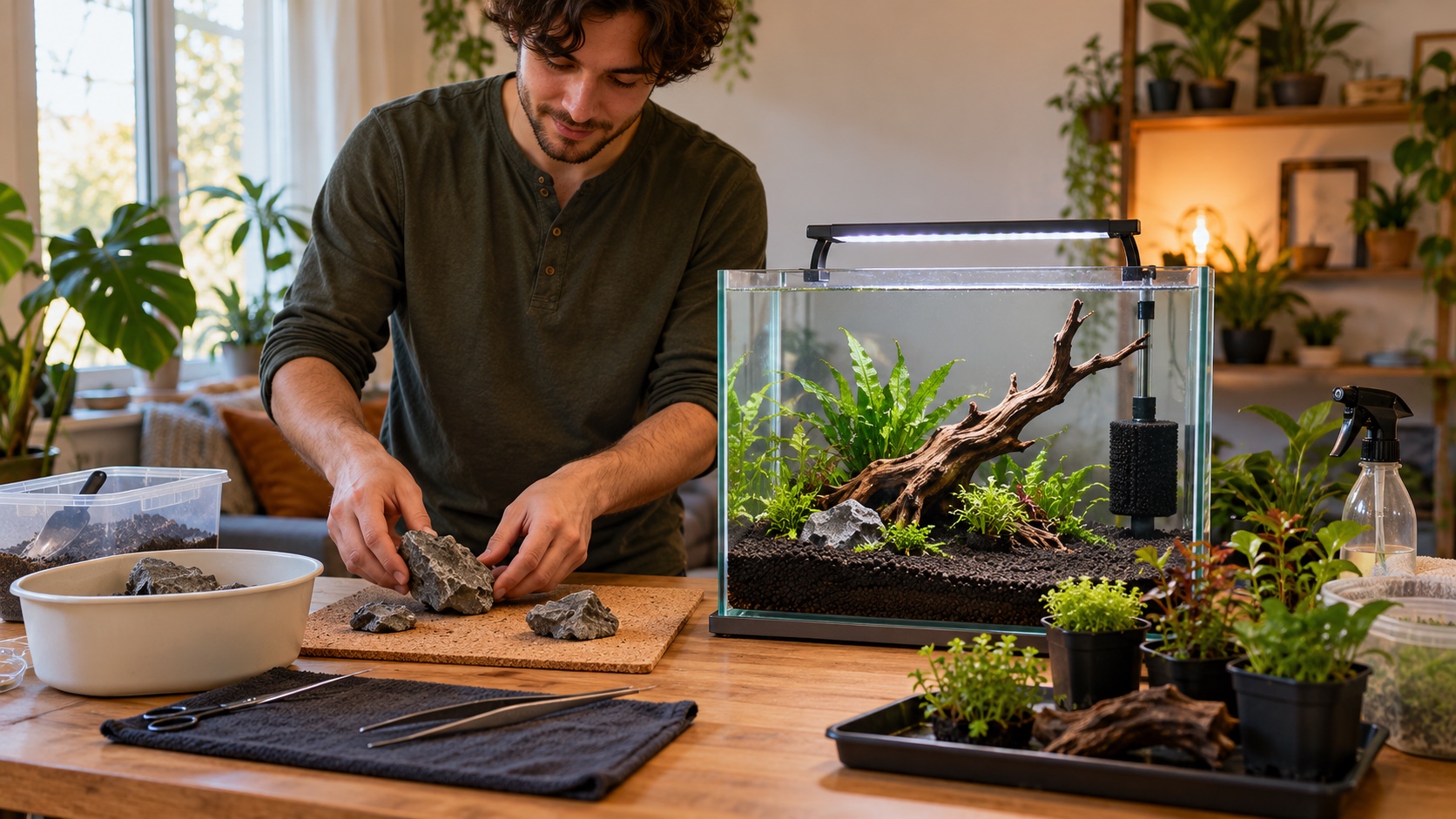
Scale materials inside a cardboard outline before purchase. Small stones often lose presence after substrate rises; oversized wood may leave no swimming or planting room. Keep the strongest piece proportional to the front pane.
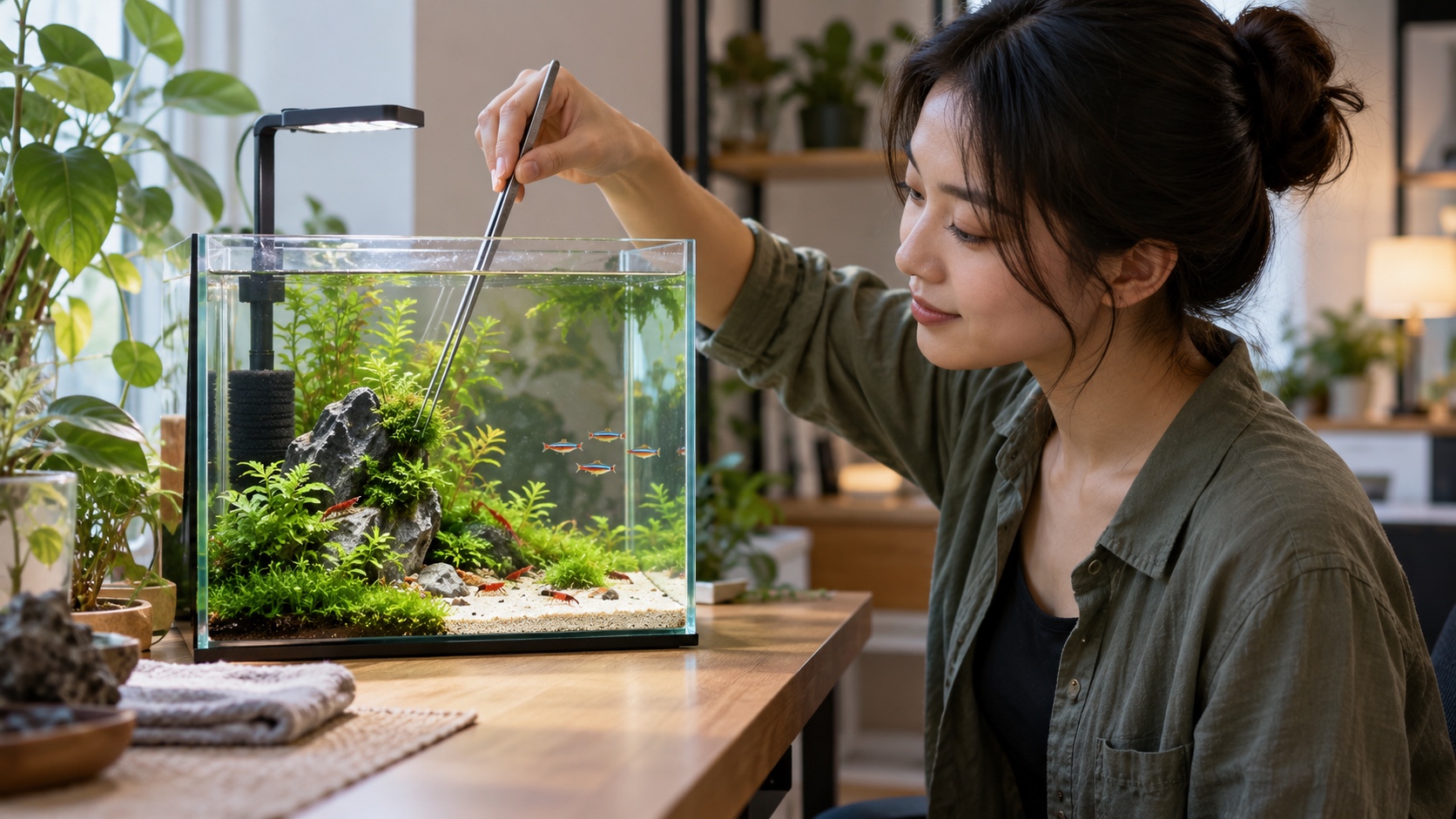
Preserve a maintenance route. Tweezers, siphon, algae tool, and fingers need entry without striking the light or hardscape. Dense beauty that cannot be reached will decline rapidly in a small volume.
Leave deliberate open substrate. It makes the scene feel larger, provides feeding visibility, and prevents every surface from becoming a waste trap. Negative space is especially valuable when glass boundaries are close.
Choose Substrate for Scale and Plants
Grain size affects the perceived landscape. Coarse gravel can make miniature stones look smaller, while very fine material may compact or move easily. Match substrate to livestock and plants first, then to visual scale.
Create slopes conservatively. Deep rear substrate reduces water volume and may shift without support. Use stable aquarium-safe structure where required and keep the front depth sufficient for chosen roots.
Plant With Small Leaves and Predictable Growth
Select species that can remain proportionate after maturity and trimming. Petite epiphytes, compact crypts, mosses, and manageable stems can create layers without consuming the tank. Confirm that a “mini” trade name describes the actual plant.
Group repeated species instead of collecting single specimens. Repetition enlarges the visual world. One fine texture traveling from foreground to hardscape can connect the whole layout.
Anticipate faster boundary loss. A few runners can cross the entire foreground, and floating plants can cover the surface quickly. Weekly thinning may be necessary even when overall growth seems slow.
Size Equipment for Livestock and Layout
Filtration must provide biological capacity and appropriate circulation without pinning animals or uprooting substrate. Use guards where shrimp or fry require them. A small sponge filter, internal filter, or gentle external option can work when matched to the tank. Consider maintenance access and power-loss behavior as well as rated flow. A filter packed behind hardscape may be impossible to clean without rebuilding the scene. Direct the return across the footprint without turning the short tank into a constant high-current channel. Watch fine plants and animal posture at full output. If flow must be reduced severely to be tolerable, confirm that biological capacity and oxygenation remain adequate rather than assuming the label’s maximum rating solves both.
Control Light Before Algae Finds the Margin
A compact fixture can produce high intensity at shallow depth. Begin with conservative output and duration. Observe new plant growth across the footprint rather than assuming a small lamp is weak.
Keep the tank away from uncontrolled window light. Several hours of seasonal sun can add heat and energy that the timer does not record. Use the aquarium fixture as the primary controllable source.
Make Evaporation a Daily Observation
Evaporation removes water but leaves dissolved minerals behind. Top off with suitable water for the system; do not count top-off as a water change. Mark or remember the normal waterline so equipment remains submerged correctly.
A lid can reduce evaporation and jumping risk but may affect gas exchange, heat, light transmission, and access. Choose one according to livestock and equipment. Clean condensation and mineral deposits without introducing household chemicals.
Watch room heating and cooling cycles. Small tanks follow environmental temperature more readily. Verify heater accuracy where one is needed, and never use a device too powerful to control the volume safely.
Plan for travel. Automatic top-off can help only when installed and tested correctly; an oversized reservoir or faulty sensor can create a different hazard. A trained caretaker with clear instructions may be the safer answer.
Feed for the Animals, Not the Tank’s Appearance
Small systems are easy to overfeed. Offer an amount the inhabitants can consume appropriately and remove persistent leftovers. Observe shy bottom dwellers without scattering excess food through inaccessible plants. Use a dedicated tiny spoon or measured portion so different caretakers do not interpret a pinch differently. Rotate foods according to species needs while keeping total intake controlled. Watch whether pellets roll behind stone or into the filter. A feeding dish can help some shrimp setups, but it must be cleaned and should not become another object that traps waste. Schedule one observer rather than several household members feeding independently.
Use Small, Measured Maintenance
Prepare replacement water carefully so temperature and chemistry shifts remain appropriate. A modest absolute volume can still represent a large percentage of the tank. Measure rather than estimating from a bucket.
Siphon open areas gently and inspect beneath removable shelters. Avoid uprooting the entire planting at once. Rotate deeper work so biological and root-zone continuity remains.
Trim before plants block flow or the surface. Collect every fragment because a loose stem can clog a small intake quickly. Use tools sized for the tank to avoid crushing neighboring groups.
Respond to Instability With Fewer Variables
When animals or plants decline, verify temperature, filter operation, ammonia, nitrite, water level, dosing, and recent maintenance. Correct immediate welfare hazards first. Do not add several products to a tiny volume without identifying the cause. Confirm test validity and units before making a large percentage water change or medication decision. Check for a dead snail, blocked intake, hidden food, heater drift, or an accidental double dose. Move animals only when the temporary container is suitable and transfer itself is safer than remaining. Small-volume emergencies reward a prepared sequence: restore oxygen and temperature, remove the source when known, use appropriate conditioned water, and observe before adding another variable.
Keep a log of water changes, feeding, fertilizer, top-off, trims, and livestock observations. In a small aquarium, a missing day or double dose can matter. The record helps distinguish a system trend from one unusual observation.
Let the Nano Aquarium Mature Without Crowding
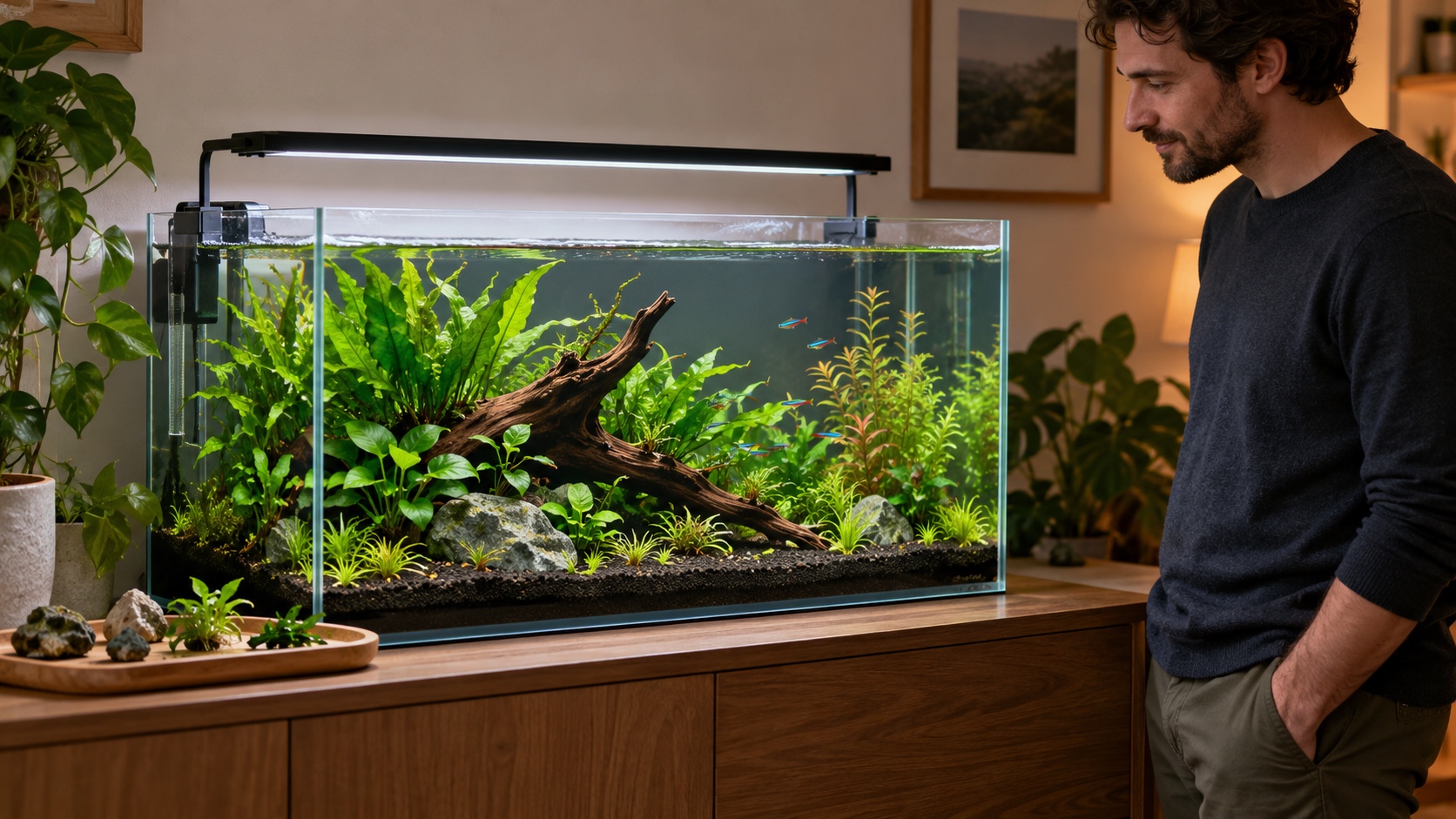
Photograph the same view weekly. Watch how the main silhouette changes as moss thickens, stems branch, and runners spread. Remove growth that erases the intended open space before it becomes a major reconstruction. Include the waterline and equipment in at least one record image so evaporation and component drift are visible. Note the date relative to the last trim and water change. A compact tank can look transformed by one plant leaning forward, so compare several weeks rather than reacting to one frame. Use the series to decide whether a group needs thinning, relocation, or replacement with a slower species. The goal is to preserve depth and access while allowing the aquarium to look mature rather than permanently new.
Reassess livestock as the tank matures. Plants and hardscape reduce usable swimming volume, while territories become more defined. Adult behavior, not juvenile store size, determines whether the community remains appropriate. Observe feeding competition, resting positions, surface use, and conflict throughout the day. Shrimp and snails may reproduce, adding biomass that was not present at setup. A fish that was calm when young may claim the only cave or open route later. Do not solve a space problem by adding more decorations. Thin plants, improve sight lines, or rehome animals responsibly when the usable habitat no longer meets their needs.
Check equipment guards, suction cups, tubing, heater placement, and cords monthly. A shifted component occupies a larger portion of a nano tank and can create strong local flow or heat. Clean intakes before reduced flow changes oxygenation, and replace hardened suction cups before equipment falls onto livestock or plants. Verify that the light remains centered after maintenance and that condensation does not reach unsafe electrical areas. Where a heater is required, compare its reading with a separate reliable thermometer and watch for rapid cycling. Secure tubing without creating a siphon path onto the floor. Small equipment deserves full-size safety attention because the water volume offers less buffering when it malfunctions.
Keep plant goals moderate enough for ordinary life. A tiny high-energy carpet can demand precise carbon and fertilizer control. A slower moss-and-epiphyte layout may offer equal visual scale with more forgiving operation. Match the design to the keeper’s travel, work schedule, and willingness to measure small doses. Prepare maintenance water before touching the tank so the intended change can be completed without delay. Use syringes or graduated containers dedicated to aquarium products when tiny quantities matter, and label them clearly. Never improvise concentrated dosing from memory. A modest layout that tolerates a delayed trim is more resilient than one whose appearance and livestock safety depend on daily perfection.
A successful nano aquascape is not a miniature excuse to ignore full aquarium responsibilities. It is a deliberately limited ecosystem whose volume, inhabitants, materials, equipment, and care schedule agree. That agreement creates both the illusion of a larger landscape and the stability that keeps its life healthy. Build an emergency plan proportional to the risks: suitable replacement water, a safe temporary container, battery-supported aeration where outages warrant it, and contact information for an experienced caretaker. Explain the difference between top-off and water change, the exact feeding amount, and the signs of filter or temperature failure. Test the plan before travel. When daily observations, measured maintenance, restrained stocking, and accessible design become routine, the small volume stops feeling fragile and begins behaving predictably. Keep a short log of temperature, water tests, maintenance, feeding changes, livestock observations, and equipment interruptions. The record makes gradual drift visible before memory turns it into a surprise. Review the log alongside monthly photographs to separate harmless visual aging from declining plant health or shrinking access. If the routine repeatedly exceeds the time available, simplify the livestock, planting, or equipment arrangement instead of skipping care. A beginner-friendly nano tank is one whose essential tasks remain easy on an ordinary week.