Blackwater Is a Habitat Choice, Not a Dirty-Tank Effect
A blackwater aquarium recreates selected qualities of forest streams and flooded margins where leaves, roots, and wood release tannins and other dissolved compounds into soft, tea-colored water. The amber tint can make fish colors glow and produce a quiet, sheltered atmosphere, but appearance alone does not define the habitat. A successful setup still needs reliable filtration, oxygenation, stable chemistry, appropriate livestock, and controlled decomposition. Beginners should resist treating botanicals as decorations that can be added by the handful without preparation or observation. This guide explains how to plan the water, substrate, wood, leaf litter, lighting, plants, fish, and maintenance as one system so the aquarium remains intentional, healthy, and understandable.
A: No. Intentional tint can coexist with clean, oxygenated, biologically stable water and controlled organic material.
A: Their effect depends strongly on the material and the water's buffering, so test rather than assume.
A: Use a tint that supports the habitat while allowing observation of fish, food, and maintenance conditions.
A: It can when its treated chemistry suits the chosen species and remains stable under the botanical load.
A: Preparation varies by material; boiling may help some sink but also removes color and speeds breakdown.
A: Use it for a specific removal need, recognizing that it can reduce the tannins you intend to keep.
A: Yes, when species are matched to the light, temperature, mineral level, and acidity of the planned tank.
A: Rotate them gradually as they skeletonize or when their decay exceeds the look and processing capacity you want.
A: Use a controlled cycling method with filtration and testing; botanicals alone do not prove waste processing.
A: Moderate botanical load, adequate oxygen, compatible livestock, measured chemistry, and consistent maintenance create stability.
Understand What Creates the Amber Water
Leaves, seed pods, bark-like botanicals, and driftwood can release tannins and humic substances as they soak and decompose. These compounds color the water from pale gold to deep brown. The exact effect depends on the material, quantity, age, water chemistry, filtration, and water-change schedule. Color can fade as materials exhaust or activated carbon removes dissolved compounds.
Tannins are not a replacement for cycling or maintenance. Dark water can still contain dangerous ammonia or nitrite, and clear water can still be chemically unsuitable. Test important parameters and watch animal behavior rather than using color as a health gauge. Blackwater should look deliberate, not become an excuse to leave waste hidden among leaves.
Choose the Habitat and Livestock Together
Decide whether the aquarium suggests a shallow forest stream, root-filled bank, leaf-litter pool, or flooded woodland margin. Then research species associated with similar conditions, while checking captive-care requirements from reliable sources. Fish sold as “blackwater” do not all share the same temperature, adult size, group needs, diet, or chemistry tolerance. Plan the social structure before decoration. Schooling fish need an adequate group and open route, territorial species need sight breaks, and bottom-oriented animals may need a particular sand texture. The wood and leaves should create useful shelter without reducing the remaining water volume below what the animals require.
Know Your Starting Water Before Trying to Soften It
Measure the source water’s hardness, alkalinity, and pH. In water with substantial buffering, a few leaves may darken the tank without greatly lowering pH. In very soft, weakly buffered water, decomposition and added acids can shift pH more readily. Beginners should prioritize stability and species-appropriate conditions over chasing an exact wild number.
Do not use unmeasured acids or rapid chemical correction to force a low pH. If softer water is genuinely required, learn a controlled method such as blending suitable purified water with source water and remineralizing to a planned range. Changes should be reproducible at every water change. Very low-mineral systems demand careful monitoring because they have less buffering against swings.
Temperature affects metabolism, oxygen availability, and decomposition. Set the heater for the chosen species and verify it with a reliable thermometer. Warm water holds less dissolved oxygen, so surface movement and stocking restraint remain important even in a visually still forest scene.
Select a Substrate That Supports the Story
Fine natural-colored sand often suits blackwater displays because it resembles deposited stream material and keeps leaf litter visually distinct. Choose grain size according to the needs of bottom-dwelling animals. A thin layer is easier to manage than a deep compacted bed unless the design and planting require greater depth.
Dark gravel or planted substrate can work, particularly where rooted crypts will grow, but bright multicolored aggregate may fight the subdued habitat. Keep nutrient-rich soil contained beneath a suitable cap if exposed soil would cloud the water or alter chemistry unexpectedly. Plan where debris can be siphoned without stripping the entire leaf layer.
Use Wood to Create Shelter and Direction
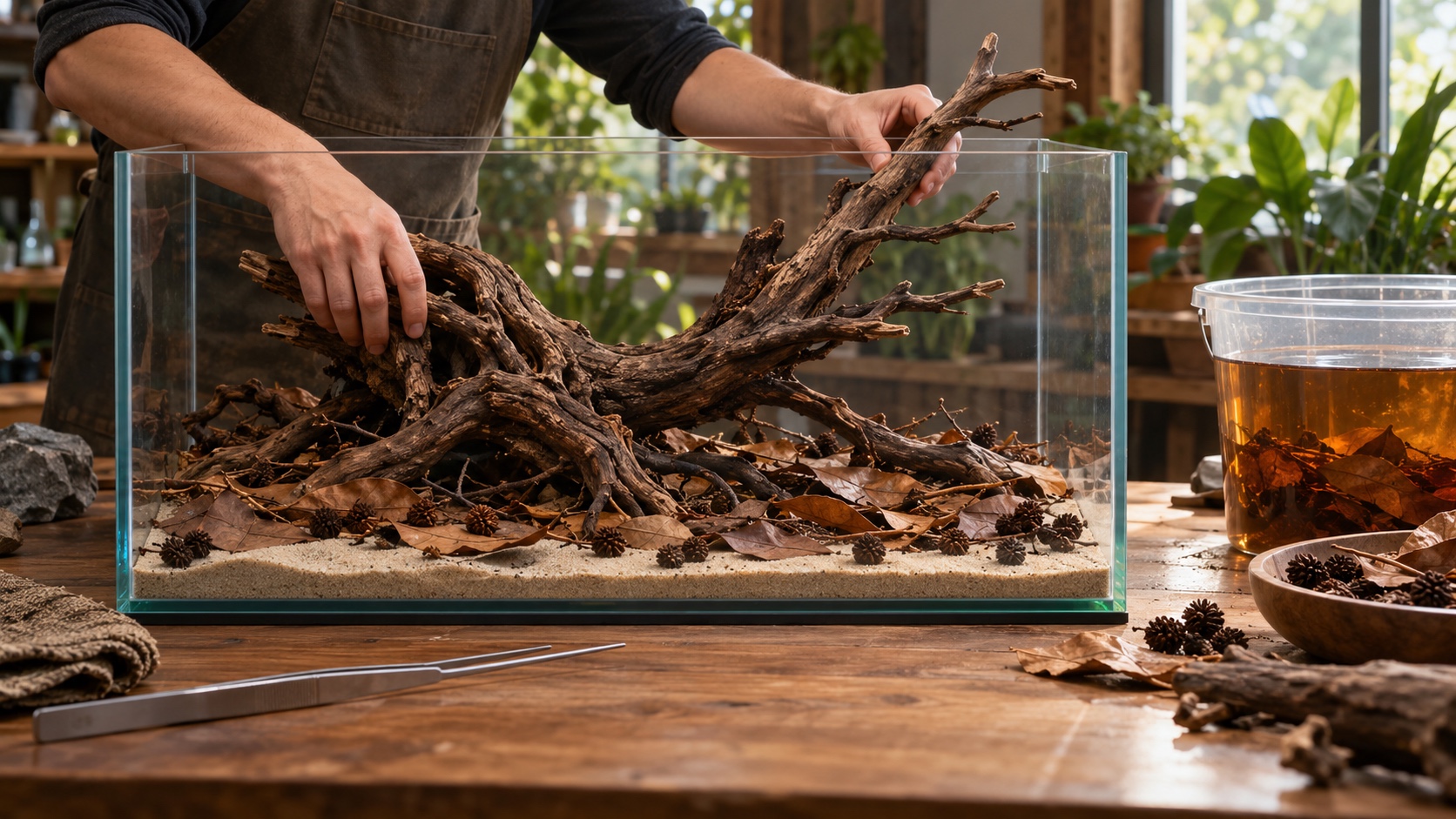
Arrange driftwood as roots entering from a bank rather than as a symmetrical centerpiece. Let the largest mass occupy one side and send finer branches across the upper or middle water, preserving an open swimming corridor. Secure buoyant pieces before filling and ensure no branch can roll toward the glass.
Source Botanicals Safely
Use materials sold for aquarium use or collected only when identification, contamination risk, and legality are certain. Avoid roadside leaves, pesticide-treated landscapes, toxic species, moldy material, and unknown pods. “Natural” does not automatically mean aquarium-safe. Different botanicals break down at different rates and may affect water differently.
Rinse and prepare materials according to their type and trusted guidance. Boiling may help some leaves sink and can reduce surface organisms, but it also releases color and may shorten their useful life. Other botanicals need soaking, scrubbing, or simple inspection. Preparation is not a universal sterilization recipe.
Begin with a modest quantity. Add a few pieces, observe color, water tests, odor, biofilm, and animal response, then build the litter gradually. A deep layer added at once introduces a large organic load and can consume oxygen as it decomposes. Controlled addition teaches how the particular tank processes material.
Arrange Leaf Litter as Habitat, Not Confetti
Place larger leaves where slow current might gather them: beneath roots, along a bank, and in selected foreground pockets. Overlap some leaves and leave stretches of sand visible. The open areas improve contrast, allow feeding observation, and provide maintenance access.
Small fish and invertebrates may investigate the biofilm and microfauna associated with decomposing litter, but botanicals do not replace a complete diet. Remove material that develops an abnormal foul odor or decay pattern, and understand which softening and skeletonization changes are normal for the chosen leaves.
Filter Without Stripping the Habitat
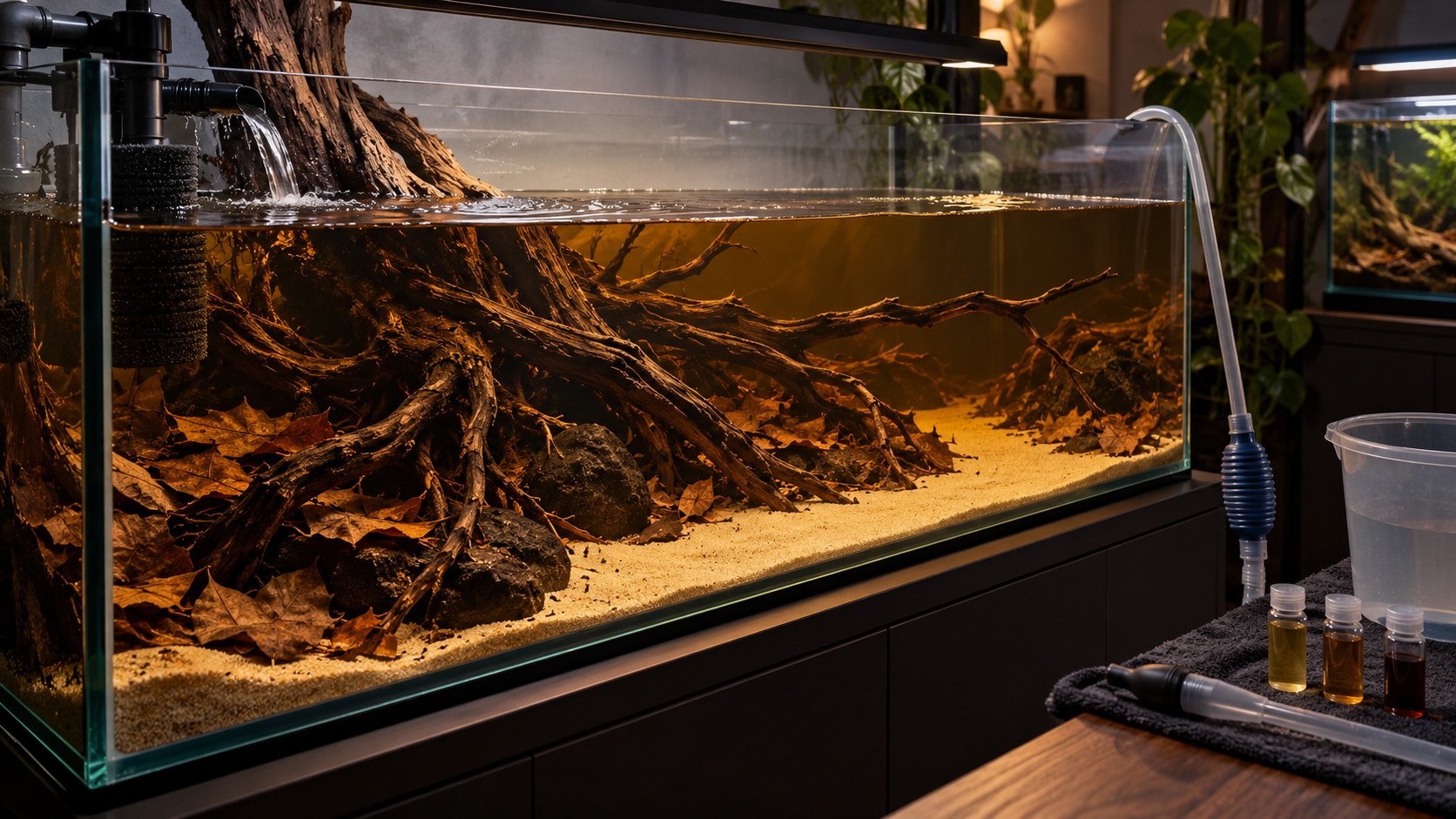
Use dependable biological and mechanical filtration sized for the livestock and tank. A sponge filter, hang-on-back unit, or canister can all work when flow and intake safety are appropriate. Aim for circulation that distributes oxygen and moves fine waste without blasting leaf litter into a pile.
Activated carbon and some resins remove tannins, so they may conflict with the desired appearance. Keep them for specific needs rather than using them automatically. Mechanical media can capture debris while mature biological media processes waste. Clean media in stages and avoid washing away the entire bacterial community.
A slight surface ripple supports gas exchange. The scene can look calm without stagnant water. Watch for protein film, gasping fish, sluggish behavior, or areas where decomposing material accumulates without movement. Adjust flow or remove excess organics before adding more aeration solely as a visual afterthought.
Light the Aquarium Like a Forest Margin
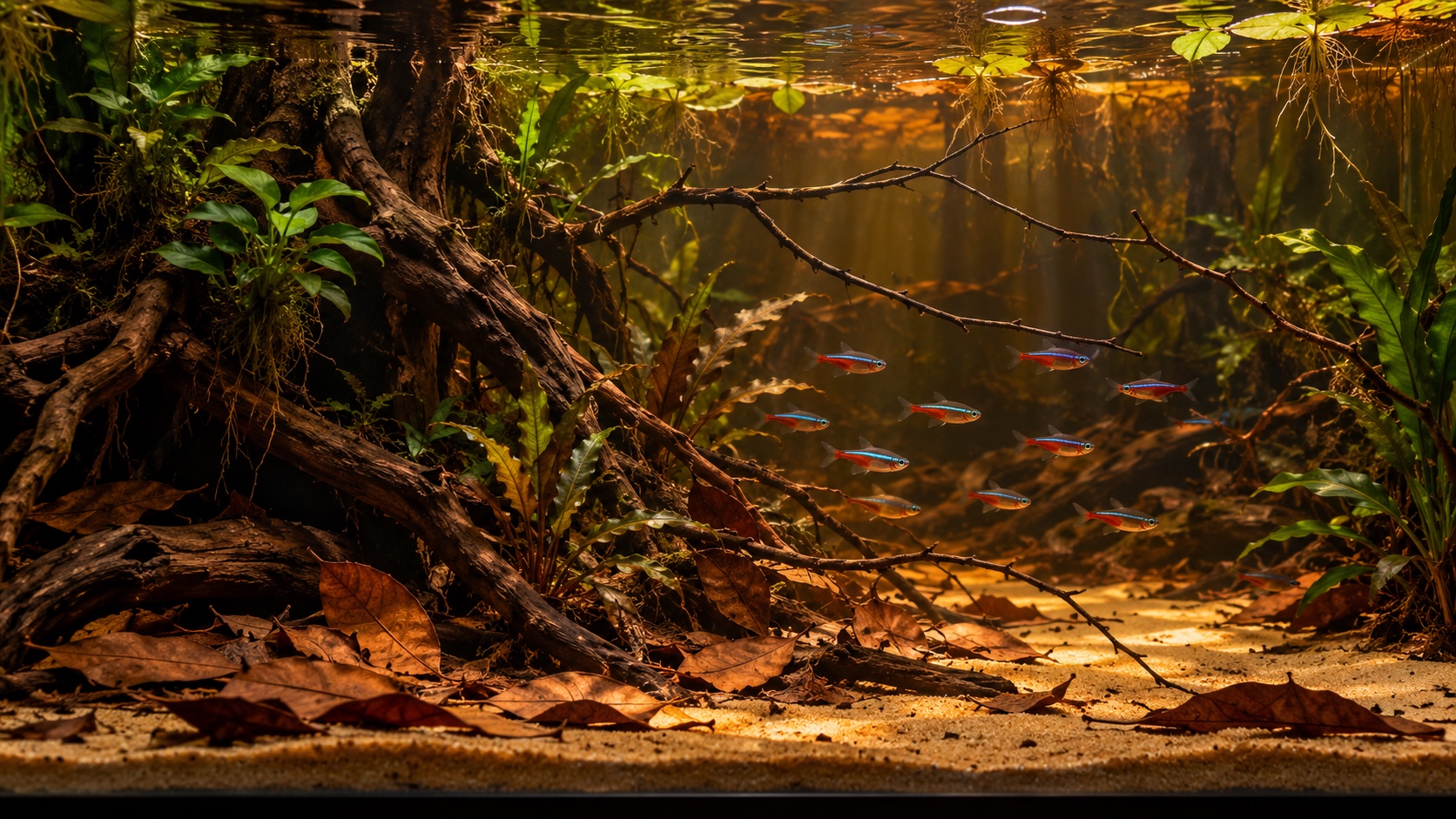
Use moderate or subdued lighting that reveals fish and wood without bleaching the amber atmosphere. Floating plants can create dappled shade, but they must not cover the entire surface or block gas exchange and feeding access. A dark background and controlled room reflections deepen the scene more effectively than extreme water tint.
Set the photoperiod with a timer and observe how fish behave at transition times. An abrupt jump from a dark room to bright aquarium light can startle sheltered species. Ambient room light before and after the main period can provide a gentler transition without extending strong plant-driving intensity all day.
Choose Plants That Accept the Conditions
Some blackwater habitats are sparsely planted, and a tank does not need dense greenery to be complete. If plants are used, choose species that tolerate the planned light, temperature, hardness, and acidity.
Selected Cryptocoryne, Java fern, Anubias, mosses, or floating plants may fit particular setups, but verify each species rather than treating the list as universal.
Attach epiphytes with exposed rhizomes and keep leaf litter from smothering small crowns. Plants in dim amber water may grow slowly, so avoid dosing or lighting changes based on impatience. Healthy new leaves and stable roots matter more than rapid coverage.
Cycle Before the Color Becomes Convincing
Set up filtration and establish biological processing before stocking. Botanicals can contribute organics, but they are not a controlled substitute for an appropriate cycling method. Test ammonia and nitrite until the system handles the expected waste reliably. The water may look mature within days while the biofilter remains young.
Add fish gradually after the tank meets their temperature, chemistry, space, and social needs. Quarantine when possible. Dim lighting and shelter can reduce visual stress for some species, yet crowding or incompatible groups will not be solved by darker water.
Feed and Observe in Tinted Water
Offer a complete, species-appropriate diet and confirm that food is being eaten. Dark substrate and leaf litter can hide leftovers.
Feed in a consistent visible area or use small portions so waste can be tracked. Siphon persistent uneaten material without removing every botanical.
Use a flashlight briefly from the side during routine inspection if the amber water and roots conceal fish. Count the group, check body condition, fins, breathing, and response to food, then return the aquarium to its normal light. A habitat that provides cover should not prevent the keeper from noticing illness or loss.
Refresh Botanicals Gradually
Leaves soften, fragment, and eventually contribute less color. Replace a portion at a time rather than stripping and renewing the entire litter bed. Gradual rotation keeps the habitat visually stable and avoids a sudden change in organic load. Keep notes on how quickly each material breaks down in your water.
Water changes remain part of blackwater care. Match temperature and chemistry, add replacement water gently, and expect the tint to lighten temporarily. If you precondition change water with botanicals, use a controlled, repeatable method and keep containers clean. Never assume dark replacement water has safe parameters without testing.
Distinguish Normal Biofilm From Warning Signs
Fresh wood and botanicals may develop pale biofilm as microorganisms colonize their surfaces. It can be removed during maintenance and often declines as the system matures.
Normal earthy smells differ from strong rotten odors. Cloudiness, oxygen distress, rising ammonia, or rapid decay after a large botanical addition requires action.
Remove the suspected excess material, increase gas exchange when needed, test the water, and perform an appropriate water change. Do not cover a deteriorating system with more tannins. The safest blackwater aquarium is one whose keeper can see past the color and read the biology.
Let Restraint Create the Atmosphere
A convincing beginner blackwater tank may contain one strong root mass, a limited leaf layer, open sand, a few shade plants, and one compatible fish group. Depth comes from shadows and overlapping branches, not from filling every gap. The water color should support the habitat rather than become the only feature.
Allow the scene to age visibly without surrendering oversight. Fresh leaves will settle, surfaces will develop film, and the tint will change between water changes. Photograph the aquarium under the same light once a week. The sequence makes gradual darkening, litter accumulation, or loss of open sand easier to recognize than daily viewing.
When chemistry stays stable, oxygen remains adequate, fish behave normally, and decomposition proceeds at a controlled pace, the aquarium can mature gracefully. The amber water then records a working relationship among wood, leaves, microbes, plants, and careful maintenance. That living process is the real appeal of blackwater keeping.
Keep a simple monthly record of pH, conductivity when available, water-change volume, botanical additions, and fish observations. The notes make slow trends visible before they become emergencies and help you repeat the combination that works. Consistency matters more than chasing an exact shade of tea-colored water.