The Best Material Is the One That Fits the Whole System
Freshwater hardscape materials do more than decorate an empty tank. Stone can change water chemistry, wood can float and release tannins, and substrate can affect plants, bottom-dwelling fish, maintenance, and the stability of every object above it. That means there is no single best rock, branch, or gravel for every aquarium. The strongest choices match the animals, planting method, water goals, layout style, equipment, and amount of maintenance the keeper can provide. This comparison looks at the useful qualities and limitations of common material families so you can build a coordinated palette instead of collecting attractive pieces that create conflicting demands.
A: A verified aquarium-suitable inert stone is a strong candidate, but every actual specimen still deserves inspection and testing.
A: No. It can suit hard-water species and designs where its effect on hardness and alkalinity is intentional.
A: Density and dryness vary even within a wood family, so test each piece and plan secure support rather than assuming.
A: Only when its composition, contamination history, grain shape, and effect on water are appropriate and reliably verified.
A: Neither is universally better; plant species, nutrient strategy, root access, livestock, and maintenance determine the fit.
A: Its low weight and texture can create hidden volume, provided pieces are contained and cannot damage glass or emerge unexpectedly.
A: One family usually produces stronger geological unity, though deliberate mixtures can work when their origin and visual relationship make sense.
A: Use gentle transitions, buried dividers or stones, controlled flow, and realistic expectations for occasional edge restoration.
A: No. Preparation cannot correct uncertain identity, pollution, chemical treatment, or naturally unsuitable material.
A: The palette coordinates chemistry, structure, animal welfare, planting, scale, and care rather than optimizing one object's appearance.
Judge Materials by Function Before Appearance
Begin with the tank’s nonnegotiable requirements. Adult fish size, digging behavior, delicate barbels, territorial boundaries, water hardness, plant nutrition, and cleaning access narrow the material list quickly. A sharp dramatic stone may be wrong for a fish that rests against the bottom. Loose fine soil may be wrong beneath a large burrowing cichlid. Suitability comes before visual style.
Then define what each material must do. One group of rocks may support a slope, a branch may create overhead shelter, and a sand area may keep feeding visible. Avoid asking every piece to be a focal point. The most useful hardscape palette usually combines a limited geological or woody family with a substrate that supports it physically and biologically.
Inert Angular Stone Offers Structure Without Intended Chemistry Change
Dense, aquarium-suitable silicate stones such as many granites, slates, and volcanic rocks can provide reliable structure when they are clean and stable. Their angular faces suit mountain, ravine, and fractured-bank layouts. “Inert” should still be verified for the actual specimen, because trade names are inconsistent and mineral veins may differ within a batch. Inspect every piece for metallic staining, crumbling seams, oily residue, and sharp points. Place heavy rock on protected stable support, not on loose substrate that can be excavated underneath it.
Calcareous Rock Works Best When Harder Water Is Acceptable
Limestone, coral-based rock, and other calcium-carbonate-rich materials can raise hardness and alkalinity as they dissolve. That behavior may be useful in tanks designed for hard-water species, where the rock supports both appearance and chemistry. It is a poor automatic choice for a soft-water plan that would require constant correction against the material.
Acid fizz tests can suggest carbonate content, but they do not replace monitoring in the intended water. A sample-soak comparison is more informative: test identical containers of source water with and without the cleaned stone over several days, checking hardness, alkalinity, pH, and conductivity. The change under aquarium conditions matters more than the label at the store.
Calcareous stone often has porous texture that accumulates algae and detritus. Decide whether that aging suits the layout and whether the surfaces can be cleaned without destabilizing the formation. Never use a chemistry-active rock as a substitute for a complete water-management plan; dissolution rates shift with pH, surface area, and water changes.
Rounded River Stone Creates a Softer, Current-Worn Landscape
Smooth cobbles and pebbles work well in stream, shoreline, and low-relief layouts. Their rounded surfaces are often easier on fish than jagged fragments, though any piece still needs inspection. Use a range of related sizes so large stones appear naturally embedded among smaller ones. Equal isolated cobbles can resemble a display of samples rather than a riverbed.
Rounded stones roll more readily than flat-based pieces. Seat them into substrate and lock important groups with hidden smaller stones. Avoid unstable towers. Their weight can compact fine substrate and create debris pockets, so preserve flow routes and leave room for a siphon between accessible groups.
Volcanic Rock Is Valuable for Texture and Hidden Support
Lava rock is lightweight for its volume, highly textured, and useful as a concealed slope core or visible rugged material. Its pores provide surface area but can trap debris, and broken edges may be abrasive. Rinse thoroughly, brush out dust, and inspect cavities before use. Because porous rocks vary, confirm the specific product is aquarium-suitable. When used beneath soil, contain pieces so plant roots and maintenance do not expose a patchwork foundation.
Branching Wood Builds Direction and Overhead Cover
Manzanita-style branches and other aquarium-suitable branching woods create open frameworks without a massive visual base. They are effective for forest canopies, root tangles, and directional compositions. Dry branches may float strongly, so soak or fasten them to a stable aquarium-safe base. Check thin forks for fish traps and leave clearance from the glass.
Some wood releases tannins heavily, while other pieces color the water only lightly. Tannin release is not harmful by definition, but it changes the intended appearance and may influence water management. New wood commonly grows pale biofilm as it becomes colonized. Plan for brushing or natural maturation rather than rejecting an otherwise sound piece immediately.
Choose branch scale carefully. Fine twigs can disappear behind mature plants or break during maintenance, while oversized limbs consume swimming space. One strong branching direction generally reads more naturally than pieces radiating evenly. Test the entire assembly dry because buoyancy and interlocking parts become harder to judge underwater.
Dense Root Wood Provides Mass, Shelter, and Tannin
Chunky root forms such as mopani-like woods make convincing banks and anchor points. Their weight may help them sink sooner, but dense shapes displace substantial water and create inaccessible pockets. Inspect deep holes and tunnels for trapped fish. Use the mass to form one protected zone while retaining open water and a maintenance path.
Different woods have different histories and treatments. Use pieces sold for aquarium use or reliably identified untreated material. Never add construction lumber, varnished roots, aromatic softwood, or unknown collected wood. Scrubbing and soaking remove loose dirt and reveal behavior, but they cannot make a toxic or chemically treated piece safe.
Sand Excels at Open Space and Bottom-Fish Comfort
Fine aquarium sand creates clean negative space, catches visible waste, and suits many species that sift or rest on the bottom. Grain shape matters as much as color. Choose smooth material appropriate to the animals and avoid deep uncirculated beds unless the system is intentionally designed for them. Strong filter flow can move light sand, so test the return direction before final planting.
Gravel Balances Root Access, Flow, and Ease of Cleaning
Natural gravel provides more interstitial flow than very fine sand and is simple to vacuum when grain size matches the siphon technique. Rounded small gravel can support many community tanks. Coarse gravel allows food and waste to fall deeply between pieces, while sharp gravel may injure digging or bottom-oriented fish. Select a consistent natural color family rather than an artificial mix that dominates the scene.
Gravel does not automatically feed plants. Rooted species may need water-column fertilization, root tabs, or another planned nutrient source depending on the plant and system. Keep heavy stone foundations independent of loose gravel. A fish that excavates around a rock can remove support even when the gravel bed looks deep.
Transitioning from gravel to sand can clarify zones, but the two materials migrate when the boundary is too steep or current crosses it. Use buried dividers, embedded stones, or gentle grade changes. Expect some mixing and decide whether the maintenance routine can restore the edge without constant reconstruction.
Active Aquatic Soil Supports Plants but Changes the Build
Commercial aquatic soils can supply nutrients, lower pH or hardness, and provide an easy root medium, depending on the product. Those benefits make them strong candidates for planted layouts. They also require product-specific startup care, may release ammonia initially, and can break down when repeatedly disturbed. Read current manufacturer guidance rather than treating every brown granule as interchangeable.
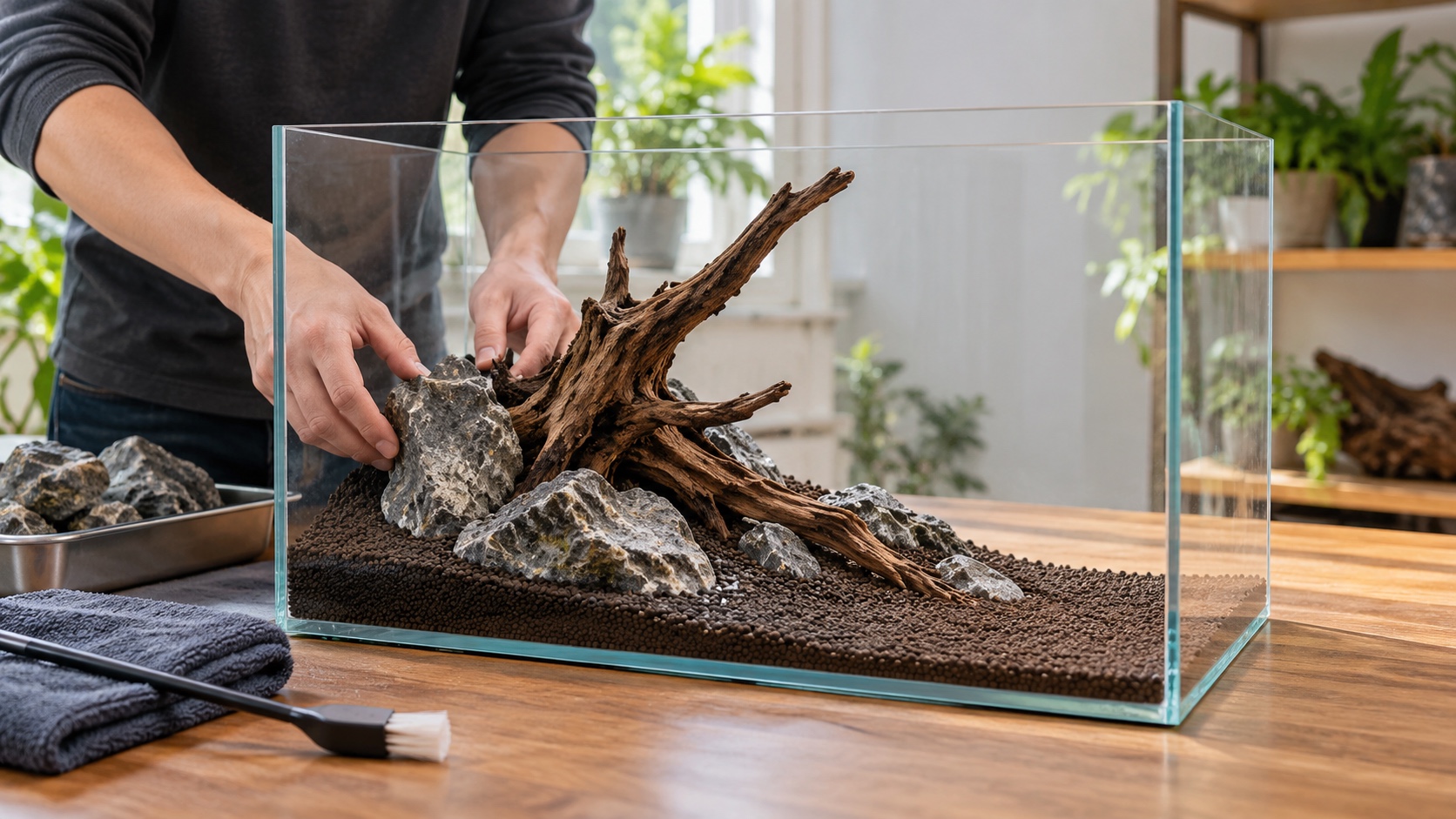
Use soil where plants need it, and prevent it from spilling into decorative sand if a clean foreground is essential. Cap or contain it only when the chosen product and planting method support that approach. Large hardscape should not rely on compressible granules for long-term stability; build hidden foundations first, then place soil around them.
Build a Shortlist by Testing Complete Material Palettes
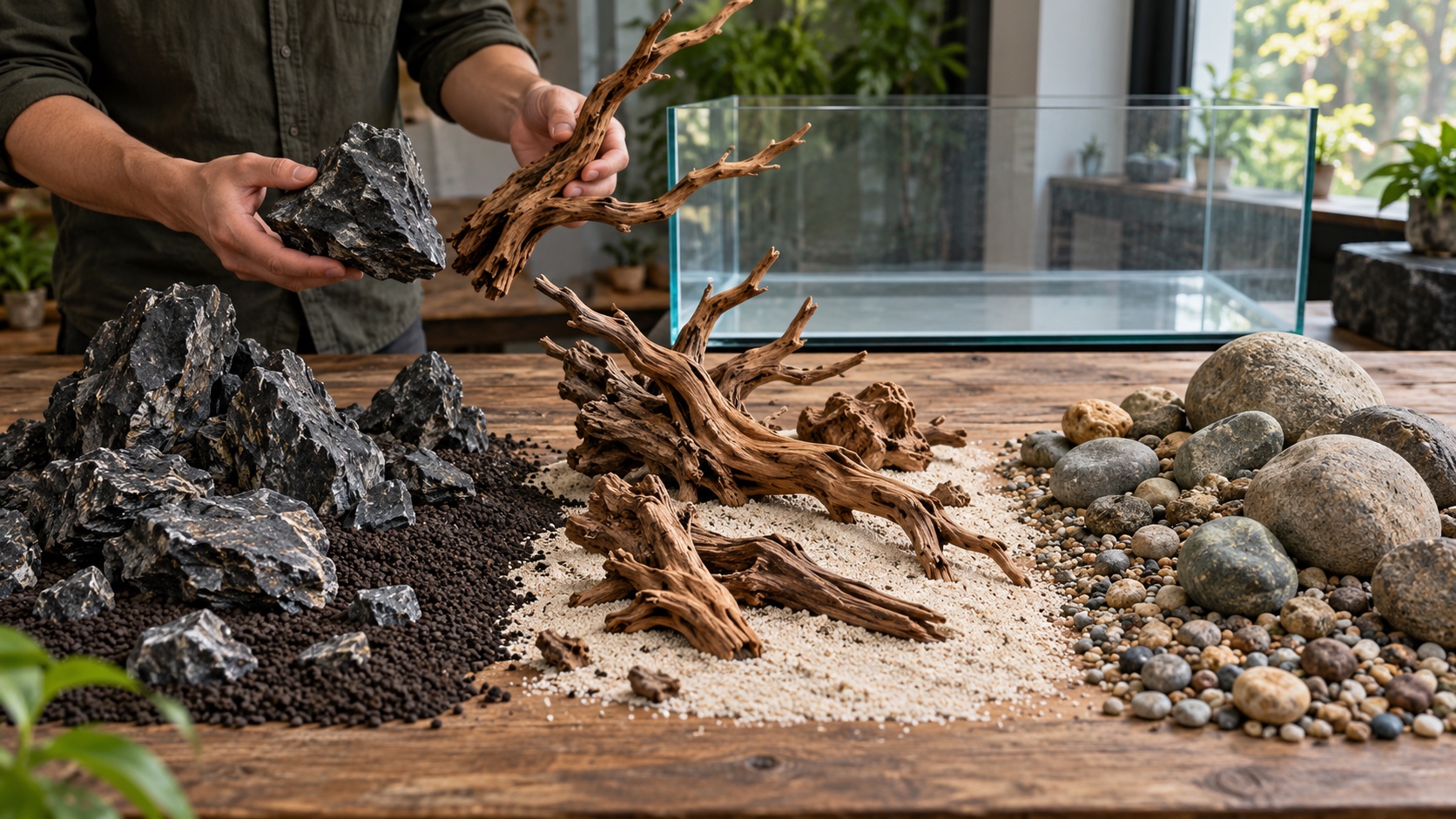
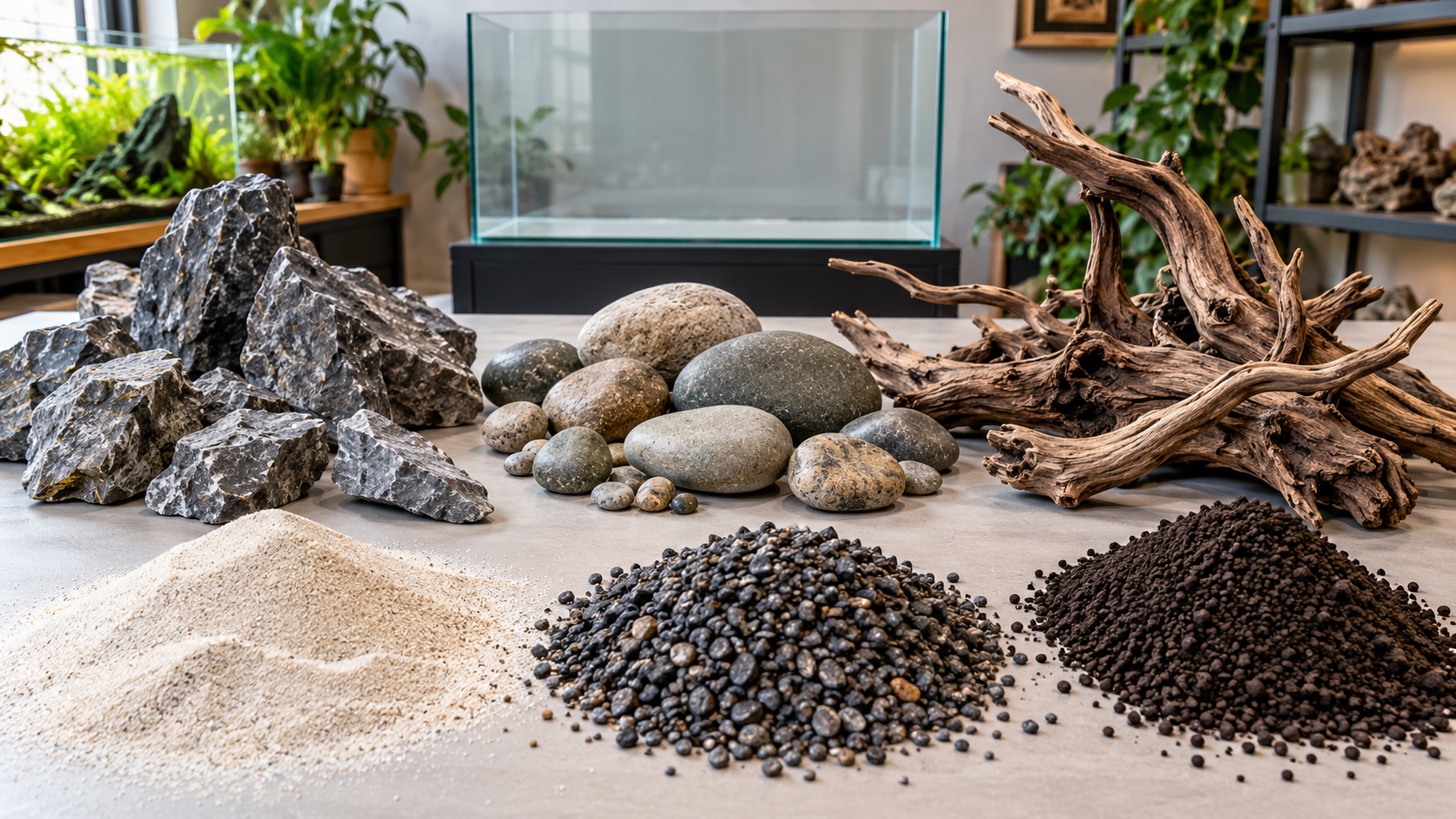
Lay candidate stone, wood, and substrate together under the aquarium light. Dry color can change dramatically when wet, so rinse representative pieces and compare them damp. Look for shared temperature, texture, and scale. Warm wood may pair naturally with tan sand, while cool fractured stone may read more clearly against dark fine substrate. Coordination matters more than matching every color exactly.
Run simple compatibility tests before purchase or installation. Soak questionable rock, confirm wood buoyancy, inspect substrate grain against the animals’ bodies and feeding behavior, and estimate the displacement of large pieces. Calculate how much open water remains. A material can be individually safe yet collectively unsuitable when the palette consumes too much volume or creates unreachable spaces.
Price the entire build, including supports, sufficient matching pieces, substrate depth, and replacement needs. A bargain rock becomes expensive if only one usable shape exists and shipping another batch changes the geology. Locally sourced materials can be excellent when collection is legal, identification is reliable, contamination risk is low, and preparation is appropriate.
The best final palette is coherent, testable, structurally stable, and compatible with care. Limit it to the few families needed to express the habitat. When every piece has a reason—support, shelter, direction, planting, or open space—the materials will continue working after algae, roots, and livestock turn the arrangement into a living aquarium.
Match Common Palettes to Realistic Use Cases
For a planted community aquascape, an inert textured stone, contained aquatic soil, and a limited amount of branching wood can provide structure without forcing a particular water chemistry. Keep soil within rooted zones and preserve a clean feeding area. Use low transition plants where materials meet instead of circling every rock with a different species. This palette favors plant control and compositional detail, but it requires trimming access and careful boundaries.
For bottom-oriented fish, smooth sand and rounded or well-worn stone often create a more appropriate contact surface. Add sturdy wood only where it cannot collapse under digging. Avoid fine crevices that trap food. Keep broad floor areas open enough to observe feeding and remove waste without dismantling shelter. The scene may look less dramatic when empty, yet it gains interest once the animals can forage and rest naturally.
For harder-water displays, compatible calcareous rock and an inert substrate can align appearance with chemistry. Record the rock batch so later additions can be compared accurately. Test the material’s actual effect and monitor it over time rather than assuming the rock alone maintains every parameter. Select replacement water and maintenance methods that reinforce the same target instead of alternating between opposing chemistry strategies. Consider whether porous faces will remain reachable once algae and mineral deposits develop under the chosen light. The palette still needs stable foundations, open space, and accessible waste collection. Leave low corridors between major groups so waste can be lifted without undermining the rocks. Keep a sample piece outside the display for later comparison if surface changes become difficult to interpret. A useful material combination succeeds because its physical and chemical behavior support the same livestock plan over many years.