Iwagumi Uses Few Elements, So Every Choice Becomes Visible
An Iwagumi aquascape can look effortless: a group of stones, a low green planting, and open water. That simplicity is demanding because there is nowhere for weak proportion, unstable rockwork, or unsuitable plant growth to hide. The style asks the aquarist to create movement and scale almost entirely through stone placement, substrate contour, negative space, and a restrained palette. Beginners do not need to reproduce a competition layout, but they should understand the visual relationships before buying rock by weight or covering the floor with a difficult carpet. This guide introduces the stone roles, compositional habits, planting choices, equipment needs, livestock considerations, and maintenance realities that make a first Iwagumi believable and sustainable.
A: No. Odd-number traditions are common, but hierarchy and geological unity matter more than following a fixed count.
A: Yes, when plant choice, light, growth expectations, and maintenance are matched to lower carbon availability.
A: Place the primary stone first because its size, lean, and position establish the rest of the formation.
A: Similar spacing, exposure, and size weaken hierarchy; cluster related stones and protect a larger open area.
A: No. Intentional bare patches can suggest erosion, reveal rock bases, and strengthen negative space.
A: Add them after testing proves biological filtration and the aquarium meets the chosen species' needs.
A: Exposed rock receives direct light, so excessive intensity, unstable growth, and local flow issues become highly visible.
A: Use a supported internal foundation and stable retaining structure rather than relying on loose soil alone.
A: Trim and thin near important faces, or accept that undersized accents may need greater initial exposure.
A: The dominant formation should feel grounded while open space carries the eye through the remaining tank.
What the Style Is Trying to Express
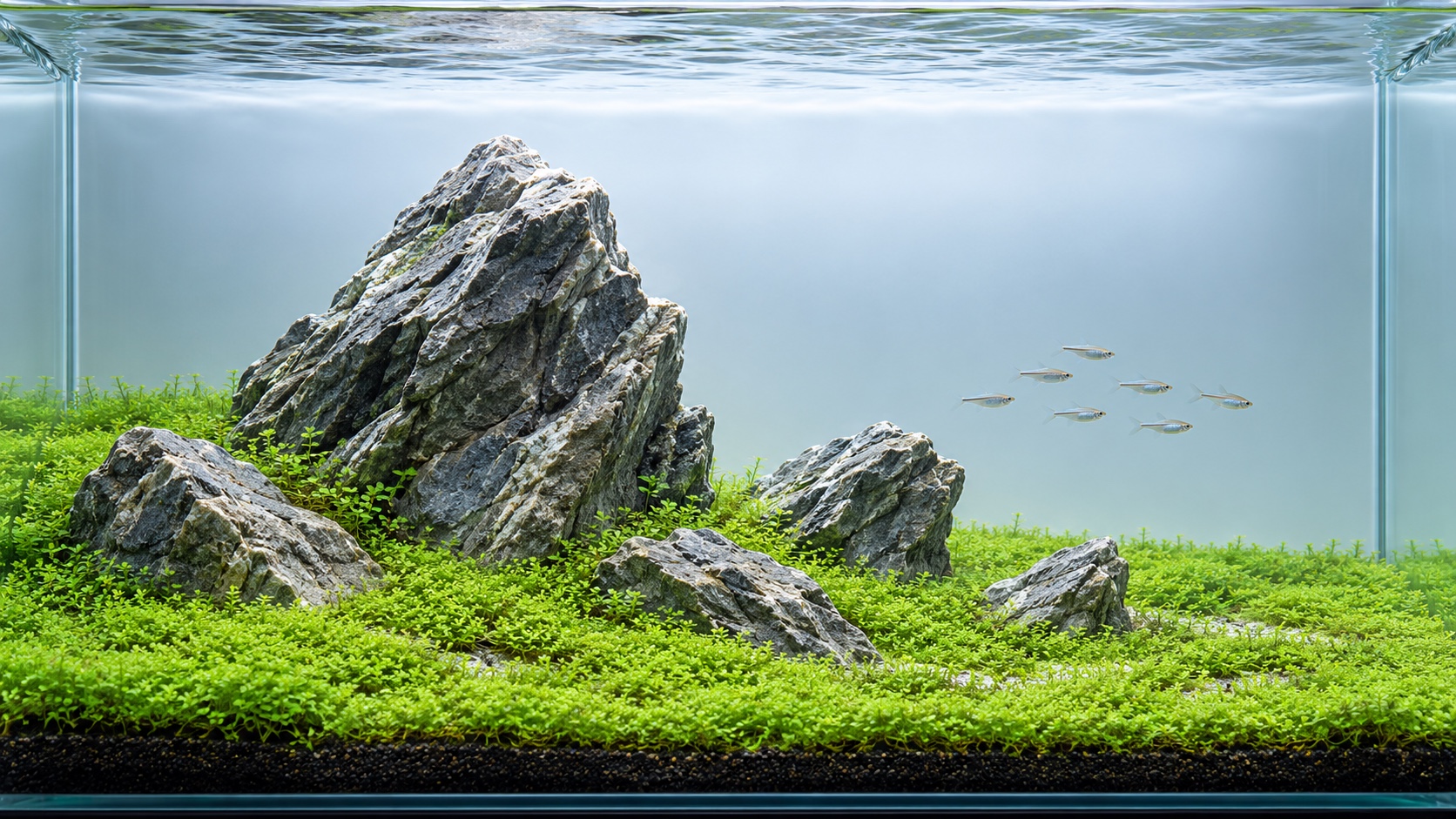
Iwagumi takes inspiration from Japanese rock arrangements, but the aquarium form is not a literal copy of a garden. It uses a dominant stone and supporting stones to suggest a larger landscape shaped by natural forces. Their grain, lean, exposure, and spacing should feel related. The result might resemble a ridge, eroded hillside, or stones emerging from a broad plain. Plants soften the base and establish scale without becoming separate attractions.
Minimal does not mean empty or easy. A layout with three plant species and five stones may demand more precise maintenance than a diverse planted tank. Carpet health is exposed across the whole foreground, algae is obvious on pale rock, and shifting substrate can change the composition. The style works best for a keeper who enjoys small corrections and can protect open space from uncontrolled growth.
Learn the Roles Before Counting Stones
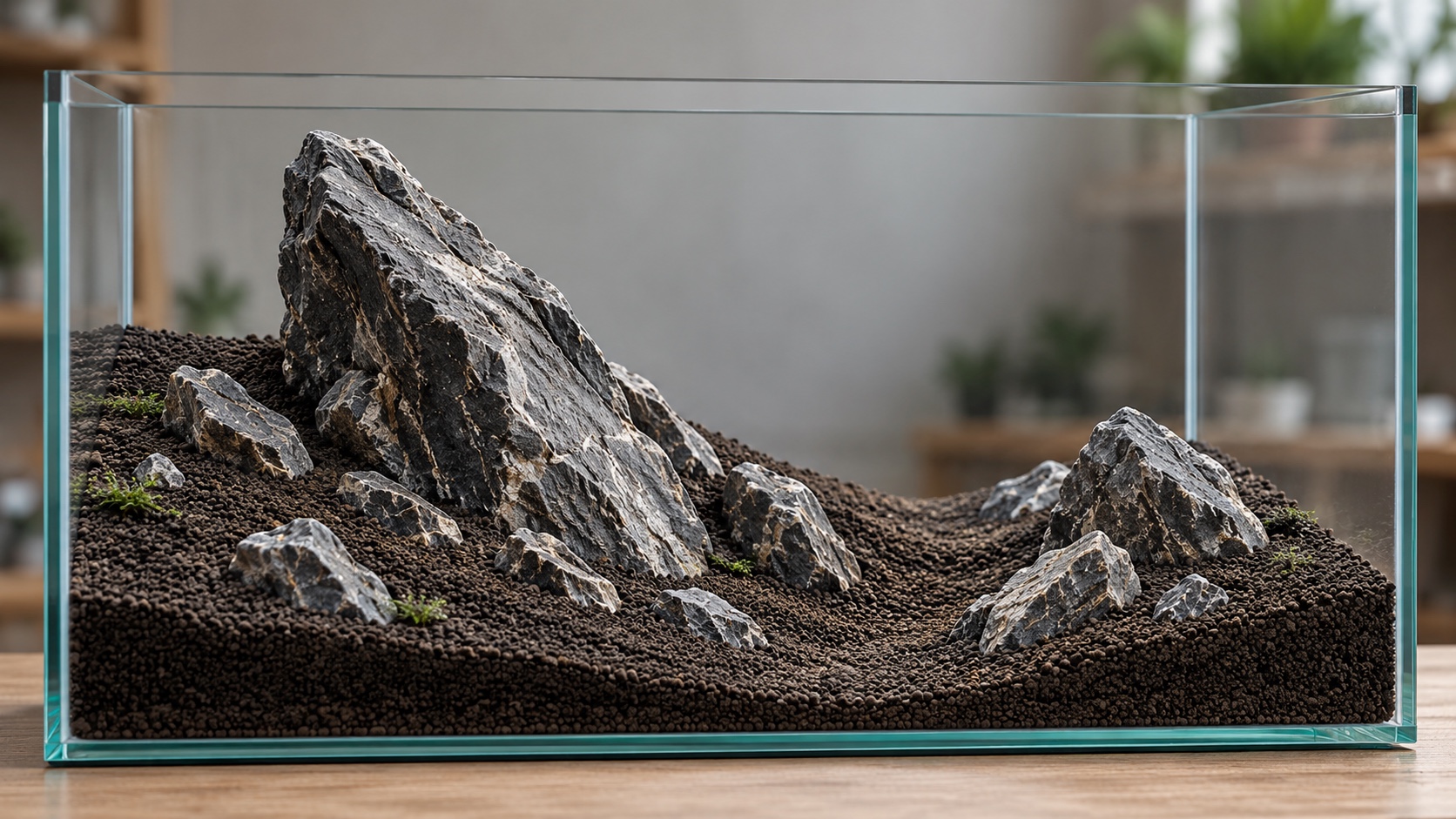
The largest and most expressive stone is commonly treated as the primary stone. It sets the direction and visual weight. Supporting stones reinforce its lean, extend its base, or carry the formation into the open side. Smaller fragments can connect gaps and make the group feel embedded. Traditional names are useful vocabulary, but the visual relationship matters more than labeling every piece correctly. Stone count is often odd because asymmetry helps avoid obvious pairs, but counting cannot create balance by itself. Five unrelated rocks remain unrelated. Three well-matched pieces may produce a stronger landscape when one clearly leads and the others explain its base. Add stones for a structural reason, not to satisfy a number remembered from a diagram.
Select One Geological Family
Choose stones that share color, texture, and strata so they appear to come from one formation. Variation in size is essential: a group of equally large rocks competes for attention, while identical small pieces resemble a border. Collect more than the minimum number needed because the final selection depends on how surfaces and angles relate inside the tank.
Consider water chemistry as well as appearance. Some popular calcareous stones can raise hardness and alkalinity. Test uncertain material and decide whether its effect suits the plants and animals you intend to keep. Avoid sharp unstable edges in swimming routes. Clean dirt with water and a dedicated brush; never use household soap or unknown chemical treatments.
Study each stone from every side. The most attractive face in your hand may create the wrong lean or sit poorly when partially buried. Look for a convincing base, a directional top, and strata that can align with the primary stone. Chips from the same material are valuable for transition details.
Use Unequal Proportion and Shared Direction
Place the primary stone away from the exact center and give it enough visible height to remain important after planting. Tilt it with confidence rather than leaving it almost upright by accident. Add the next stone close enough to join the same formation, but make it clearly subordinate. Repeating the dominant angle in smaller stones creates unity; slight deviations prevent mechanical repetition.
Do not distribute stones evenly across the aquarium. Natural formations contain clusters, overlaps, buried sections, and larger gaps. An open plain can balance a heavy rock group without requiring a matching group on the opposite side. Negative space is active composition, not an area waiting to be filled.
Build Depth With Substrate and Overlap
A rearward slope lifts distant stones and gives the carpet a visible plane. Support significant elevation with aquarium-safe inert material rather than relying on loose soil alone. Seat heavy rock on a stable foundation before surrounding it with substrate. This prevents later settling from changing the lean or sending a stone toward the glass. Overlap is equally important. A smaller stone partly hidden behind the primary mass appears farther away, while a detailed foreground fragment can bring the landscape toward the viewer. Avoid lining up peaks at one distance. Photograph the arrangement at eye level because overhead inspection exaggerates separation and can hide a flat composition.
Choose a Carpet for Your Actual System
Fine carpeting plants strengthen the sense of a vast landscape, but their demands differ. Some require strong carbon dioxide availability and careful nutrition to spread densely. Others grow taller, slower, or more irregularly under moderate conditions. Consider dwarf sagittaria, Marsilea, small Eleocharis, Micranthemum species, or other options only after verifying their specific needs and availability.
A low-tech Iwagumi is possible when expectations match the plant. The foreground may become a textured meadow rather than a flawless short carpet. Moderate light, patient growth, and controlled spacing can be more stable than forcing a demanding species under inadequate carbon. A few deliberate bare patches around stone bases can look natural and reduce the pressure for perfect coverage.
Use accent plants sparingly. A small transition near the rock group may hide an awkward soil edge, but tall stems and broad focal plants can compete with the stone architecture. Every additional species should strengthen scale, contour, or stone integration.
Match Light, Carbon, and Nutrients
The shallow planting often receives direct light across most of the tank. Excess intensity can encourage algae on stone and carpet before roots establish. Begin with a conservative photoperiod and controllable brightness. If pressurized carbon dioxide is used, prioritize safe, stable delivery and good circulation before increasing light.
Feed plants with a coherent substrate and water-column strategy. Rooted carpets draw from the bed, but water-column nutrients still matter, especially during establishment and after trimming. Avoid reacting to every spot of algae with larger doses or sudden blackouts. Confirm growth, circulation, carbon stability, water-change practice, and organic buildup first.
Plant in Small Portions Around the Stone Structure
Divide foreground plants into small plugs and space them through damp substrate. Use tighter spacing where quick coverage matters and wider gaps near selected stone faces. Keep crowns at the correct level and avoid burying delicate leaves. Plant around stable rocks rather than disturbing their foundations. Fill slowly over a barrier so plugs and slopes remain in place. The first planting can intentionally follow imagined moisture and shelter. Dense plugs in hollows and lighter coverage on exposed ridges make the terrain easier to read before the carpet closes. That pattern also creates useful maintenance reference points. When runners later cross every boundary, you know which areas should be thinned back to restore the original topography.
Cycle the Aquarium Before Adding the School
Iwagumi photographs often feature a single school moving over the landscape, but fish belong only after biological filtration is proven. Test ammonia and nitrite, account for the startup behavior of active soil, and let plants root. Clear water is not a substitute for cycling. Add livestock gradually and quarantine when possible.
Choose species by adult size, group requirement, swimming length, temperature, hardness, and behavior. Small fish can strengthen apparent scale, yet a visually convenient species may still be wrong for the available water or footprint. Preserve open midwater and avoid stocking levels that turn a minimalist scene into constant crowding.
Some Iwagumi layouts offer little cover. Consider whether the selected fish feel secure in bright open water and whether shaded retreats can be provided without undermining the composition. Welfare is a design constraint, not a detail added after the photograph.
Maintain Stone Visibility and Carpet Health
Trim the carpet before it becomes a thick mat that lifts from the substrate or shades its own base. Remove loose fragments and thin dense areas so circulation reaches lower growth.
Pull runners that erase intentional bare patches. Use a soft dedicated brush or careful spot maintenance on stone, avoiding chemical shortcuts that could harm the aquarium.
Debris often collects behind rocks and in low valleys. Adjust broad flow, use a baster to lift particles during water changes, and siphon accessible areas gently. Do not undermine stone foundations. Clean the glass and inspect rock stability without levering against the arrangement.
Plan trimming around recovery rather than the calendar. Fast growth under high energy may need frequent light cuts, while a moderate system can hold its contour longer. Remove only as much leaf mass as the rooted carpet can replace. When the lower layer is weak, thin and renew sections instead of shortening the entire surface again.
Expect the Composition to Change as Plants Mature
A stone that dominates the dry layout may lose height once the carpet thickens. Smaller rocks can disappear entirely. Plan for that by exposing enough of each important face and photographing the hardscape before planting. The reference image helps guide trimming when growth softens every boundary.
Mineral deposits and algae can also change apparent contrast. Address the water or lighting condition that creates them instead of repeatedly scrubbing with force. Rough stone contains delicate edges and pockets where aggressive cleaning can disturb plants. A slightly aged surface may suit the landscape better than a freshly polished rock, provided growth remains controlled.
Know When Simplicity Is Working
A successful beginner Iwagumi has a clear primary stone, related supporting pieces, an intentional open area, healthy low planting, and enough swimming space for appropriate livestock. The eye should move through the formation rather than bounce among equal rocks. Maintenance should restore the original relationships without constant reconstruction.
View the aquarium without its main light for a moment and judge only the large masses. The stone silhouette and open field should still be understandable. Then restore the light and inspect the finer transitions. This two-scale review prevents tiny carpet details from distracting you from a weakening overall structure.
Resist adding wood, a new colored plant, or another focal stone when the tank feels quiet. Quiet is part of the style. Improve angle, exposure, carpet contour, or negative space first. When a few elements remain convincing under close observation, the layout has achieved the discipline that makes Iwagumi distinctive.
The layout also needs to function on ordinary weeks. If every water change requires rebuilding soil or removing half the carpet, the initial design may be too fragile for the chosen routine. Simplify the edge, reduce the plant demand, or improve access. Minimalist appearance should come from clear decisions, not from constant emergency work hidden outside the frame.
Measure success over several maintenance cycles. The stones should remain secure, open space should be recoverable with light trimming, and plant health should not depend on frantic adjustments. When the aquarium returns to its intended form through a calm routine, the design and the keeper’s available time are finally aligned.