Build a Pirate World That Still Functions as Habitat
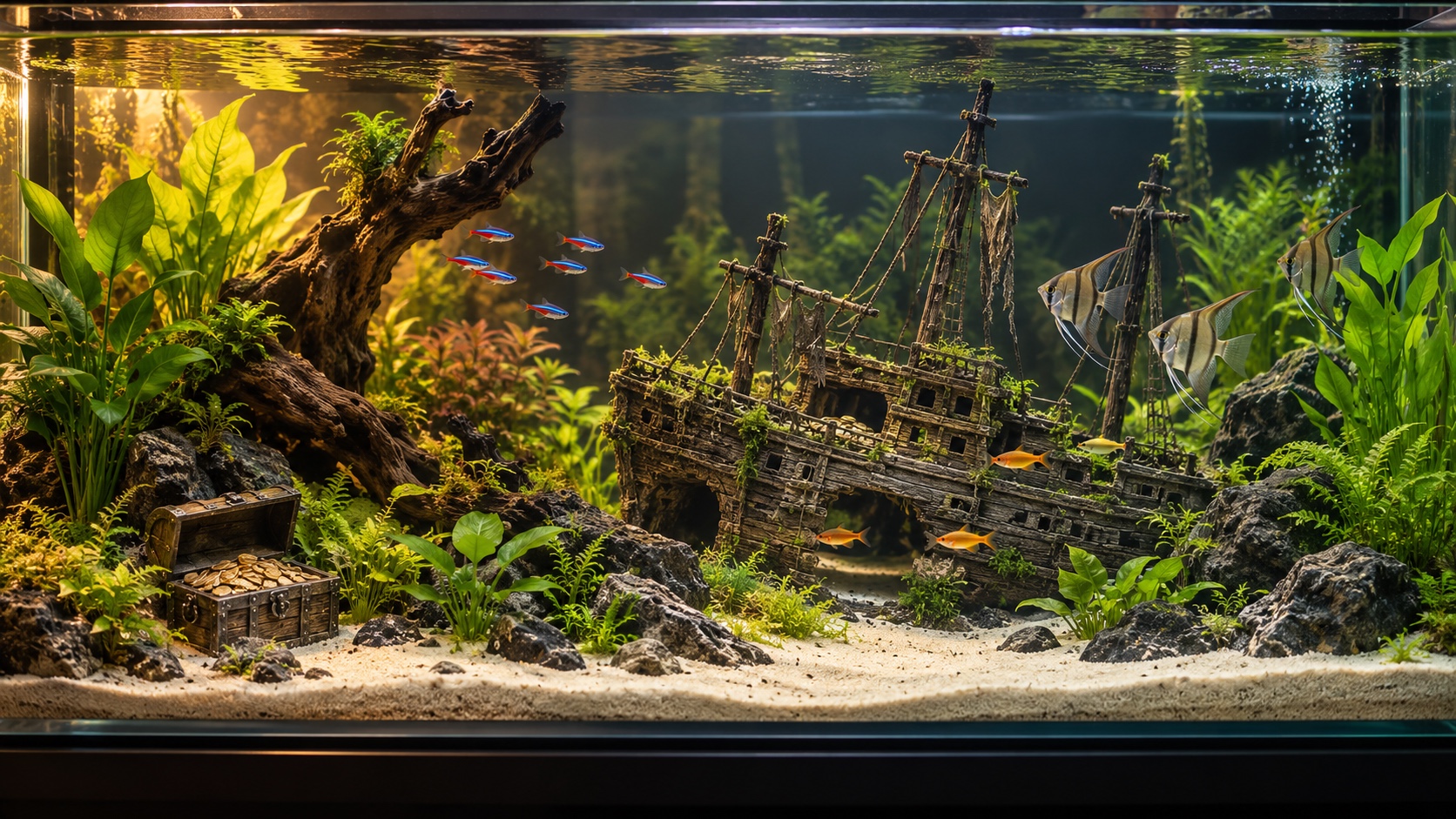
A pirate-themed aquarium can be dramatic without becoming a pile of novelty props. The most convincing versions treat the sunken ship as one landscape feature, use sand, dark rock, wood, and plants to imply age, and reserve treasure as a small accent rather than the entire story. Fish still need open swimming routes, safe shelter, suitable water, stable structures, and cleanable surfaces. By screening every ornament, scaling the wreck to the tank, burying it only where stability allows, and planning flow through its openings, aquarists can create an atmospheric scene that remains humane and maintainable after the first photograph.
A: Only when it is specifically made for aquarium submersion and its materials, coatings, and openings are safe.
A: It should establish the theme while leaving adequate adult swimming space, maintenance access, and open water.
A: Only when every route is smooth, inspectable, unobstructed, and comfortably larger than the fish at adult size.
A: Partial burial can work when it preserves stability, openings, cleanability, and safe support.
A: No. Unknown metals can corrode or leach, and small loose pieces create swallowing and equipment risks.
A: Compatible mosses, epiphytes, crypts, and background stems can imply age without overwhelming the wreck.
A: Hollow chambers and interrupted flow create low-movement areas where food and debris settle.
A: Only if the interior is smooth, accessible, safely sized, and cannot close or trap an animal.
A: Use lighting appropriate for plants and livestock, then shape atmosphere without creating stressful extremes.
A: Remove it if it becomes unstable, develops sharp cracks, loses coatings, or cannot be cleaned and inspected safely.
Choose the Inhabitants Before the Wreck
Research adult size, group behavior, territory, bottom use, current, temperature, and cover. The ship must fit around the animals rather than forcing incompatible fish into a themed volume.
Write a Specific Pirate Scene
Decide whether the tank depicts an old wreck on a quiet sandbar, a ship claimed by roots and plants, or a rocky channel containing lost cargo. A specific setting prevents every pirate symbol from entering the same aquarium.
Choose an atmosphere. Warm light and pale sand can suggest a shallow tropical wreck; dark wood and subdued planting can create a deeper, older mood. Keep color choices compatible with normal animal lighting.
Define the main view and the ship’s direction. A diagonal hull can lead the eye into the tank, while a broad side view emphasizes structure. Check that the bow or mast does not collide visually with a pane or rim.
Limit treasure to one secondary area. The viewer should discover it after seeing the wreck, not encounter two equal focal points. Avoid bright metallic color that overwhelms fish and plants.
Select an Aquarium-Rated Ship
Choose a product intended for continuous aquarium submersion, with clear material information and intact coatings. Reject craft models, metal fittings, painted toys, or unknown adhesives. Decorative realism does not establish chemical safety.
Inspect every window, deck opening, broken plank, mast, and internal cavity. Sand sharp seams, drilling holes, and narrow traps cannot be assumed safe simply because the outer hull is smooth. When an opening cannot be inspected or cleaned, prevent access or select another ornament.
Test Fish Passages at Adult Size
Measure the narrowest part of every route through the wreck. Consider body depth, fins, barbels, and growth. A juvenile that passes today may wedge later. Broad arches are safer than decorative slots.
Check whether one territorial fish could control all exits. Multiple shelter options outside the ship may reduce conflict. Do not make the only retreat a blind internal chamber.
Keep masts and rigging simple. Thin decorative lines can catch long fins or trap debris. Remove or reject fragile projections using methods consistent with the product’s safe construction.
Rehearse the Dry Layout
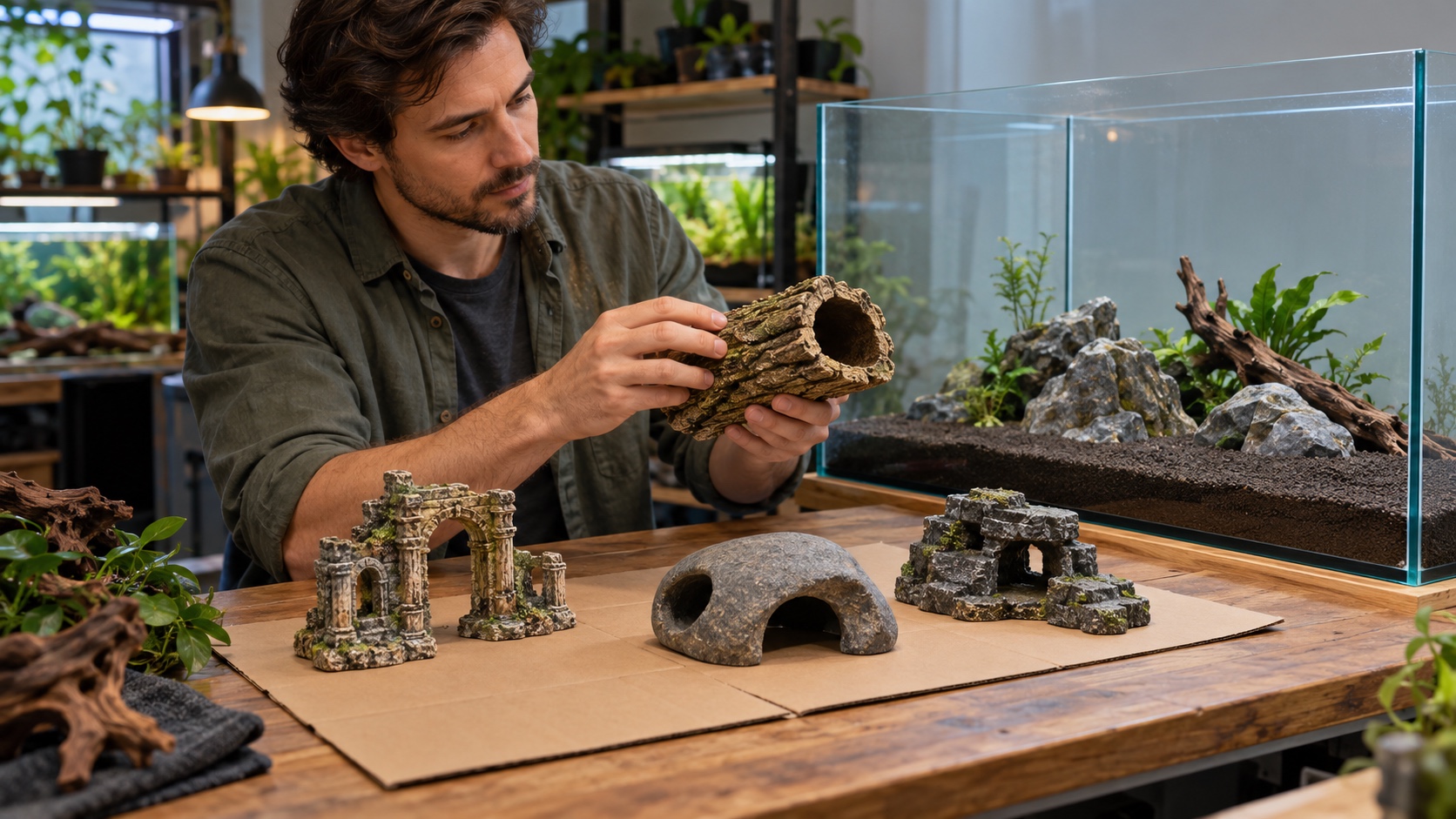
Place the ship, dark rock, wood, and treasure on a board matching the tank footprint. Photograph at tank height. The wreck should leave visible sand, open water, and service routes instead of occupying the whole rectangle.
Anchor the Ship Without Hiding Risk
Test whether the hollow ornament traps air or floats. Flood it fully and follow safe preparation guidance. Never pin it down with unstable rocks or bury an unknown opening beneath substrate.
Support the ship on a stable surface appropriate to its weight and the tank. Partial burial can imply age, but keep access for cleaning and do not create a pressure point against glass.
Shape Sand and Rock Around the Wreck
Use substrate movement to suggest the ship has settled over time. Raise sand against selected lower edges while leaving entrances, inspection points, and fish routes clear. Avoid a perfectly even burial line.
Cluster matching rocks where currents might expose or deposit them. Several related pieces integrate the wreck better than a ring of equally spaced stones. Preserve a clean foreground route.
Add aquarium wood only when its grain and direction strengthen the scene. A root crossing one hull edge can imply age, but wood should not block the ship’s safe exits or create unstable leverage.
Anticipate burrowing. Fish, snails, and maintenance can move sand from beneath edges. Retest support and opening clearance rather than treating the first arrangement as permanent.
Use Treasure as a Controlled Accent
Select aquarium-rated treasure without loose metal, sharp coins, flaking paint, or tiny detachable pieces. Dull color generally integrates better than reflective gold. Check the chest hinge and interior for pinch or trap points.
Place the chest away from the ship’s strongest silhouette, perhaps partly revealed beside a rock. Leave enough surrounding space to siphon debris. The accent should not become a waste pocket.
Skip loose faux coins when they can be swallowed, moved into equipment, or expose sharp edges. A single molded insert often creates the same story with fewer maintenance risks.
Plant the Wreck Into the Environment
Use hardy plants to connect hull, substrate, and rock. Small epiphytes can soften the base, moss can occupy a controlled damaged edge, and background stems can suggest distance. Do not glue plants indiscriminately across painted surfaces. Attach only where both plant anatomy and ornament material permit a verified aquarium-safe method. Keep rhizomes exposed and leave coating seams visible for inspection. Place taller groups behind rather than inside the wreck when stems would block fish routes. Repeat two or three compatible species instead of assigning a different plant to every deck. Controlled growth makes the ship appear embedded in one ecosystem rather than decorated with a plant collection.
Commission the Aquarium Before Adding Fish
Fill slowly and watch the ship for movement, trapped air, rattling, or coating changes. Run filtration and examine flow through and behind the wreck. Adjust circulation when debris settles in inaccessible cavities.
Cycle the aquarium completely. Decorations and plants do not replace established biological filtration. Verify ammonia and nitrite safety before stocking according to an appropriate method.
Feed a small test amount in the empty stocked-ready layout only when appropriate to observe where particles travel, then remove it. The exercise can reveal hidden collection zones before animals depend on the habitat.
Inspect from the sides and above with a light. Confirm that every fish-accessible chamber can be seen or safely serviced. If not, close access with an aquarium-safe designed solution or remove the ornament.
Maintain the Story Without Endangering Fish
Check entrances daily during initial stocking. Normal exploration is expected, but repeated scraping, wedging, conflict, or refusal to exit requires immediate correction. Do not assume fish will learn around a hazardous feature. Count animals at feeding and observe whether one individual controls the wreck. Use a flashlight from outside the glass to inspect dark chambers without probing blindly. If removal is necessary, prepare a suitable container and account for every occupant before lifting. A fish may remain inside a hollow hull even when the visible opening appears empty. Protect the aquarium lid and floor from water while moving the saturated, unexpectedly heavy ornament.
Siphon sand and waste from accessible spaces around the ship. Lift the ornament only when animals are accounted for and the aquascape can be restored safely. Never trap a fish inside during removal. Use a narrow siphon or baster to reach beneath overhangs without excavating support. Record where uneaten food repeatedly collects and redirect feeding or flow rather than cleaning the same pocket forever. Rotate deeper maintenance so the whole wreck is not disturbed at once. When the ship is replaced, confirm each support point, opening, and plant attachment, then watch it through a full filter cycle for movement.
Let the Wreck Age Through Plants, Not Decay
Photograph coatings, seams, and contact points at setup. Compare them during monthly inspections. Remove the ornament if paint peels, resin softens, cracks create edges, or unknown material becomes exposed. Focus on areas where sand rubs the hull, plant ties contact paint, and fish repeatedly enter. Inspect the underside when it can be lifted safely because deterioration often begins outside the main view. Keep the maker’s material and care information with the aquarium records. When a change is ambiguous, remove the ship to a safe container and investigate without exposing livestock. Theme continuity never justifies leaving a questionable material submerged.
Trim plants to reveal portions of the hull. Total coverage makes the anchor unreadable and prevents inspection. Alternate planted softness with visible weathered surfaces and open windows. Moss should be thinned from within so lower attachment remains healthy, not merely shaved into a dense wet pad. Remove roots and runners that enter narrow deck gaps. Maintain one clear line from bow to stern or another defining silhouette so the wreck remains legible from across the room. After trimming, collect every fragment; loose moss and stems can lodge in rigging, intakes, or the chest. Let plants recover before judging whether additional coverage is needed.
Keep treasure color subordinate. If algae or mineral deposits change its appearance, clean it safely rather than repainting it with household products. Accept natural visual aging only when the material remains intact. Check whether fish move or mouth loose pieces and remove anything that can enter the digestive tract. A molded chest insert is easier to account for than dozens of separate coins. Position the accent where the siphon can reach its edges and interior without dismantling the ship. If reflective highlights dominate photographs, reduce the amount of treasure or shade it through composition instead of altering the aquarium light away from plant and fish needs.
Recheck structure after every major sand cleaning or plant removal. Support can change when roots and substrate shift. Stability is a recurring maintenance condition, not a one-time setup claim. Press gently from safe directions while livestock is protected and watch for rocking, but never test a heavy ornament by pushing it toward glass. Restore substrate around the planned support without sealing drainage or fish passages. Burrowing activity should be reviewed more often. If the ship requires constant correction, redesign its base or replace it with a lighter appropriately shaped ornament. Repeated near-failure is not maintenance; it is evidence that the original installation is unsuitable.
A successful pirate aquarium tells its story through a safe wreck, restrained treasure, coherent materials, mature plants, and normal fish behavior. The theme should reward close viewing without hiding traps, unstable props, or inaccessible waste. When habitat rules lead the design, the ship appears to belong underwater instead of merely being placed there. Keep an emergency removal plan: a container large enough for the ornament, a temporary shelter for territorial fish, and a method to preserve filter operation while the layout is open. Share that plan with anyone who maintains the tank. Review adult fish clearance, water flow, and hidden debris as the aquarium matures. The best themed build remains understandable even when one unsafe accent is removed, because its atmosphere comes from the whole environment rather than a single irreplaceable prop. Observe the wreck during feeding and after lights dim. These moments reveal whether particles vanish into the hull, one fish controls every entrance, or a nocturnal occupant becomes trapped behind daytime territory. Adjust flow, feeding position, or secondary shelters from those observations. Keep replacement options simple and aquarium-rated so a damaged ship can be retired without leaving livestock exposed. The strongest pirate scene survives practical change because sand contours, dark wood, stone rhythm, and planted age carry as much narrative weight as the ornament itself.