Judge the Finished Decoration, Not the Word Resin
Resin decorations can be appropriate for an aquarium, but “resin” names a broad family of materials rather than a single safety standard. The answer depends on the formulated product, pigments and fillers, complete cure, surface coating, construction, fish-accessible geometry, and the manufacturer’s stated use. A hard ornament sold for continuous aquarium submersion by a traceable maker is a different proposition from a craft casting, a freshly mixed epoxy, or an unidentified marketplace prop. Fishkeepers should therefore avoid blanket claims that all resin is safe or unsafe. The practical task is to verify intended use, inspect the entire object, prepare it according to reliable directions, and keep watching it after installation. Chemical suitability matters, but so do sharp seams, narrow cavities, trapped air, unstable bases, inaccessible waste pockets, and coatings that deteriorate. This guide explains the material questions every buyer should ask before a decorative object becomes part of a living system.
A: No. Hardness does not verify the formulation, cure history, pigments, coatings, geometry, or intended submerged use.
A: Rinsing removes surface dust but does not establish the aquatic suitability of the resin, colorants, finish, or embedded materials.
A: Not by itself. Seek product-specific guidance for the finished object in the intended aquarium environment.
A: Only if the manufacturer explicitly directs it. Heat can warp resin or damage coatings.
A: No. A soak may reveal obvious changes, but it cannot certify unknown chemistry or long-term behavior.
A: They may trap air, collect waste, conceal animals, float, or become unexpectedly heavy during removal.
A: Use only a complete repair system specifically supported for that object and aquatic use; ordinary household paint is not an adequate substitute.
A: Peeling, softening, exposed filler, sharp cracking, instability, or a trap-prone cavity is sufficient reason to remove the item.
A: Check frequently after installation and during routine maintenance, with closer comparison whenever fish behavior or the finish changes.
A: Price is not proof. Traceable manufacturing, product-specific guidance, sound construction, and ongoing condition matter more.
Separate Commercial Aquarium Ornaments From Craft Castings
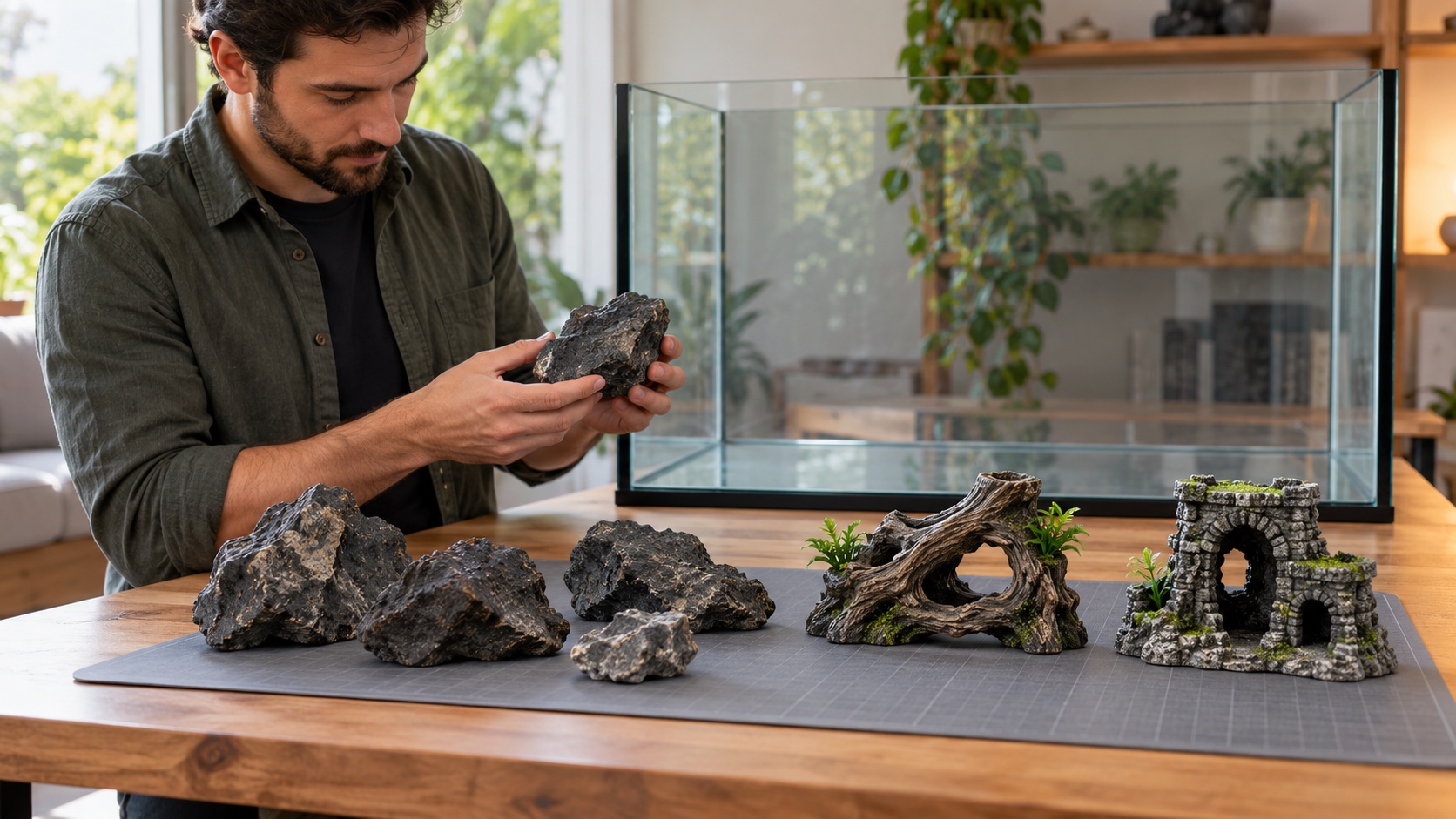
A commercially made aquarium ornament should be identified for continuous submerged use, not merely described as waterproof, outdoor, marine-looking, or suitable near water. Those descriptions do not establish how the finished material behaves in warm freshwater, saltwater, acidic conditions, or under aquarium lighting. Look for a responsible manufacturer, product instructions, a material or care statement, and a way to ask technical questions.
Craft resin castings carry more uncertainty. The maker may know the base resin but not the aquatic suitability of dyes, mica, glitter, embedded objects, mold release, clear coat, adhesive, or repair material. A beautiful fully hardened craft object is still an unknown combination unless every component and the finished-use claim can be verified.
Understand What “Fully Cured” Actually Requires
Thermosetting resins change through a chemical reaction. Surface hardness alone does not prove that the stated mix ratio, temperature, thickness, and cure time were correct. An object can feel solid while remaining under-cured in a thick pocket or along a poorly mixed edge.
Follow the exact technical directions for the specific system. Do not shorten the schedule because the ornament no longer feels tacky, and do not assume extra hardener improves the result. Incorrect proportions can leave unreacted components rather than create a stronger cure.
Temperature matters because cure schedules are normally tied to a defined ambient range. A cold garage or unusually thick casting may need different handling than a thin sample cured under controlled conditions. When the process history is unknown, a home rinse cannot reconstruct it.
Never place liquid resin, uncured putty, solvent-wet parts, or sanding residue into an occupied aquarium. Keep mixing and post-processing away from livestock, food preparation, and aquarium equipment, and follow the maker’s protective-equipment and disposal instructions.
Require Evidence for the Complete Product
Safety information about a base polymer does not automatically cover the finished decoration. Pigments, mineral fillers, flexible modifiers, flame retardants, metallic powders, artificial moss, and surface paints can change the exposure. Product-specific aquarium-use documentation is more relevant than a generic statement about epoxy or polyurethane as a category. If the seller cannot identify the material or intended environment, treat the uncertainty as a reason to choose another object.
Inspect Paint, Clear Coats, and Color Layers
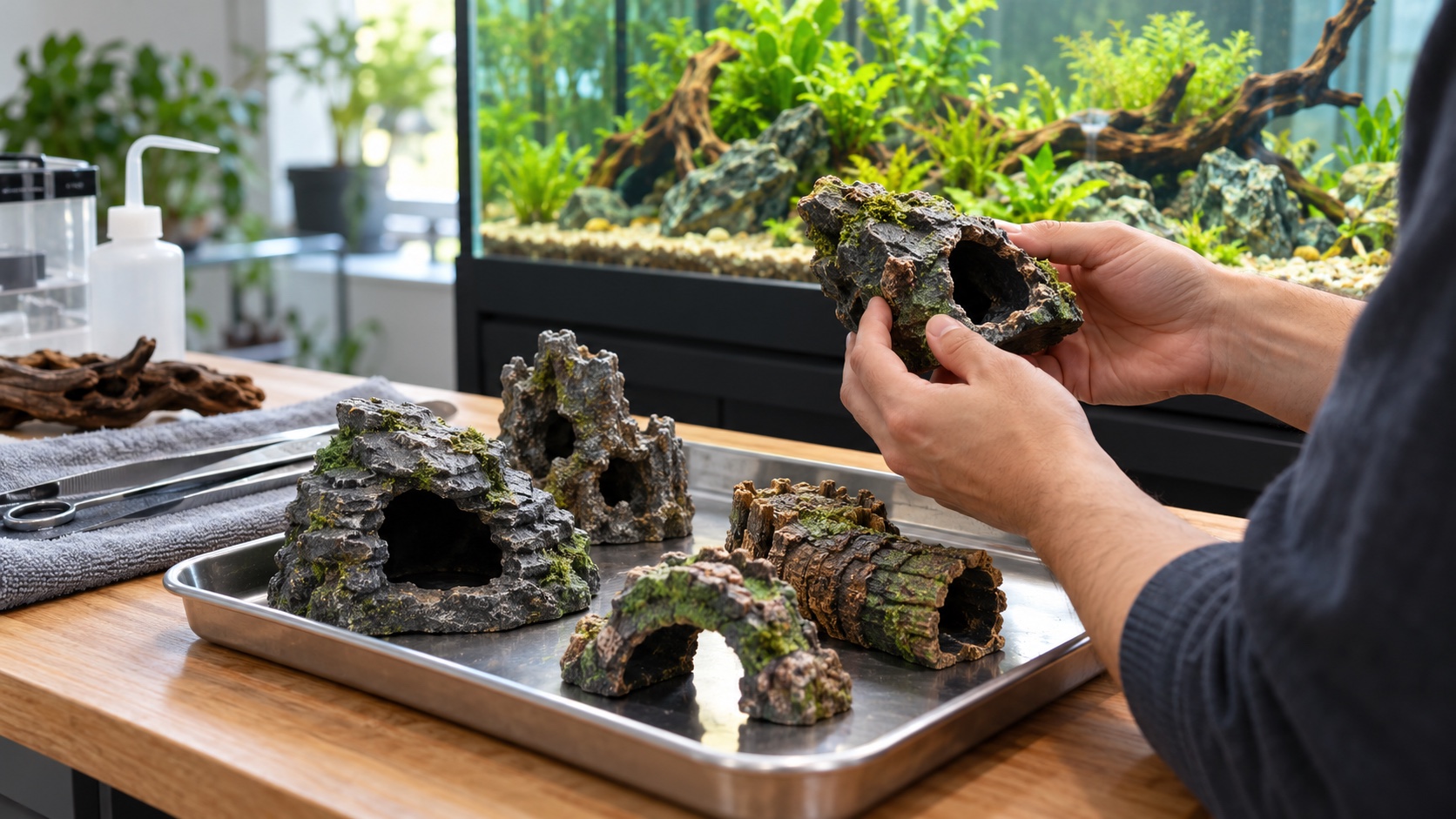
Many realistic resin decorations depend on painted highlights and protective topcoats. Examine high points, recesses, openings, and the base under bright neutral light. Reject pieces with flakes, blisters, sticky areas, strong persistent odor, exposed porous material, or a coating that marks a damp white cloth.
A painted surface may be appropriate when the complete object is sold and warranted for aquarium use. That is different from repainting a faded ornament with household acrylic, spray paint, nail product, or an unidentified clear finish. “Non-toxic” on an art supply is not the same claim as suitability for permanent underwater exposure.
Photograph the new object before submersion. Later comparisons can distinguish deliberate shading from new cracks or loss of color. Pay particular attention where substrate rubs the base, fish graze repeatedly, and cleaning tools contact raised detail.
Check Seams, Edges, and Small Projections
Run a fingertip and a piece of fine fabric over every accessible surface. Fabric that catches can reveal burrs that a finger misses. Look inside windows, arches, tunnels, fake roots, and broken-wall details, not just across the visible front.
Casting seams and trimmed pour points can be sharper than the textured face. Delicate fins, barbels, and soft-bodied animals may contact the same edge many times. Reject an object when correction would cut through an unknown coating or expose a different internal material.
Treat Every Opening as a Possible Fish Route
Fish investigate spaces according to behavior rather than the product photograph. Measure the narrowest interior point, including turns and decorative constrictions. Use adult body depth, fin spread, barbels, head shape, and the possibility of growth or breeding condition rather than current juvenile length.
A blind chamber creates a different risk from a broad tunnel. The aquarist may be unable to see a trapped or resting animal, and a territorial fish may control the only exit. Prefer inspectable interiors with more than one generous route when the intended species is likely to enter.
Very small holes are not automatically irrelevant. Fry, shrimp, snails, and slender fish may reach them even when larger livestock cannot. Seal or exclude access only with a verified aquarium-appropriate method that does not introduce a new edge, crevice, or uncertain adhesive.
Recheck clearance as fish grow and plants spread. A safe arch can become a narrow slot when moss thickens or roots cross the opening. The decoration must remain safe in the mature layout, not only on setup day.
Look for Hollow Spaces and Trapped Air
Hollow construction makes large ornaments lighter, but it can create buoyancy, stagnant water, hidden debris, and inaccessible animal spaces. Submerge an unstocked piece slowly in a separate container and rotate it according to the maker’s directions. Watch where bubbles escape and whether the object ever floods completely.
Evaluate the Base and Weight Underwater
Set the decoration on the surface that will support it before filling the tank. A narrow base may rock on coarse gravel, while a broad hollow base can bridge uneven substrate and then settle during maintenance. Burrowing fish can remove support from an apparently stable edge.
Do not wedge a buoyant piece beneath heavy stone or brace it against aquarium glass. Use only a stable installation method compatible with the product and tank. If the object needs improvised force to stay down, it is the wrong object for that position.
Plan how the saturated ornament will be lifted. Water inside a hollow casting can make it unexpectedly heavy and can pour across the floor or carry a concealed fish. Leave grip clearance and prepare a container before removal.
Prepare New Resin Decorations Conservatively
Follow product directions first. In the absence of special instructions, a gentle rinse with appropriate water and a soft dedicated brush removes packaging dust without introducing soap or household cleaner. Do not boil, bleach, bake, sand, or solvent-wipe a resin ornament unless the manufacturer explicitly supports that treatment.
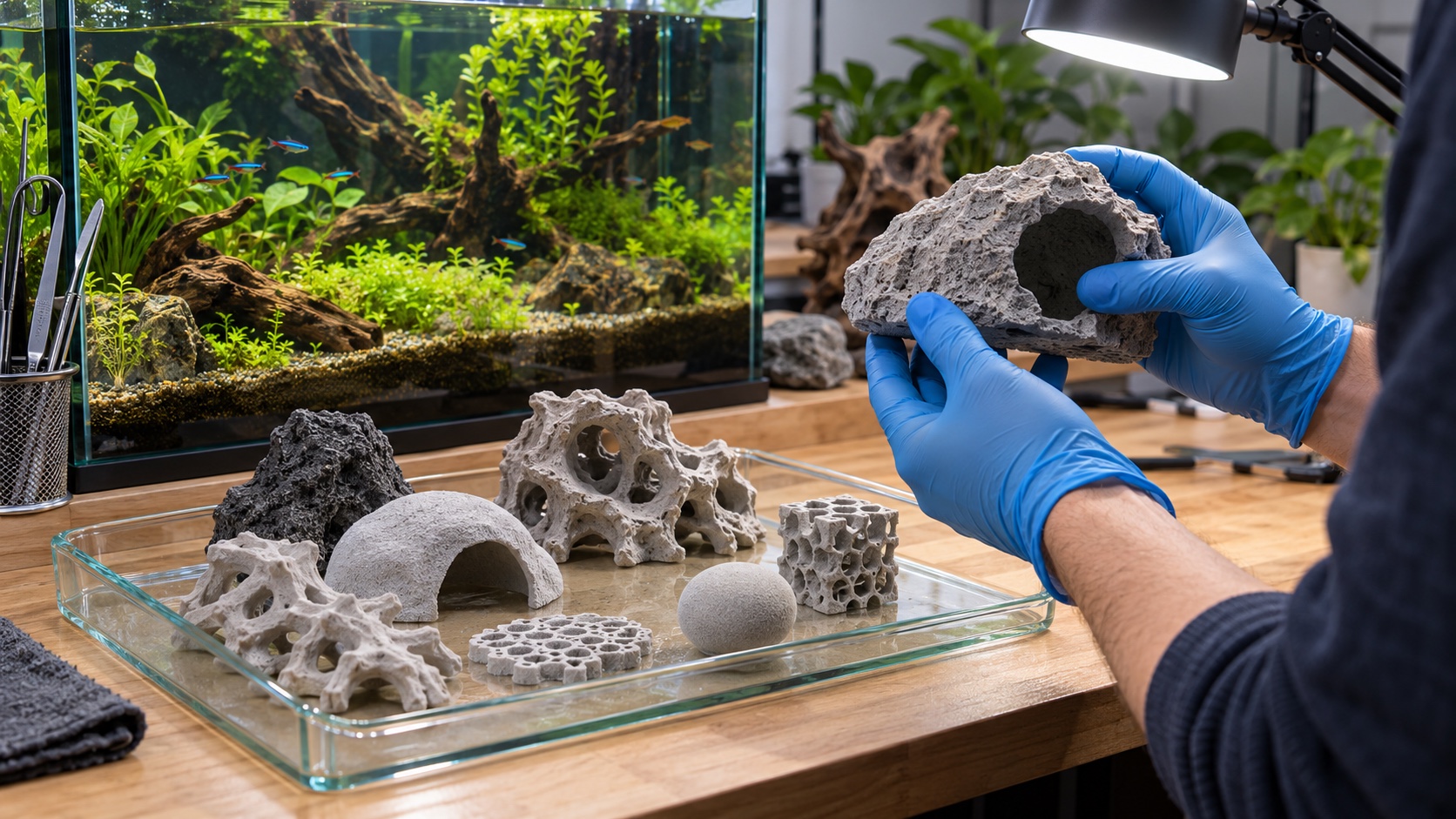
A separate observation soak can reveal unexpected floating, odor, softening, color release, or trapped air, but it cannot certify an undocumented material. Use a clean container dedicated to aquarium work, record the start condition, and compare the object under similar light. Discarding soak water does not transform a questionable product into a verified one.
Rinse away all loose manufacturing or sanding dust before the object approaches the display. If preparation exposes raw interior material, opens a crack, or changes the finish, stop and ask the maker rather than trying to seal the damage with a random coating.
Install decorations before livestock when possible. Running the complete aquascape gives time to observe circulation, stability, and debris paths without asking fish to test the object for you.
Monitor the Ornament After Installation
During the first weeks, inspect the object during feeding and after lights change. Watch for fish scraping against an entrance, disappearing into an uninspectable cavity, defending every route, or repeatedly mouthing loose details. Normal curiosity should not be confused with evidence that the structure is safe.
Look for new haze, oily film, odor, soft spots, swelling, peeling, exposed filler, or color on cleaning material. Water tests remain important for husbandry, but normal ammonia, nitrite, nitrate, hardness, or pH readings cannot rule out every material problem. Physical change is enough reason to remove the decoration for investigation.
Document the product name, maker, purchase source, installation date, and any preparation. If several tanks use similar ornaments, this record helps identify the exact item when a coating issue or recall is reported.
Clean Without Damaging the Protective Surface
Use a soft aquarium-dedicated brush and removed tank water when ordinary debris must be loosened. Avoid metal scraping, abrasive pads, and household chemicals that may scratch coatings or leave residues. The goal is to restore accessible flow and visibility, not to make a mature ornament look factory-new.
Account for every occupant before lifting a cave or ruin. Move slowly over a suitable container because shrimp, fry, snails, and small fish may remain inside. Never shake an ornament to force an animal out.
Clean waste pockets before they become anaerobic or overwhelm routine maintenance. A narrow siphon or baster may reach behind the object without moving it. If debris continuously settles inside a chamber that cannot be serviced, alter placement or retire the ornament.
After replacement, confirm that the base contacts its intended supports and that no entrance has been turned toward glass or buried. Observe the area through a full filter cycle for rocking, new dead zones, or displaced territorial behavior.
Know When Removal Is the Safe Answer
Remove the decoration when a coating peels, resin softens, cracks create edges, unknown filler appears, odor develops, the object will not stay stable, or an animal can become trapped. Do not wait for a measurable water-quality crisis. Place the suspect item in a separate container and preserve product information for the manufacturer.
Retire pieces that require repeated emergency repairs. A verified repair product may be suitable for a defined job when used exactly as directed and fully cured, but it should not become a permanent series of patches over failing material. Replace important shelter before removing the old one when animal behavior requires continuity.
Resin aquarium decorations are safest when they arrive as documented finished products, remain physically intact, suit adult livestock, and can be inspected and cleaned. Material confidence is only one part of the decision. Geometry, stability, installation, and long-term observation determine whether the object functions as habitat or becomes an avoidable uncertainty.
When evidence is incomplete, choose a simpler alternative from a source that will answer questions. The aquarium does not benefit from testing an unknown craft formula, mystery coating, or damaged bargain ornament on living animals. Good decoration earns its place through verifiable construction and ordinary maintainability.
Review that evidence again when the aquarium changes. Warmer operation, salt addition for a defined treatment, stronger lighting, different cleaning products, or a species that grazes surfaces may alter the exposure that supported the original choice. Ask a new question rather than assuming the first decision covers every future use.